

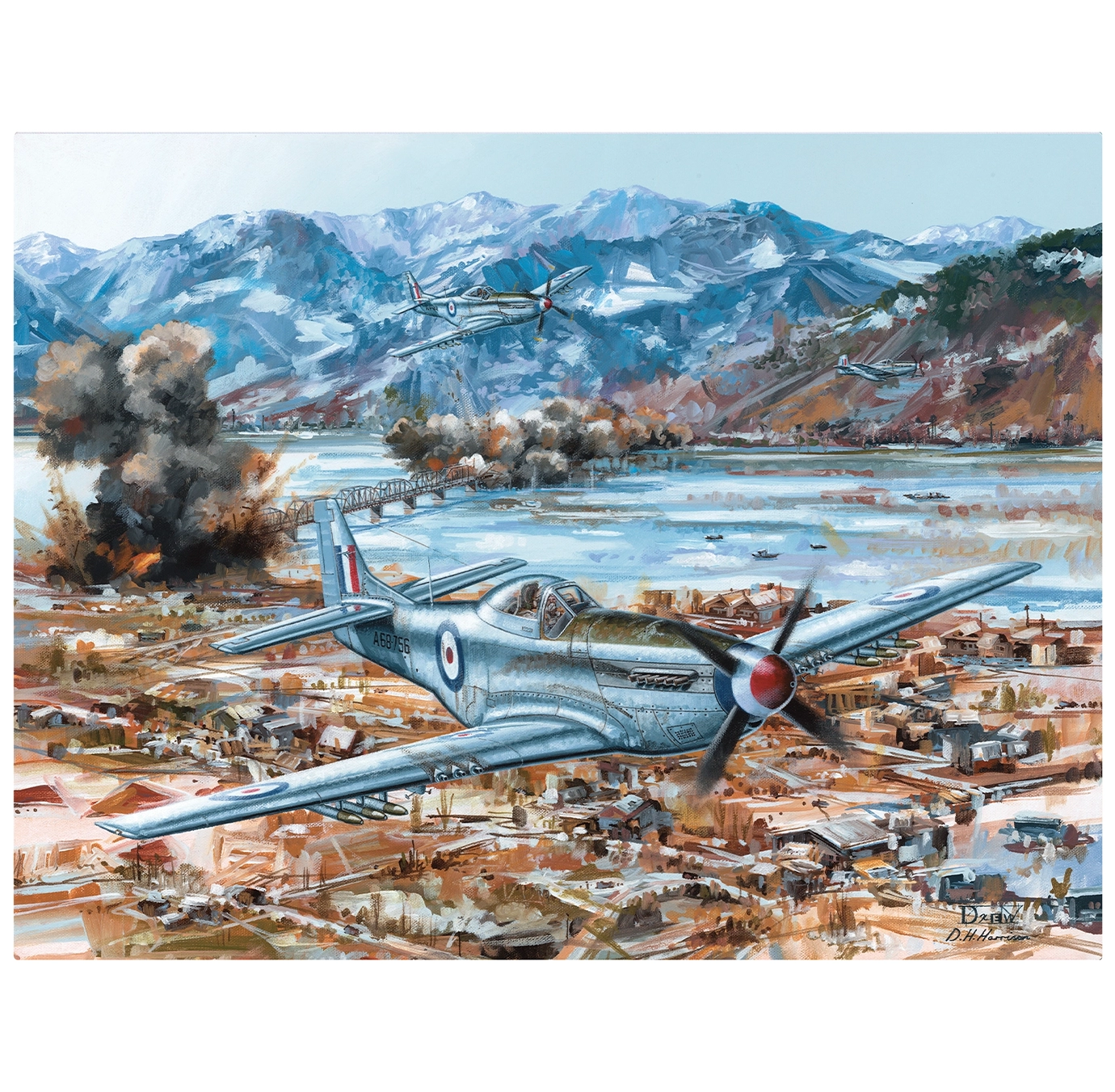
P-51D Mustang: Cutting the Lines
Discover the people, events and research behind each commissioned work.
View the original commissioned artwork and, where available, enquire about acquisition.
Discover and purchase rare #1–#10 Archive Editions and historically significant retained pieces.
Explore related Limited Edition lapel pins, medallions and art.
North American P-51D Mustang
The North American Mustang entered Australian service during the final year of the Second World War. No. 3 Squadron RAAF flew earlier Mustang variants in Italy from late 1944, striking enemy transport, rail yards, gun positions and strongpoints. Australian-built P-51D Mustangs followed too late to see wartime combat, but their story was far from over.
After Japan’s surrender, Nos 76, 77 and 82 Squadrons joined the British Commonwealth Occupation Force in Japan. By 1950, No. 77 Squadron was the remaining Australian Mustang unit at Iwakuni and was preparing to return home. Then North Korea invaded South Korea on 25 June.
Read more
Within days, 77 Squadron was committed to the United Nations response. Its Mustangs flew their first Korean War operations on 2 July 1950. Initially used for bomber escort, the aircraft increasingly became fighter-bombers, attacking roads, railways, bridges, vehicles, troops and supply positions with bombs, rockets and machine-gun fire.
Cutting the Lines focuses on one of those missions. On 17 December 1950, four Mustangs attacked a railway bridge near Sonchon after previous attempts by heavier bombers had failed. The bridge was destroyed with bombs alone. It was one operation among thousands, but it captures the Mustang’s transformation from celebrated fighter to hard-working ground-attack aircraft in Australia’s first air campaign of the jet age.
No. 77 Squadron entered the Korean War with experienced pilots and an aircraft well suited to low-level ground attack. The Mustang no longer represented the cutting edge of fighter technology, but it had useful range, could carry bombs and rockets and could remain over the battlefield longer than many early jets. Australian War Memorial records show the squadron ranging across the peninsula in support of United Nations ground forces, striking railway lines, roads, vehicles and military installations.
The cost was real. Wing Commander Lou Spence, the squadron’s commanding officer, was killed on 9 September 1950 when his Mustang failed to recover from a low-level dive during an attack at An’gang-ni. He was succeeded by Squadron Leader Richard ‘Dick’ Cresswell, an experienced wartime fighter commander. Under Cresswell, 77 Squadron continued intensive operations as United Nations forces advanced north and then withdrew before Chinese intervention.
The arrival of the Soviet-designed MiG-15 changed the air war. A piston-engined Mustang could not compete with the new swept-wing jet at altitude, and on 7 April 1951 the squadron was withdrawn to Japan to convert to the Gloster Meteor. Official Air Force histories record 3,872 Mustang sorties in Korea. The Mustang phase lasted only nine months, but it established 77 Squadron as one of Australia’s most important combat aviation units of the post-war era.
Campaign Facts
No. 3 Squadron RAAF flew Mustang fighters in Italy during the final months of the Second World War, while Australian-built P-51D Mustangs arrived too late to see Australian combat service during the conflict. After the war, Nos 76, 77 and 82 Squadrons operated Mustangs in Japan as part of the British Commonwealth Occupation Force.
Read more
When the Korean War began on 25 June 1950, No. 77 Squadron was placed on standby and flew its first missions on 2 July. The Mustangs undertook a range of roles, including bomber escort, close air support, and attacks against roads, railways, bridges, vehicles and military positions. Wing Commander Lou Spence was killed in action on 9 September 1950 and was succeeded by Richard ‘Dick’ Cresswell.
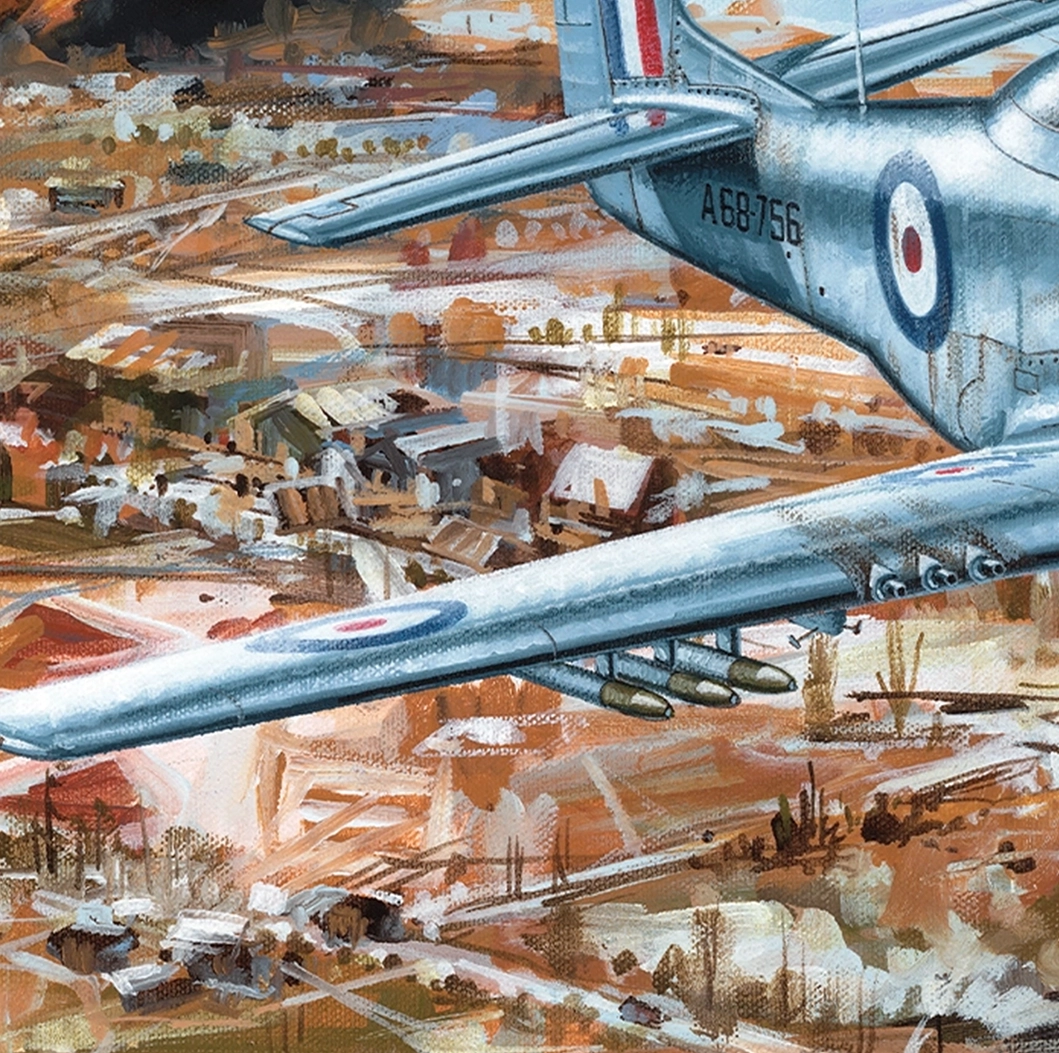
On 17 December 1950, four Mustangs attacked and destroyed a railway bridge near Sonchon; the artwork identifies A68-756, flown by Flight Lieutenant Des Murphy, as one of the aircraft involved. During the Korean War, Air Force records show that No. 77 Squadron flew 3,872 Mustang sorties before withdrawing its Mustangs in April 1951 to convert to Gloster Meteor jets. The Mustang’s Korean service marked a significant technological turning point: one of the finest piston-engined fighters of the Second World War was operating within five years alongside swept-wing jet fighters. In Korea, its value increasingly lay in ground attack, where its range, endurance and ability to carry weapons remained highly useful.
P-51D Mustang: Cutting the Lines
Drew Harrison’s Cutting the Lines is the fourth work in BrandNet’s Iconic Aviation Collection. Unlike a generic Mustang portrait, it places the aircraft inside a specific Australian combat story: No. 77 Squadron’s attack on the Sonchon railway bridge in December 1950.
Read more
The subject suits the Mustang’s Korean role. Harrison shows the aircraft low and committed to the attack, turning the graceful lines of one of aviation’s most famous fighters into the shape of a working fighter-bomber.
The title carries the mission in plain language. Railway bridges and lines were vital to the movement of troops and supplies. To cut them was to interrupt the enemy’s ability to sustain operations. Harrison’s composition makes the railway target as important to the story as the aircraft attacking it.
Historical Accuracy
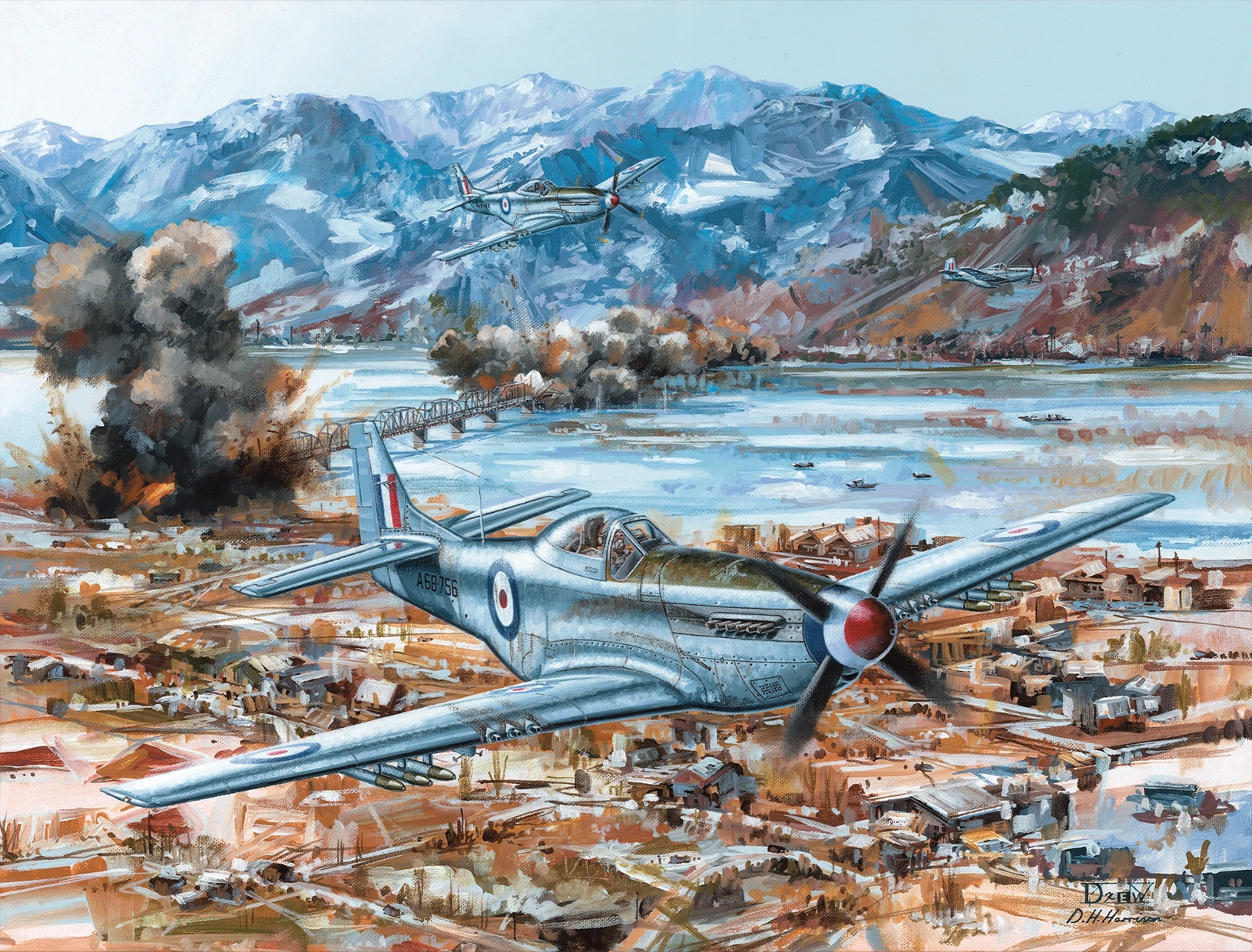
Cutting the Lines is based on a specific No. 77 Squadron action during the Korean War. Military Shop’s original collection history identifies the mission as the 17 December 1950 attack on a railway bridge near Sonchon and names Flight Lieutenant Des Murphy flying P-51D Mustang A68-756 among the four attacking aircraft.
Read more
The broader historical setting is strongly supported by Australian War Memorial and Air Force records: 77 Squadron flew P-51D Mustangs in Korea from July 1950 until April 1951, increasingly in ground-attack roles against roads, railways, vehicles and military targets.
The artwork remains an artistic reconstruction. The bridge attack is the historical anchor, while aircraft spacing, viewpoint, light and the precise instant represented are Harrison’s composition. It should therefore be presented as a researched interpretation of the Sonchon mission rather than as a literal reproduction of a surviving photograph.
An aircraft tied to the mission
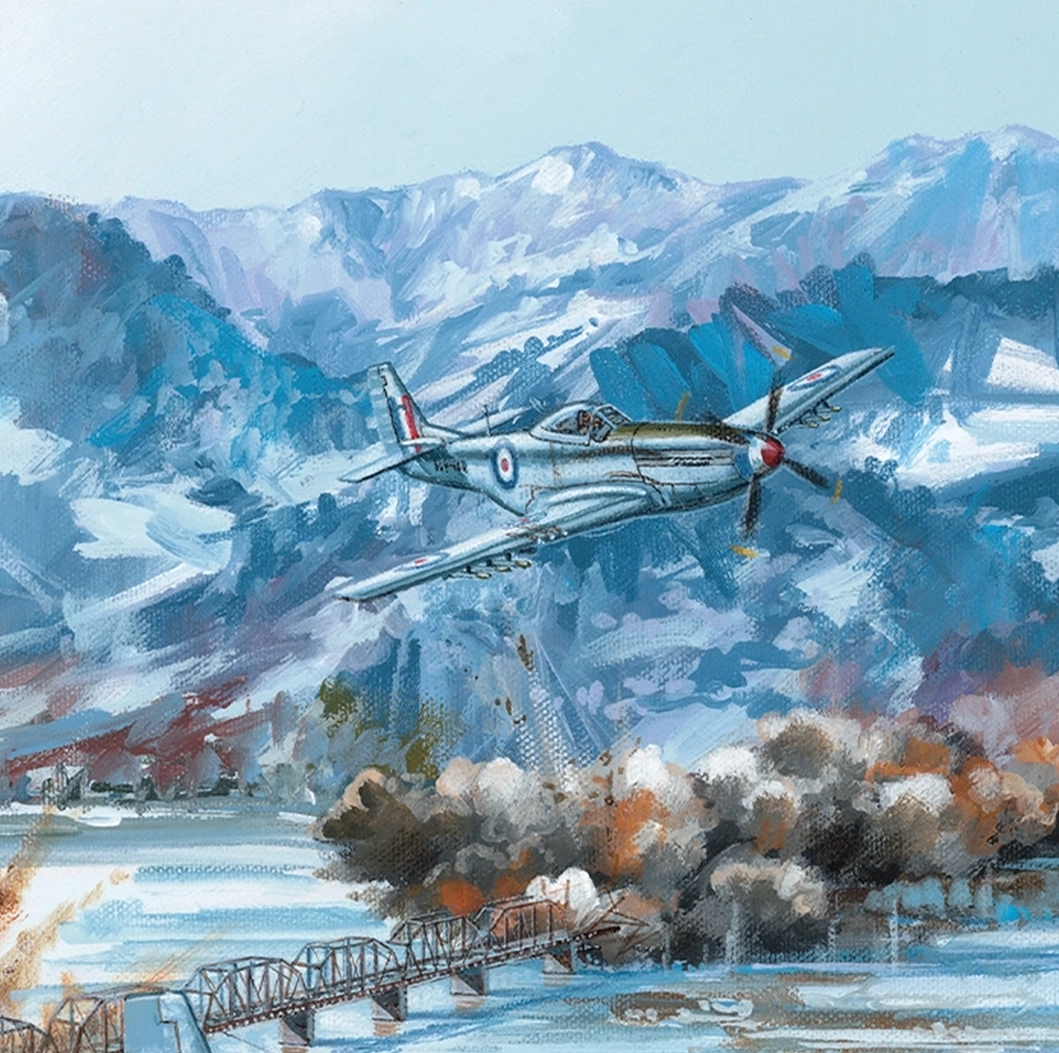
The collection history identifies Flight Lieutenant Des Murphy flying P-51D A68-756 during the 17 December attack. Using an identifiable Australian airframe gives the painting a direct link to No. 77 Squadron’s operational record rather than presenting an anonymous Mustang. The aircraft becomes a vehicle for telling a specific RAAF story.
The real objective
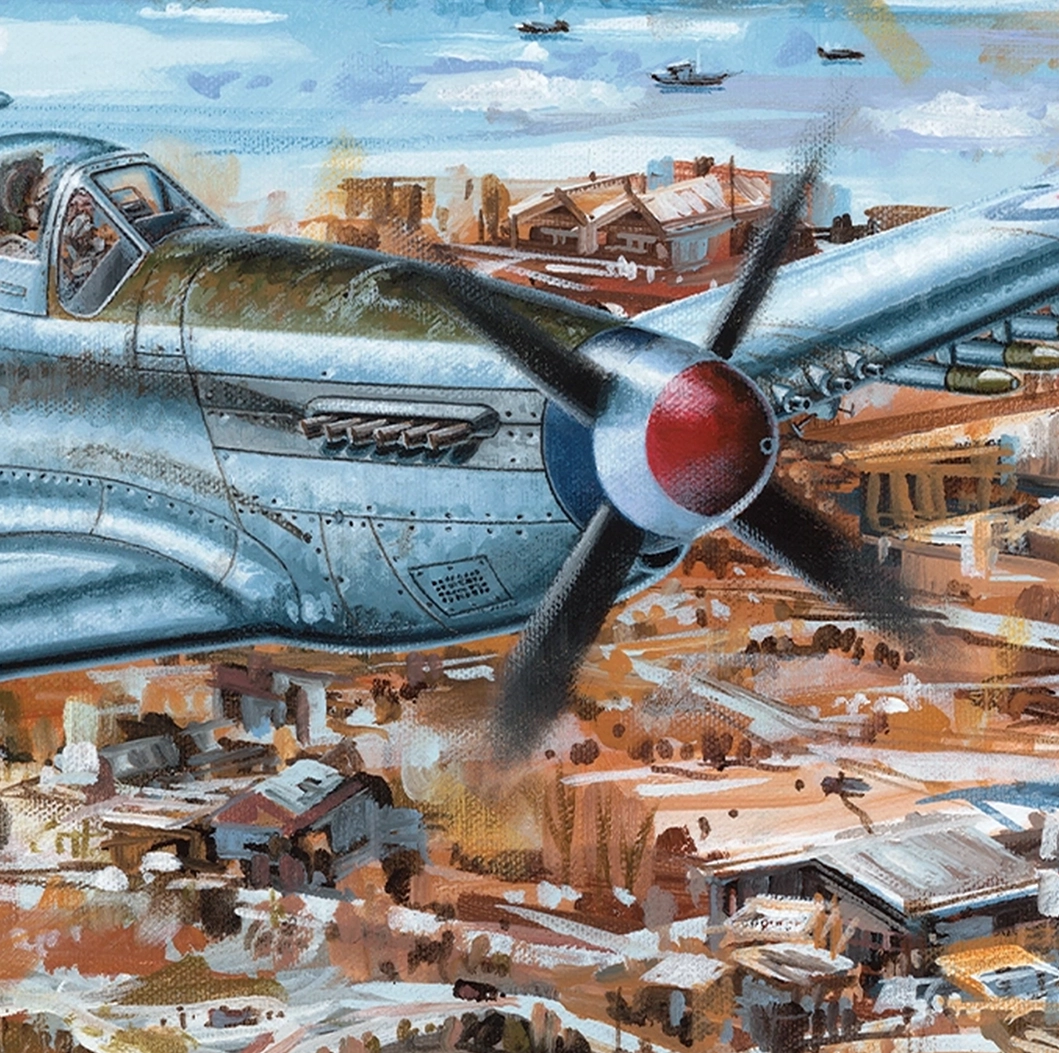
The bridge beneath the Mustangs explains the title and the tactical purpose of the operation. Rail infrastructure was central to movement and supply in Korea. The Australian War Memorial records railway lines, roads, military installations and vehicles among the main targets attacked by 77 Squadron. Destroying a bridge could interrupt far more than a single train.
The Mustang’s second life
The painting shows why the Mustang remained valuable even as jet fighters began to dominate air-to-air combat. By 1950 the P-51D could not match the MiG-15 at altitude, but its range, endurance and ability to carry bombs and rockets made it effective in ground support. Cutting the Lines celebrates that less glamorous but highly demanding role.
Drew Harrison
Drew Harrison is an Australian aviation and military artist whose Iconic Aviation Collection combines researched aircraft history with cinematic composition. Each work uses a different operational story to explain why its aircraft mattered to the Royal Australian Air Force.
Read more
For Cutting the Lines, the challenge was to move beyond the Mustang’s familiar reputation as a Second World War fighter and show its Australian post-war combat story. Harrison therefore centres the work on 77 Squadron in Korea and the aircraft’s fighter-bomber role.
That decision gives the painting a distinctive Australian identity. The Mustang is one of the world’s most frequently depicted warbirds; the Sonchon mission allows Harrison to tell a less familiar story about Australians using the aircraft in a very different war, five years after the Second World War ended.
Artist’s Notes
The Mustang’s elegant shape can easily dominate any painting, but Cutting the Lines is built around action and purpose. The aircraft are not displayed for admiration; they are working at low level against a transport target. The railway line gives the composition direction. It carries the viewer through the landscape and toward the bridge, while the Mustangs cross and attack that line. The visual relationship between aircraft and railway is what gives the title its force.
Detailed Artwork Description
The Mustangs enter the scene low, fast and armed. Their polished, recognisable forms contrast with the hard geometry of the railway and bridge below. The landscape creates depth but remains secondary to the attack. The composition is designed around movement. The aircraft draw the eye across the image while the rail line provides an opposing path through the terrain, bringing both together at the target.
Rather than present the Mustang in the open sky, Harrison places it close to the ground where the danger of the Korean mission becomes more immediate. Low-level attack exposed pilots to small-arms and anti-aircraft fire and left little margin for error. The result is an image about the Mustang as a combat tool, not simply an aviation icon.
The original Cutting the Lines
The original Drew Harrison artwork from the Iconic Aviation Collection is preserved within the BrandNet Archives. It is the unique source work from which the P-51D Mustang limited-edition collector artworks were developed.
Read More
As one of the six smaller original aviation paintings commissioned for the Iconic Aviation Collection, Cutting the Lines records a specific Australian combat story within the broader history of the Mustang. The original sits at the centre of the numbered canvas, paper, aluminium and medallion releases that followed.
Own a part of the story
Cutting the Lines was released across several limited-edition formats. The current collection includes the three principal artwork editions, the individual Mustang medallion, the complete six-aircraft medallion set and the Mustang coffee mug. The Mustang drink cooler is excluded because it is currently marked SOLD OUT.
 Click to enlarge
P-51D Mustang Limited Edition Canvas Artwork
The canvas edition gives the low-level attack room to breathe, preserving the complete Cutting the Lines composition while providing a substantial display format.
View the Artwork → Click to enlarge
P-51D Mustang Limited Edition Print
The fine-art paper edition is the most traditional collector presentation, combining Harrison’s signature and edition number with the certificate and artist material.
View the Artwork → Click to enlarge
P-51D Mustang Limited Edition Aluminium Artwork
The aluminium format gives the Mustang artwork a crisp, contemporary presentation and a material connection to the aircraft itself.
View the Artwork → Click to enlarge
Air Force 100 Iconic Aviation Limited Edition Medallion Set of 6
This individual medallion allows the Mustang story to stand alone within the wider Iconic Aviation medallion program. It is currently listed as available..
View the Set →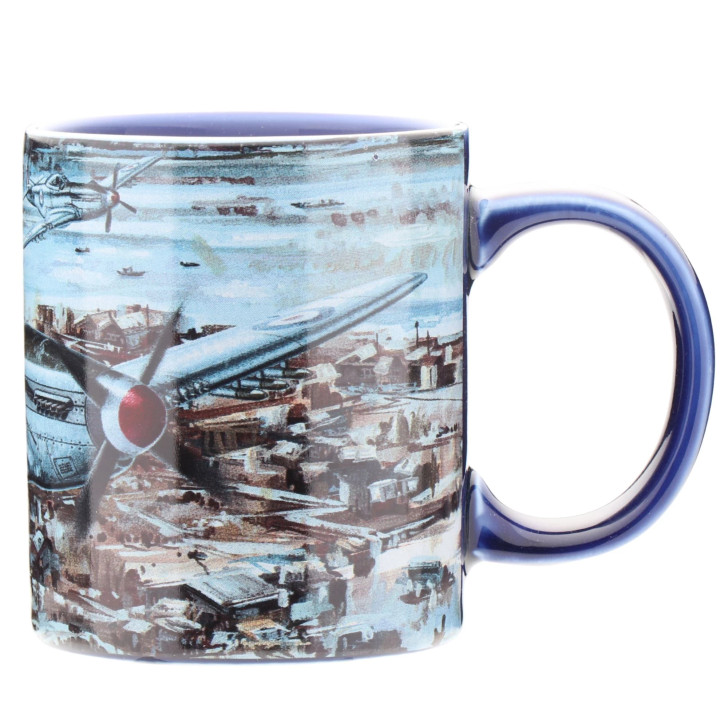 Click to enlarge
P-51D Mustang Limited Edition Coffee Mug
A more accessible numbered collectable that carries Harrison’s Mustang artwork into an everyday format while remaining part of the original Iconic Aviation release.
View the Set →History, artwork and collecting
Explore the history behind the Lancaster Artwork, the choices and decisions made by the artist, and the Archive and Limited Edition pieces created from the commission.
The Aircraft
Did Australian Mustangs fight in the Second World War?
Yes. No. 3 Squadron RAAF flew Mustang aircraft in Italy from late 1944, although Australian-built P-51D Mustangs arrived too late to see Australian wartime combat. The distinction is important. No. 3 Squadron used earlier imported Mustang variants against targets in northern Italy and Yugoslavia. Australian-produced P-51D aircraft became important after the war, including occupation service in Japan and combat with No. 77 Squadron in Korea.
Why was No. 77 Squadron already in Japan when the Korean War began?
It was serving with the British Commonwealth Occupation Force after the Second World War. No. 76, 77 and 82 Squadrons formed part of the Australian air component in Japan. By 1950 the other two squadrons had returned home and 77 Squadron was preparing to follow when the North Korean invasion abruptly changed its mission.
When did 77 Squadron begin combat operations in Korea?
Its first Korean War missions were flown on 2 July 1950. Air Force records sixteen Mustang sorties across three missions that day. From that point the squadron became deeply involved in the air campaign, moving between bases in Japan and Korea as the front changed.
What did the Mustang do in Korea?
It flew bomber escort, close support and ground-attack missions. As the campaign developed, roads, railways, bridges, vehicles, troop concentrations and military installations became major targets. The aircraft carried bombs and rockets and used its machine guns during low-level attacks.
Why did the RAAF replace the Mustang with the Meteor?
The arrival of the MiG-15 exposed the Mustang’s limitations against modern jet fighters. The P-51D remained useful for ground attack, but it could not compete with the speed and climb performance of the MiG-15. No. 77 Squadron withdrew to Japan in April 1951 and converted to the Gloster Meteor before returning to operations.
How much did 77 Squadron fly during the Mustang phase?
Official Air Force histories record 3,872 Mustang sorties during the Korean War. Those sorties were flown in only about nine months. The intensity helps explain why the Mustang’s Korean chapter remains so significant despite being much shorter than the squadron’s later Meteor service.
The Commission
What event does Cutting the Lines depict?
The 17 December 1950 attack by four No. 77 Squadron Mustangs on a railway bridge near Sonchon. Military Shop’s original collection history says the bridge had resisted three previous B-29 attacks. Squadron Leader Dick Cresswell volunteered a small Mustang flight for the task, and the bridge was destroyed with bombs.
Which aircraft is specifically identified in the story?
P-51D Mustang A68-756, flown by Flight Lieutenant Des Murphy. The collection history identifies Murphy and A68-756 among the four Mustangs involved. That gives Harrison’s painting a specific aircraft and pilot connection rather than a generic Korean War setting.
Why is the railway so prominent in the composition?
Because transport infrastructure was itself the target. Rail lines and bridges moved troops and supplies. Attacking them was interdiction, disrupting the enemy before those resources could reach the front. The title Cutting the Lines refers directly to that purpose.
Is the painting a copy of a wartime photograph?
No. It is a researched artistic reconstruction of the mission. The historical event, unit, aircraft type and operational context are grounded in the record. Harrison composes the viewpoint, aircraft positions and moment of attack to turn that history into a coherent artwork.
The Collection
Which principal Mustang artwork editions are available?
Canvas, archival paper and aluminium editions are currently listed. The canvas is $249 and limited to 100; the signed paper print is $195 and limited to 250; and the aluminium artwork is $169 and limited to 250.
Can I buy the P-51D Mustang medallion individually?
Yes. It is currently listed at $45. The individual proof-quality medallion uses imagery from Cutting the Lines and is also represented within the complete Iconic Aviation Medallion Set of 6. The current Mustang collection page states a release of 500 individual medallions.
What is in the Iconic Aviation Medallion Set of 6?
One medallion for each of the six commissioned aircraft: F-111C, C-130 Hercules, Lancaster, P-51D Mustang, Catalina and CAC Sabre. Only 1,000 complete sets were released. The medallions use full-colour artwork details and raised aircraft schematics and are currently offered as a complete set for $225.
Is the Mustang coffee mug still available?
Yes. The current collection page lists it at $15 and limited to 1,000. There is also a complete set of six Iconic Aviation mugs, currently listed at $90 and limited to 1,000 sets. The Mustang drink cooler is marked SOLD OUT and is therefore excluded from the live product cards.
Archive Editions
What makes an early-numbered Cutting the Lines edition interesting?
It identifies a piece from the beginning of a finite release tied directly to Harrison’s original commission. A low number does not change the image, but when the number is verified and retained with the artist’s signature, certificate and BrandNet provenance, it gives the piece a clearly documented position within the release.
Should the individual Mustang medallion and six-medallion set be treated separately?
Yes. They are different numbered releases. The individual Mustang medallion was a stand-alone collectable, while the six-medallion set preserves the whole Iconic Aviation sequence in one presentation. Each should retain its own edition number, packaging and provenance.
What should accompany a paper or canvas Archive Edition?
The edition number, artist signature, certificate and original artist information should remain with it wherever possible. Those materials establish provenance and distinguish the numbered collector artwork from an ordinary reproduction. The archive record should also capture dimensions, condition and original packaging where relevant.
Why preserve the original Cutting the Lines with its editions?
The original records Harrison’s commission; the editions show how the work was translated into the collector series. Together they preserve the complete BrandNet story, the historical subject, the commissioned painting and the numbered artworks and collectables released from it.
Cutting the Lines: The Mustang in Australia’s Korean War
The Mustang entered history as one of the great fighters of the Second World War. Cutting the Lines preserves a different Australian chapter: an ageing piston-engined fighter working low over Korea, attacking the roads and railways that sustained an enemy army.
By focusing on No. 77 Squadron and the Sonchon bridge mission, Drew Harrison turns a familiar aircraft into a distinctly Australian story. Preserved with its numbered editions and medallions, the original connects the BrandNet Archives to the men, machines and missions of Australia’s first major air campaign after 1945.
Explore the BrandNet Archives →
Explore more Australian military stories, art and collectables
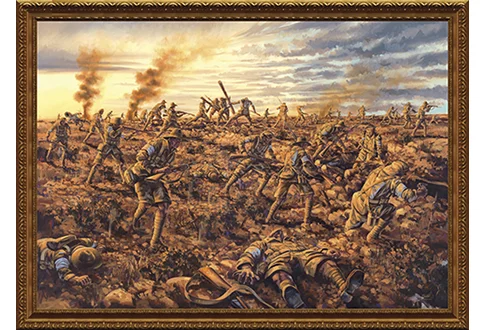
The Battle of The Nek is one story within a much larger archive of commissioned military artworks, historically significant pieces, low-number Archive Editions and Limited Edition collections.
Explore The BrandNet Archives