

Catalina: Black Cat in the Shadows
Discover the people, events and research behind each commissioned work.
View the original commissioned artwork and, where available, enquire about acquisition.
Discover and purchase rare #1–#10 Archive Editions and historically significant retained pieces.
Explore related Limited Edition lapel pins, medallions and art.
Consolidated Catalina
The Consolidated Catalina was never fast, heavily armoured or glamorous. What it possessed was something Australia desperately needed in the Pacific War: extraordinary range. The Royal Australian Air Force used more than 150 Catalinas between 1941 and 1945, turning the flying boat into one of its most versatile and strategically important aircraft.
Originally acquired for maritime patrol and reconnaissance, Catalinas were soon flying long-range bombing, reconnaissance, air-sea rescue and minelaying missions. Many sorties lasted 18 hours or more. Their ability to remain airborne for extraordinary periods allowed Australian crews to reach targets far beyond the practical range of most other RAAF aircraft
Read more
As operations moved increasingly into darkness, many Catalinas were painted in dark colours and became known as the ‘Black Cats’. Their most remarkable work included precision minelaying at night. Flying only metres above the water, crews placed mines in enemy harbours and shipping routes across the Netherlands East Indies and as far north as the approaches to China.
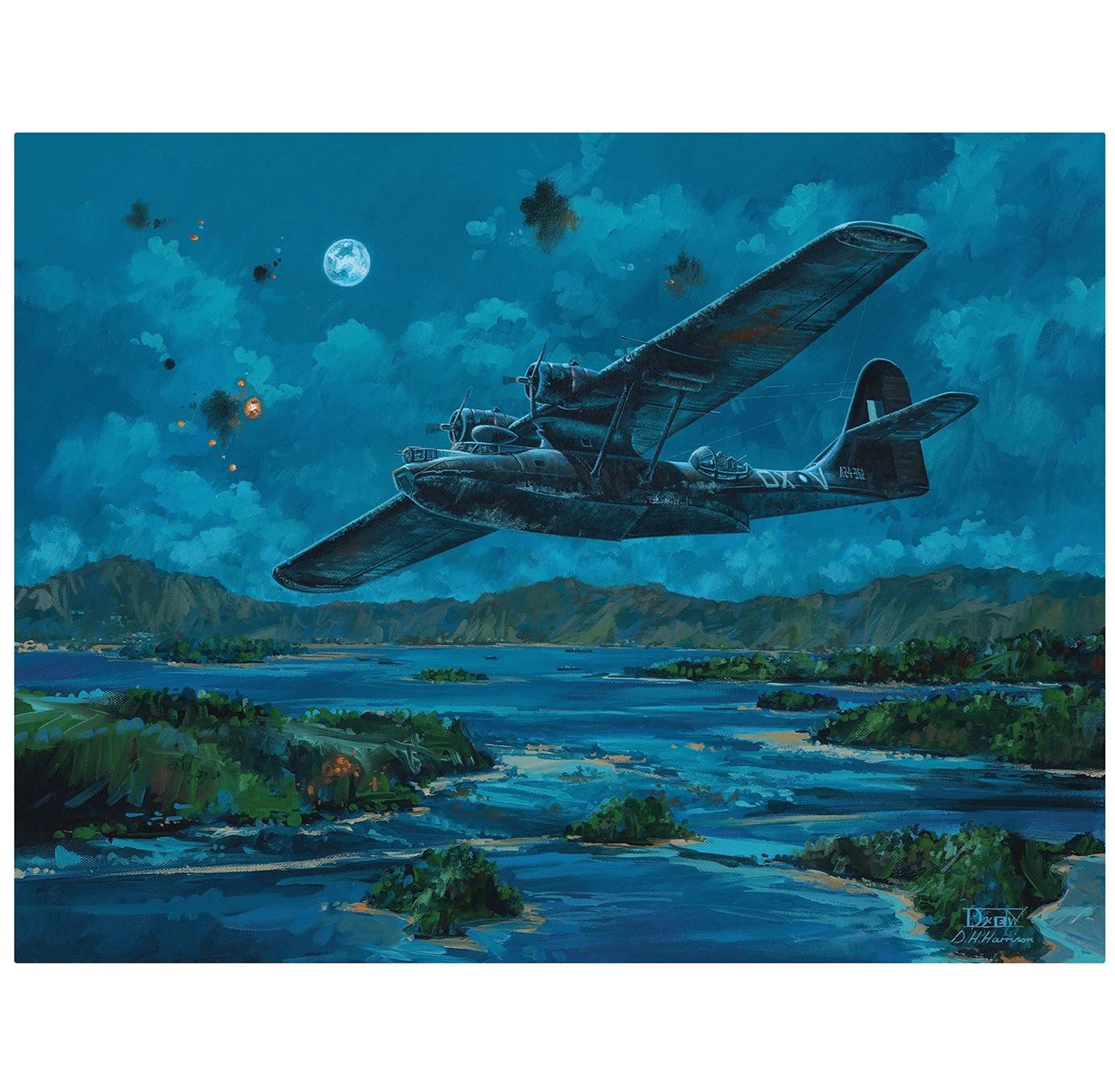
Black Cat in the Shadows focuses on No. 43 Squadron and Catalina A24-362, OX-V. On 21 July 1945, Flight Lieutenant John Paine and crew took the aircraft into the Sawu Sea searching for targets and harassing Japanese installations. It was the kind of long, lonely operation the Black Cats continued almost until Japan’s surrender.
RAAF Catalina operations expanded dramatically after Japan entered the war. In the early Pacific campaigns the aircraft’s range allowed crews to strike distant Japanese bases when few other Australian aircraft could reach them. As faster bombers became available, the Catalina found a role uniquely suited to its strengths: clandestine long-range work at night.
Nos 11 and 20 Squadrons were joined by Nos 42 and 43 Squadrons, with the latter formed at Bowen on 1 May 1943. In 1944, Nos 20, 42 and 43 Squadrons came under No. 76 Wing, which became heavily committed to offensive minelaying. Black-painted Catalinas flew at very low altitude over enemy waters, placing magnetic mines with remarkable precision in harbours and sea lanes. The Australian War Memorial records that around 70 per cent of RAAF Catalina missions were long-range offensive strikes.
Their duties remained diverse. Catalinas patrolled for submarines and shipping, attacked targets of opportunity, rescued downed airmen and, after Japan’s surrender, helped repatriate Australian prisoners of war. Some 173 airmen lost their lives in RAAF Catalina operations. The aircraft’s wartime legend was built not on speed but on endurance: crews departing into darkness for missions measured not in minutes, but in most of a day.
Campaign Facts
Between 1941 and 1945, the Royal Australian Air Force (RAAF) operated more than 150 Catalinas in a wide range of roles, including maritime patrol, reconnaissance, bombing, minelaying, air-sea rescue and transport. Many of these long-range missions lasted 18 hours or more, demonstrating the Catalina’s exceptional endurance.
Read more
Aircraft used for night operations were commonly painted in dark colours and became known as ‘Black Cats’. These aircraft developed into specialists in low-level precision minelaying, attacking Japanese harbours and sea routes across the South-West Pacific and Netherlands East Indies. No. 43 Squadron RAAF was formed at Bowen, Queensland, on 1 May 1943, and, together with Nos 20 and 42 Squadrons, became part of No. 76 Wing’s major minelaying effort.
According to the Australian War Memorial, around 70 per cent of RAAF Catalina missions were long-range offensive strikes. The Black Cats’ combination of very long range and slow, low-level flight made them particularly effective for laying mines in the narrow channels and harbours on which Japanese shipping depended. Black Cat in the Shadows depicts Catalina A24-362, OX-V, of No. 43 Squadron during a July 1945 operation in the Sawu Sea. The Catalina’s service came at a considerable cost, with approximately 173 airmen losing their lives during RAAF Catalina operations in the Second World War.
Catalina: Black Cat in the Shadows
Drew Harrison’s Black Cat in the Shadows is the fifth work in BrandNet’s Iconic Aviation Collection. For the Catalina, Harrison chose a subject defined by darkness rather than daylight spectacle: a black-painted flying boat moving through a night operation over enemy-held waters.
Read more
The featured aircraft, A24-362 OX-V, gives the painting a specific No. 43 Squadron connection. Rather than present the Catalina as a peaceful flying boat, Harrison returns it to the environment in which the Black Cats built their wartime reputation, low, distant and operating largely unseen.
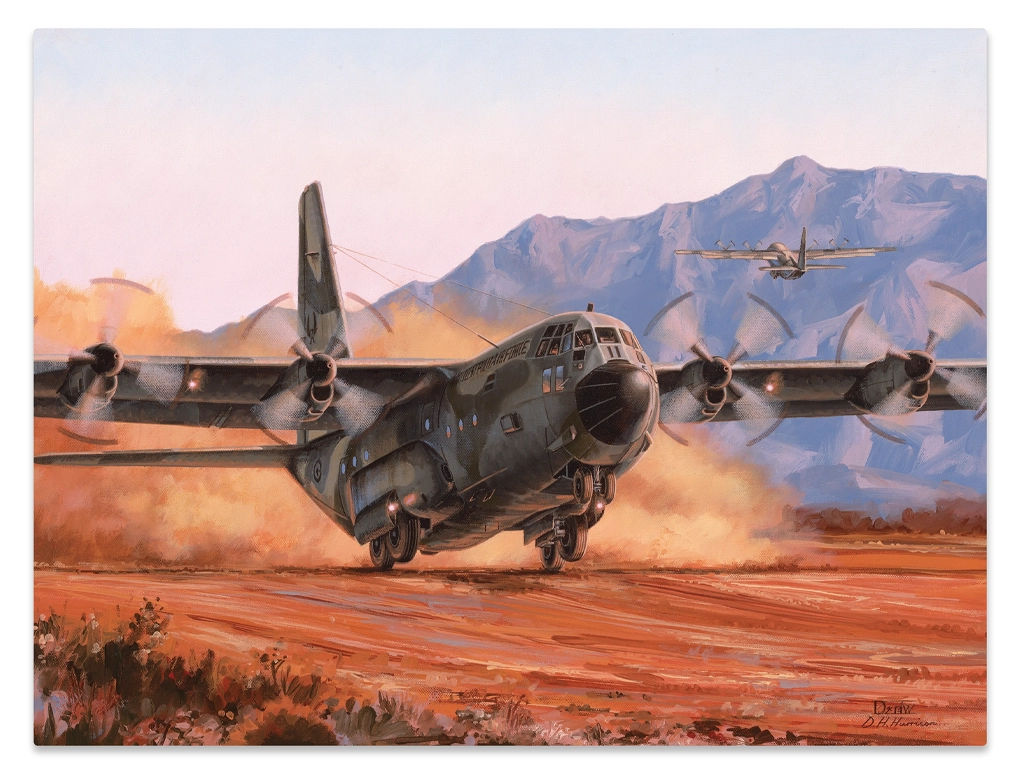
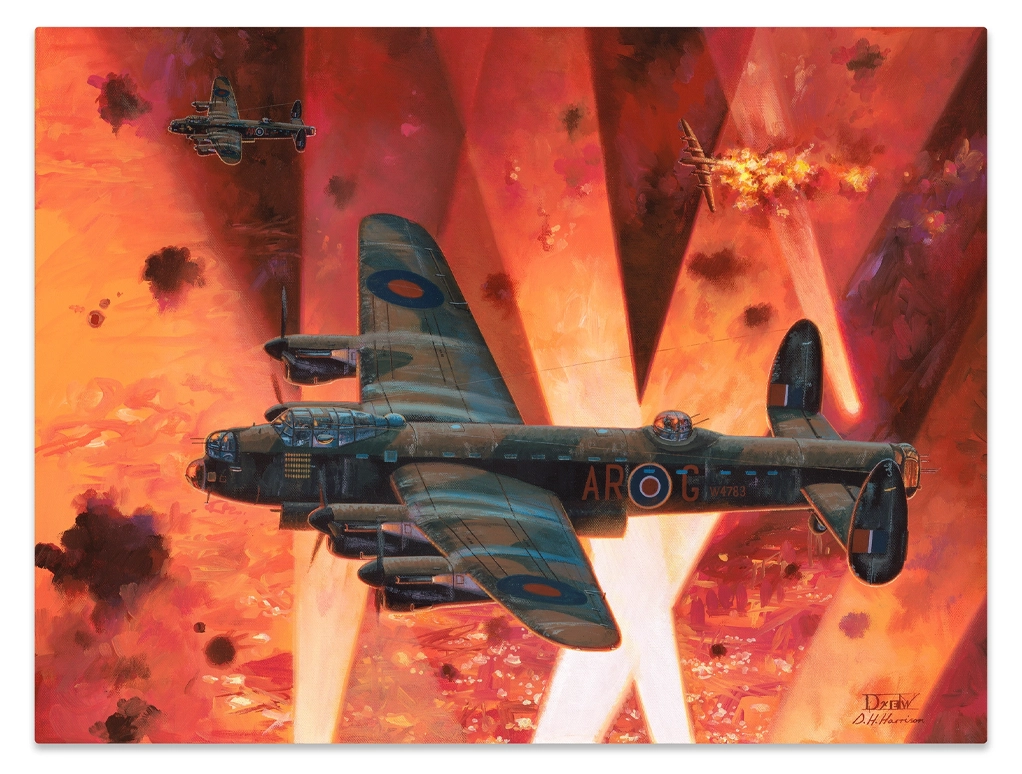
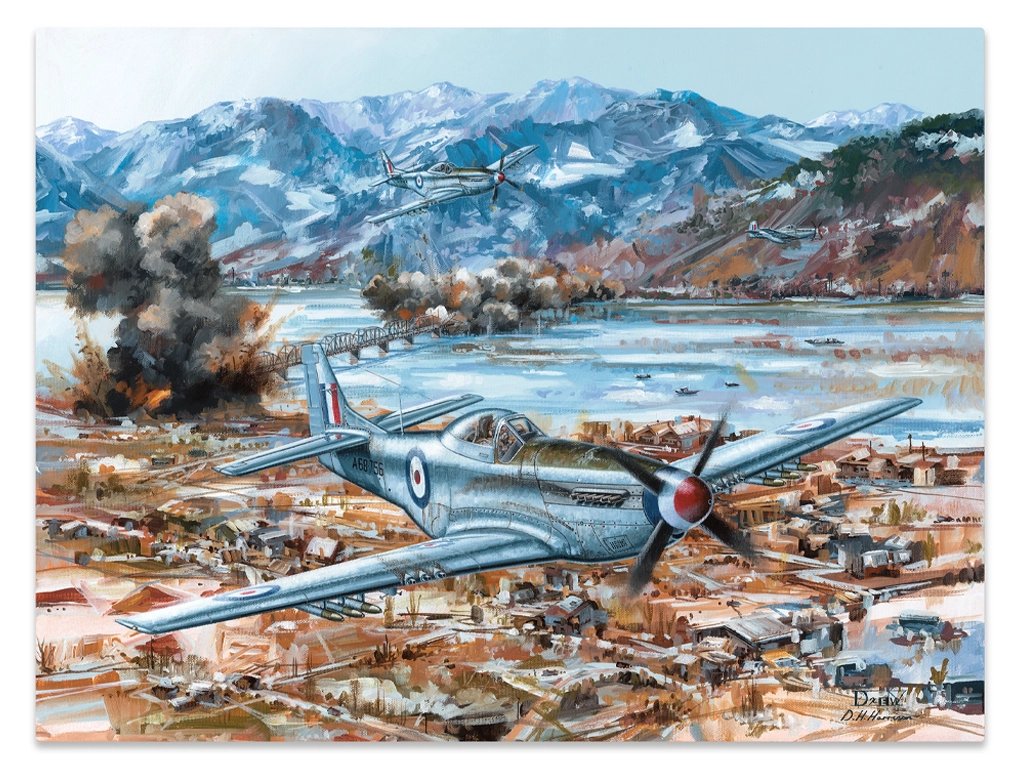
That approach distinguishes the Catalina within the Iconic Aviation series. The F-111 is about speed and strike; the Hercules about lift; the Lancaster about the bomber offensive; the Mustang about low-level interdiction. Black Cat in the Shadows is about endurance, secrecy and the ability to use darkness itself as protection.
Historical Accuracy
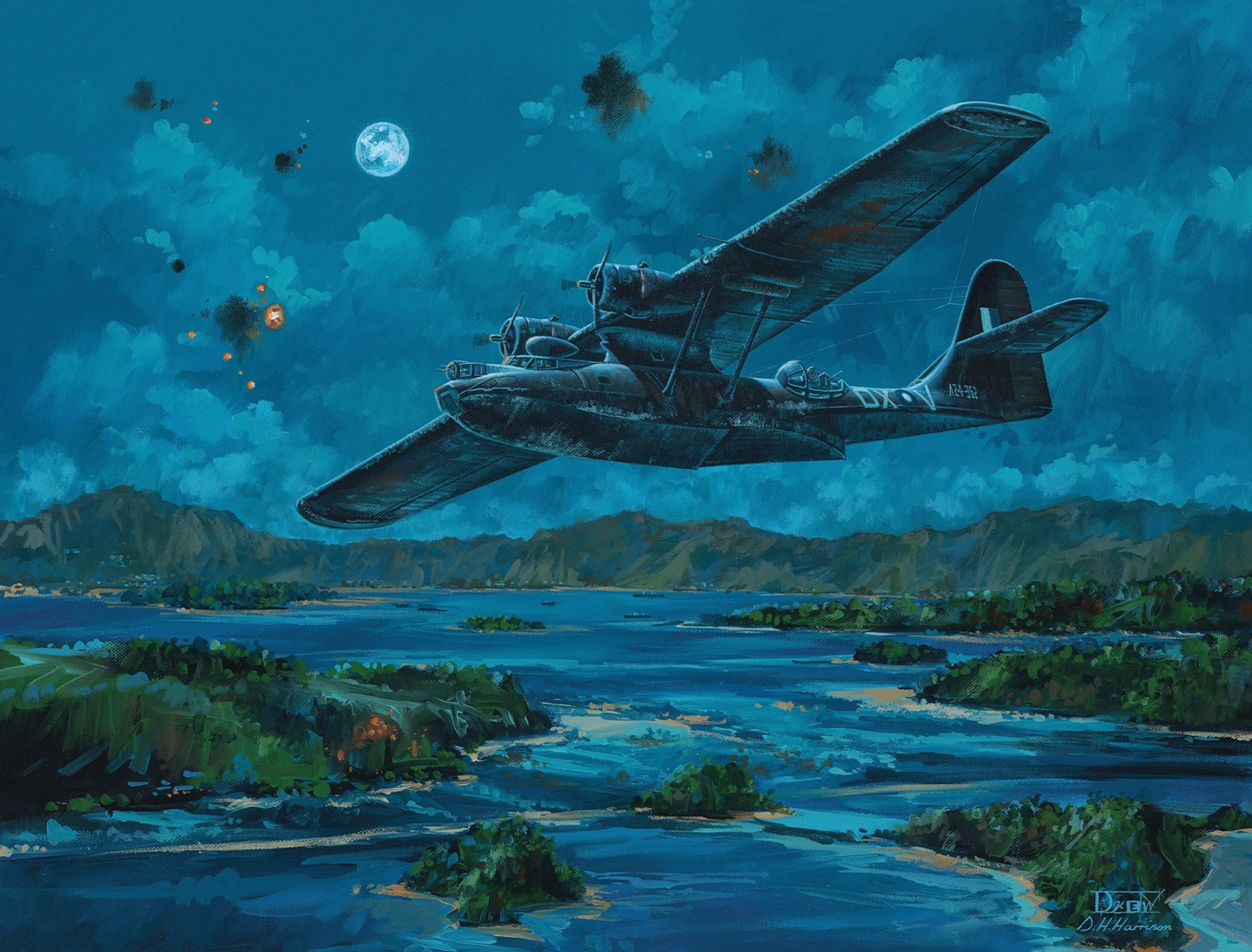
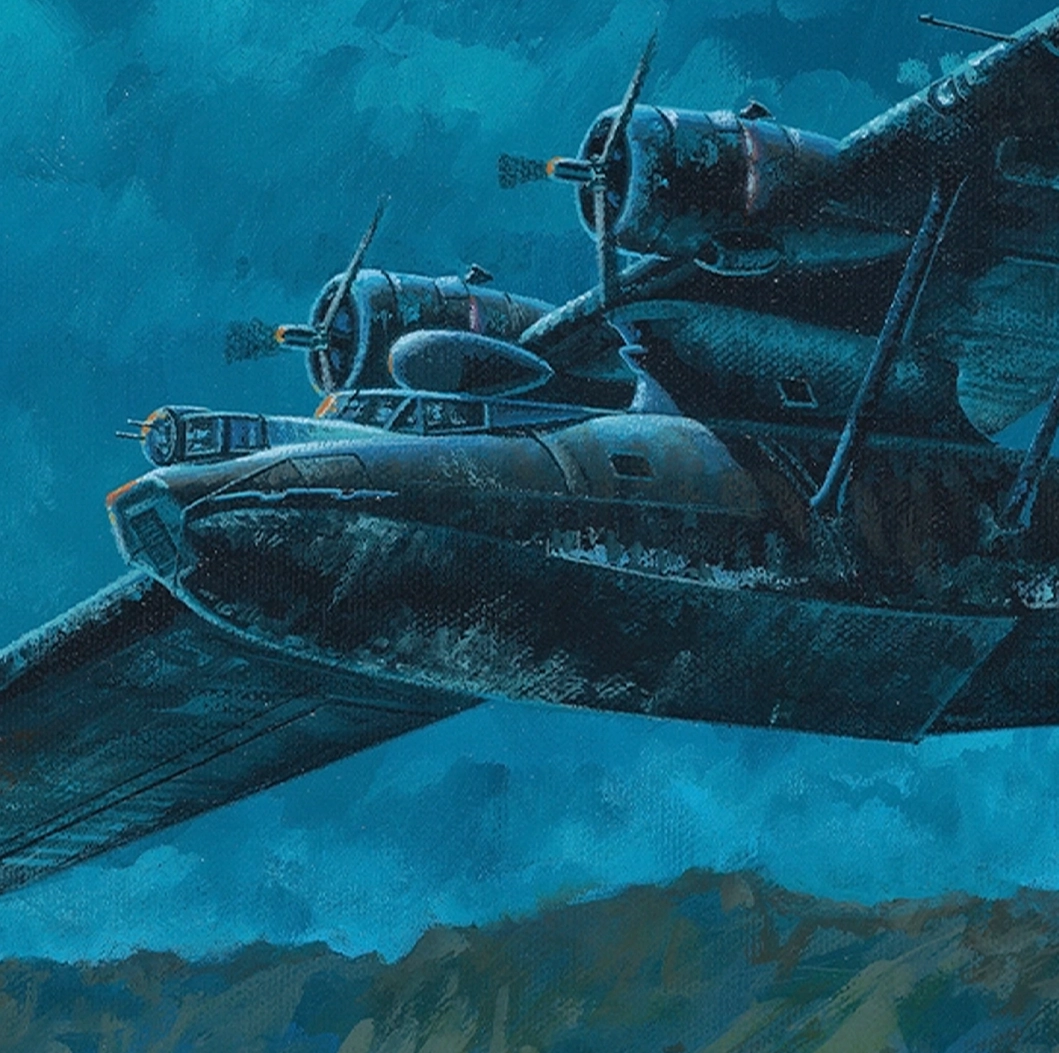
Black Cat in the Shadows is anchored to a real aircraft and a documented late-war operation. Military Shop’s Iconic Aviation history identifies the subject as late-model Catalina PB2B-2 A24-362, squadron code OX-V, of No. 43 Squadron RAAF. On 21 July 1945, Flight Lieutenant John Paine and crew searched the Sawu Sea for targets of opportunity and harassed enemy installations.
Read more
The wider setting reflects documented Black Cat operations: long-range night sorties, low-level maritime flying and attacks against Japanese-held territory. The Australian War Memorial confirms No. 43 Squadron’s Catalina roles included minelaying, maritime patrol, air-sea rescue and attacks on designated targets.
The painting should be presented as a researched interpretation rather than a frame-by-frame record of the 21 July sortie. A24-362, its squadron identity and operational context provide the historical foundation; the precise lighting, viewpoint and moment depicted are Harrison’s artistic construction.
A real No. 43 Squadron Black Cat
The painting centres on an identifiable late-model Catalina from the closing weeks of the Pacific War. Military Shop’s collection history records Flight Lieutenant John Paine and crew flying A24-362 in the Sawu Sea on 21 July 1945, searching for targets of opportunity and harassing Japanese installations. The aircraft gives Harrison’s composition a specific operational anchor.
Camouflage and protection
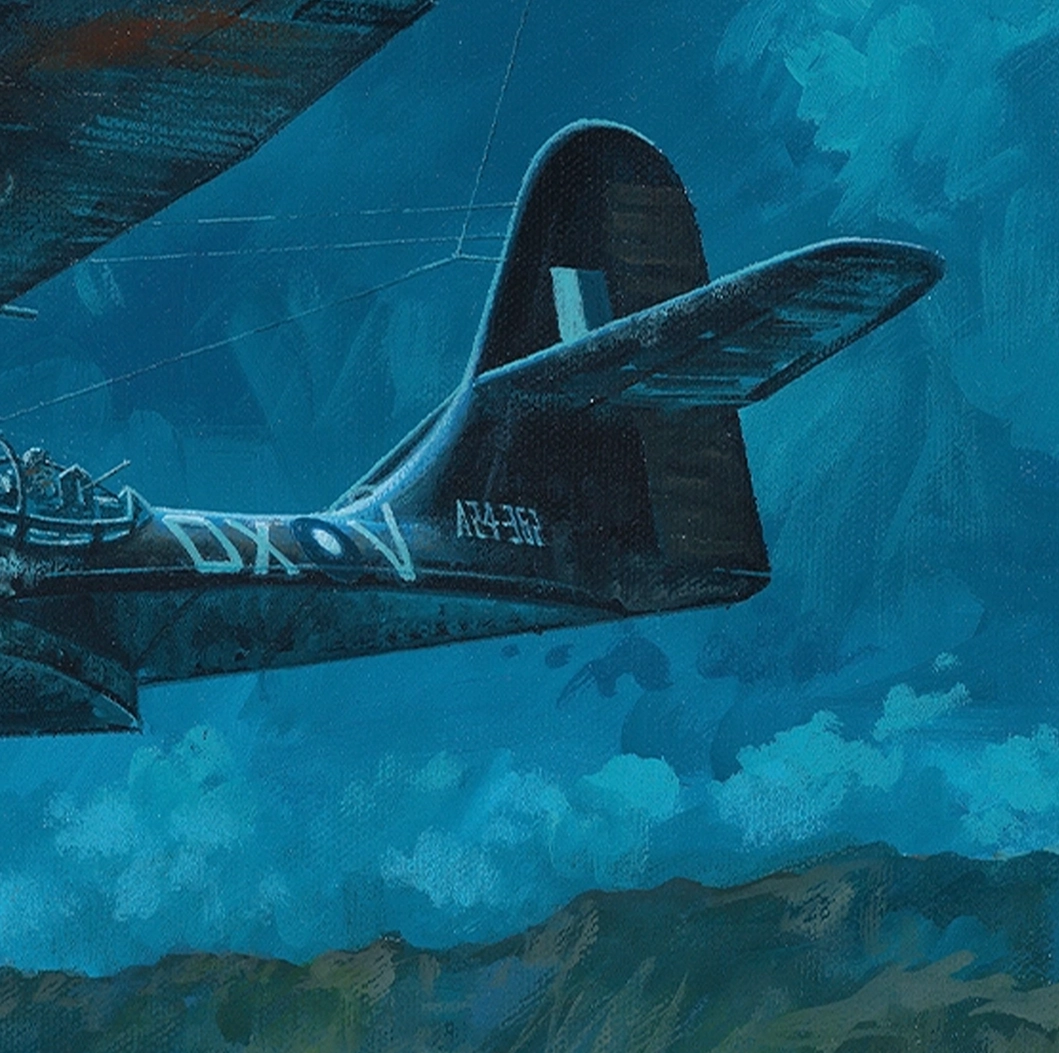
The night is not simply atmosphere. It explains how the slow Catalina survived deep offensive missions. Black Cats were painted in dark finishes because many later combat operations were conducted at night. Darkness reduced visibility to enemy fighters and ground defences and became part of the aircraft’s operational identity.

The Catalina’s unusual advantage
Where faster aircraft relied on speed, the Catalina relied on endurance and the ability to work close to the sea. Its slow speed was an advantage for precision minelaying, allowing crews to place mines accurately at extremely low altitude. Its range allowed those missions to reach distant enemy waters that were inaccessible to many other Australian aircraft.
Drew Harrison
Drew Harrison is an Australian aviation and military artist whose Iconic Aviation Collection combines researched aircraft history with contemporary cinematic composition. Six works were commissioned to interpret aircraft that became important chapters in Royal Australian Air Force history.
Read more
The Catalina offered Harrison an unusual visual problem. Much of its most important Australian combat work occurred at night, when the aircraft was deliberately difficult to see. Black Cat in the Shadows turns that limitation into the defining character of the painting.
Rather than flood the scene with detail, Harrison uses darkness, controlled highlights and the Catalina’s distinctive silhouette to create tension. The viewer is asked to imagine the vast unseen distance around the aircraft and the hours already flown or still to come.
Artist’s Notes
The Catalina’s story is one of endurance. The aircraft was slow, but it could remain in the air for extraordinary periods and operate over water in ways that made it invaluable to Australia’s Pacific campaign. The title Black Cat in the Shadows reflects both the aircraft’s wartime nickname and the way it fought. The black-painted Catalinas worked at night, often far from friendly territory, where concealment, patience and precise low-level flying mattered more than raw speed.
Detailed Artwork Description
A24-362 emerges from the darkness rather than sitting against a conventional daylight sky. Its broad parasol wing and twin-engine flying-boat form are instantly recognisable, but the black finish allows much of the aircraft to merge into the night.
Light is used sparingly. Small highlights define the airframe and separate it from the surrounding shadows, while the low operational setting gives the aircraft a sense of purpose rather than display. The composition is intentionally restrained. Black Cat operations depended upon avoiding attention. Harrison therefore makes concealment part of the visual language: the aircraft is present, but never entirely exposed. The effect mirrors the historical mission, long-range Australian aircraft moving quietly through hostile night skies.
The original Black Cat in the Shadows
The original Drew Harrison artwork from the Iconic Aviation Collection is preserved within the BrandNet Archives. It is the unique source work from which the Catalina limited-edition collector artworks were developed.
Read More
As one of the six smaller original aviation paintings commissioned for the Iconic Aviation Collection, Black Cat in the Shadows preserves a distinctly Australian Pacific War story, the RAAF crews who turned a slow flying boat into a formidable long-range night aircraft.
Own a part of the story
Black Cat in the Shadows was released across artwork and collector formats. The individual Catalina medallion is excluded because it is currently marked SOLD OUT. The principal artwork editions, Catalina mug, Catalina drink cooler and complete Iconic Aviation sets remain listed for purchase.
 Click to enlarge
Catalina Limited Edition Canvas Artwork
The canvas edition gives Harrison’s dark night composition a strong gallery presence while preserving the complete Black Cat in the Shadows artwork.
View the Artwork → Click to enlarge
Catalina Limited Edition Print
The fine-art paper edition preserves the subtle tonal detail that gives the Black Cat its atmosphere and provides a traditional collector presentation.
View the Artwork → Click to enlarge
Catalina Limited Edition Aluminium Artwork
The aluminium format provides a crisp contemporary presentation and a material link to the aircraft itself.
View the Artwork → Click to enlarge
Air Force 100 Iconic Aviation Limited Edition Medallion Set of 6
Minted from brass alloy with a highly polished silver finish, the set combines full-colour extracts from Drew Harrison’s six artworks with raised aircraft schematics, bringing the complete Iconic Aviation series into one numbered collection.
View the Set → Click to enlarge
Catalina Limited Edition Drink Cooler
A practical collector piece that uses the complete Catalina artwork in a format designed for camping, barbeques and sporting events.
View the Set →History, artwork and collecting
Explore the history behind the Lancaster Artwork, the choices and decisions made by the artist, and the Archive and Limited Edition pieces created from the commission.
The Aircraft
Why was the Catalina so important to Australia in the Pacific War?
Its extraordinary range allowed the RAAF to reach places other aircraft could not. Catalinas could remain airborne for 18 hours or more and operate over enormous maritime distances. Early in the Pacific War they were among the few Australian aircraft capable of striking distant Japanese bases; later their range made them ideal for reconnaissance, rescue and offensive minelaying.
Why were they called Black Cats?
Many RAAF Catalinas were painted in dark colours for night operations. The Catalina was slow and vulnerable in daylight. By operating at night and using dark camouflage, crews reduced their visibility to enemy fighters and defences. The black finish became so closely associated with Australian operations that ‘Black Cat’ entered RAAF legend.
What did the Black Cats actually do?
They flew long-range bombing, reconnaissance, maritime patrol, rescue and especially minelaying missions. RAAF Catalinas penetrated deep into Japanese-held waters, often at very low altitude. Mine-laying crews placed magnetic mines in harbours and sea lanes, restricting shipping and forcing the Japanese to divert resources to minesweeping and alternative routes.
How low did they fly during minelaying?
Often only a few metres above the water. The Australian War Memorial describes Black Cat crews placing mines with remarkable precision, sometimes within about ten metres of their intended point. Slow speed and stable low-level flight made the Catalina unusually effective for the task.
How long could Catalina missions last?
Eighteen to twenty hours was not unusual on long-range missions. The aircraft’s endurance was legendary. Some specially modified Catalina flights exceeded 30 hours. Combat crews faced the additional strain of darkness, weather, navigation and enemy territory throughout missions that could consume most of a day.
What happened after Japan surrendered?
Catalinas helped bring Australian prisoners of war home. No. 76 Wing aircraft transported former prisoners from Japanese camps and other locations. For men who had endured years of captivity, the arrival of a Catalina could represent the first stage of the journey back to Australia.
The Commission
Which Catalina does Black Cat in the Shadows depict?
A24-362, code OX-V, of No. 43 Squadron RAAF. Military Shop’s Iconic Aviation history identifies Flight Lieutenant John Paine and crew operating A24-362 in the Sawu Sea on 21 July 1945, searching for targets and harassing Japanese installations.
Does the painting show a specific moment from that sortie?
It is based on the documented operation but is an artistic reconstruction. The aircraft, unit and mission provide the historical foundation. Harrison uses composition, darkness and controlled light to convey the character of Black Cat operations rather than claim the scene reproduces a surviving wartime photograph.
Why is the artwork so dark?
Because darkness was part of the Black Cat’s protection and identity. The aircraft operated at night precisely because it was slow and vulnerable. Harrison makes concealment part of the image, allowing the Catalina to emerge from shadow rather than treating the night simply as a dramatic background.
Why choose a 1945 mission rather than an earlier Catalina action?
It shows that the Black Cats remained operational almost until the end of the Pacific War. The 21 July mission took place only weeks before Japan’s surrender. It reinforces the sustained pace of Catalina operations and connects the artwork to No. 43 Squadron’s late-war offensive role.
The Collection
Which Catalina artwork editions are currently available?
Canvas, fine-art paper and aluminium editions are currently listed. The canvas is $249 and limited to 100; the paper print is $195 and limited to 250; and the aluminium artwork is $169 and limited to 250.
Can I buy the individual Catalina medallion?
The current Catalina collection page marks the individual medallion SOLD OUT. The Catalina remains represented in the Air Force 100 Iconic Aviation Limited Edition Medallion Set of 6, currently listed at $225 and limited to 1,000 complete sets.
What other Catalina collectables remain available?
The current collection page lists the Catalina mug at $15 and drink cooler at $10. It also lists the complete six-mug set at $90 and six-drink-cooler set at $60, both limited to 1,000 sets. These provide lower-priced ways to collect Harrison’s complete Iconic Aviation series.
What is included in the six-medallion set?
One medallion for each of the F-111C, C-130 Hercules, Lancaster, P-51D Mustang, Catalina and CAC Sabre. Each proof-quality medallion combines a full-colour extract from Harrison’s artwork with a raised aircraft schematic. The complete set is limited to 1,000.
Archive Editions
What makes an early-numbered Catalina edition interesting?
It records a piece from the beginning of a finite release tied directly to Harrison’s original commission. A verified low number, particularly with its certificate and BrandNet provenance, gives the piece a clearly documented position within the original release.
What should remain with a Catalina Archive Edition?
The edition number, certificate, artist material and original presentation components should remain together wherever possible. Canvas, paper and aluminium editions have different specifications and edition sizes. Keeping the supporting material with the artwork preserves those distinctions and strengthens provenance.
Why is the individual medallion treated differently from the six-medallion set?
They are separate collector releases with their own numbering and packaging. The individual Catalina medallion focuses on one aircraft, while the six-medallion set presents the entire Iconic Aviation sequence. The Catalina individual edition is now sold out, making the complete set the current medallion route for this aircraft.
Why preserve the original with its limited editions?
The original records the commission; the numbered editions show how the artwork reached collectors. Together they preserve BrandNet’s complete role in the project, commissioning Harrison’s interpretation, retaining the unique source work and documenting the finite collector releases created from it.
Black Cat in the Shadows. First and furthest
The Catalina occupies a distinctive place in Australian air power. It was not the fastest or most glamorous aircraft of the Pacific War, yet its extraordinary endurance allowed Australian crews to operate farther, longer and deeper into enemy-held waters than almost any other RAAF aircraft.
Drew Harrison’s Black Cat in the Shadows preserves that story through A24-362 and No. 43 Squadron. Held with its limited editions and wider Iconic Aviation collection, the original becomes a contemporary link to the Black Cat crews who disappeared into the night for missions that could last most of a day — and whose work remained largely unseen.
Explore the BrandNet Archives →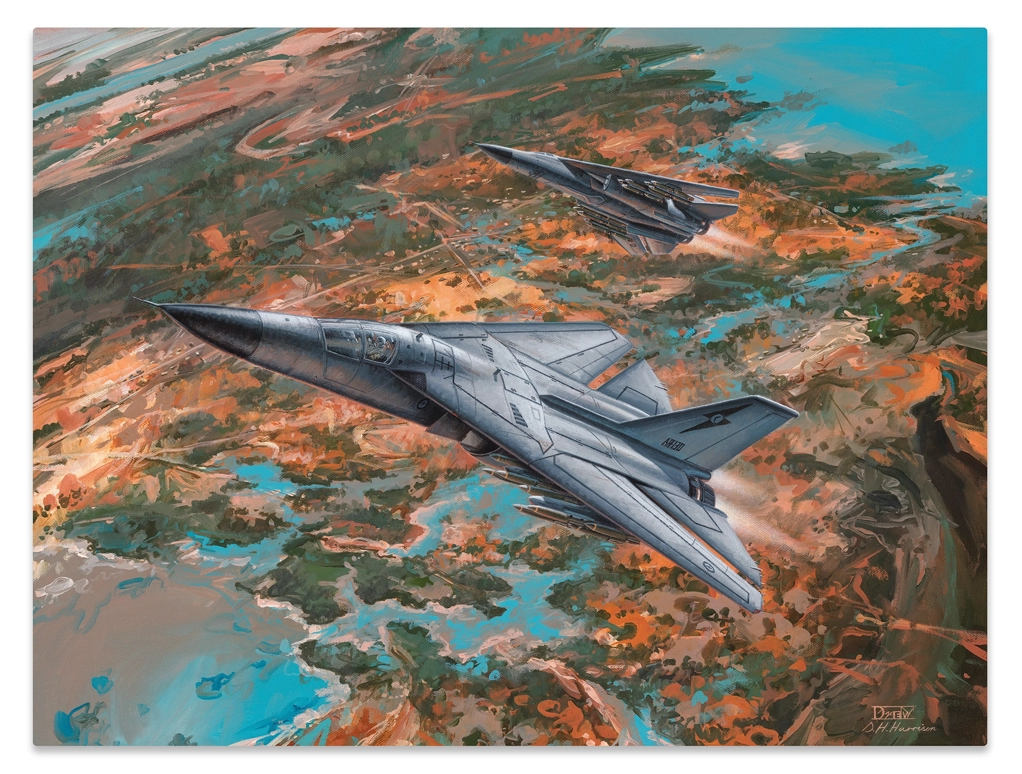
Explore more Australian military stories, art and collectables
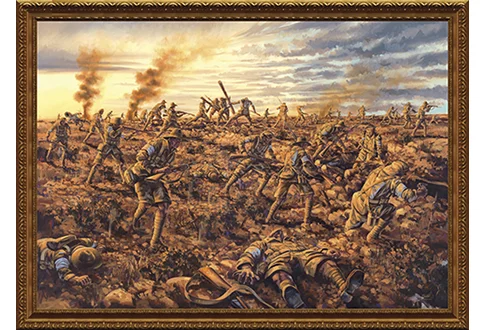
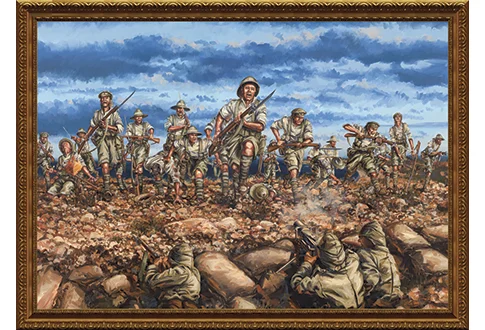
The Battle of The Nek is one story within a much larger archive of commissioned military artworks, historically significant pieces, low-number Archive Editions and Limited Edition collections.
Explore The BrandNet Archives