

Lancaster: Into the Cauldron
Discover the people, events and research behind each commissioned work.
View the original commissioned artwork and, where available, enquire about acquisition.
Discover and purchase rare #1–#10 Archive Editions and historically significant retained pieces.
Explore related Limited Edition lapel pins, medallions and art.
Avro Lancaster Mk I
For thousands of young Australians in the Second World War, the air war over Europe became the most dangerous theatre in which they could serve. Trained through the Empire Air Training Scheme, Australian aircrew joined RAF Bomber Command and flew night after night against targets across Germany and occupied Europe.
Among the best-known Australian units was No. 460 Squadron RAAF. Formed in Britain in November 1941, it converted to the four-engined Avro Lancaster in 1942 and became one of Bomber Command’s hardest-working heavy bomber squadrons. Its crews attacked industrial centres, transport networks, military installations and major German cities, flying through darkness, cloud, icing, searchlights, anti-aircraft fire and night fighters.
Read more
The price was immense. Air Force records that 3,486 Australians died while serving with Bomber Command. No. 460 Squadron alone suffered 1,018 fatal casualties, including 589 Australians, and lost 181 aircraft on operations.
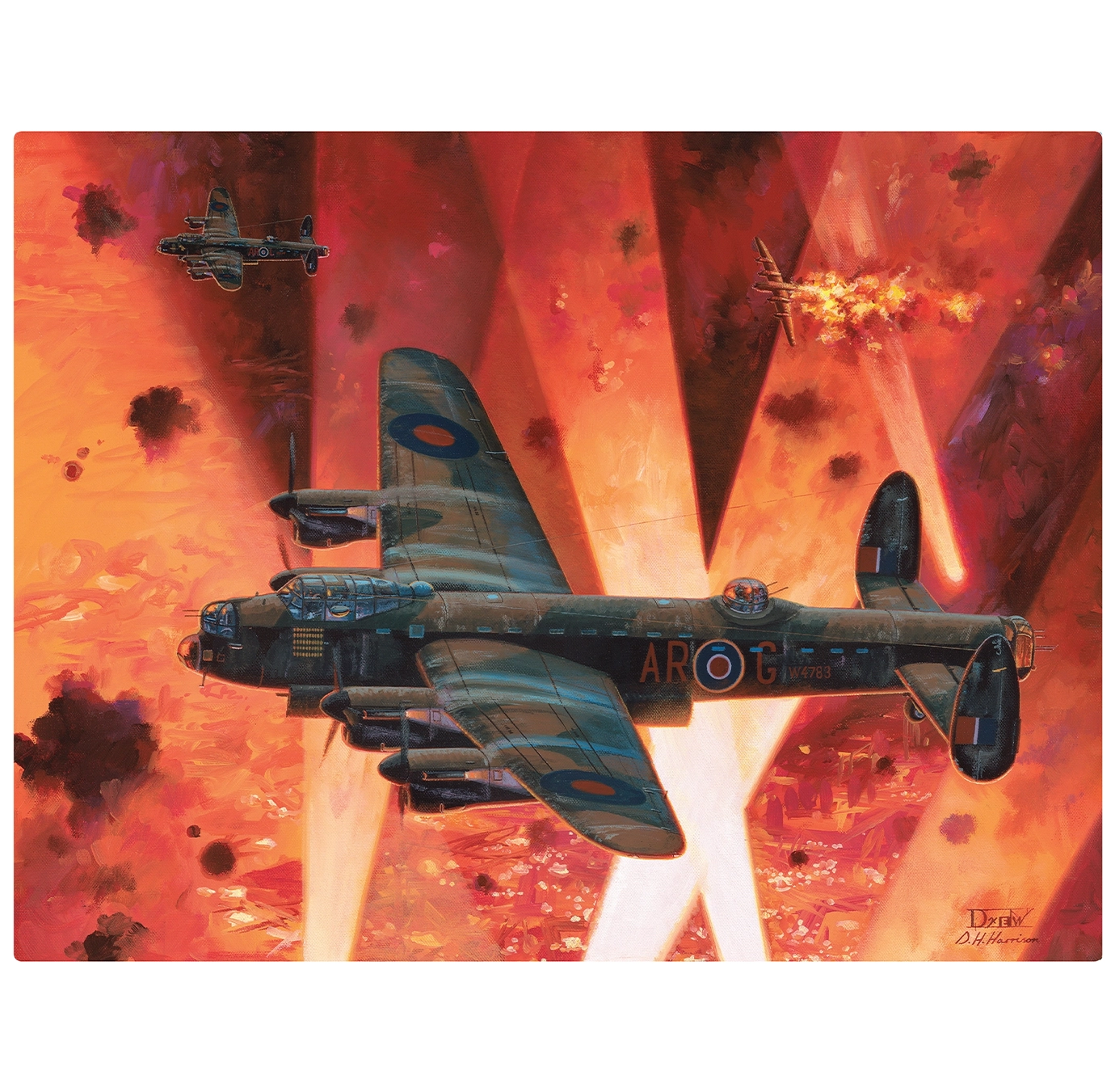
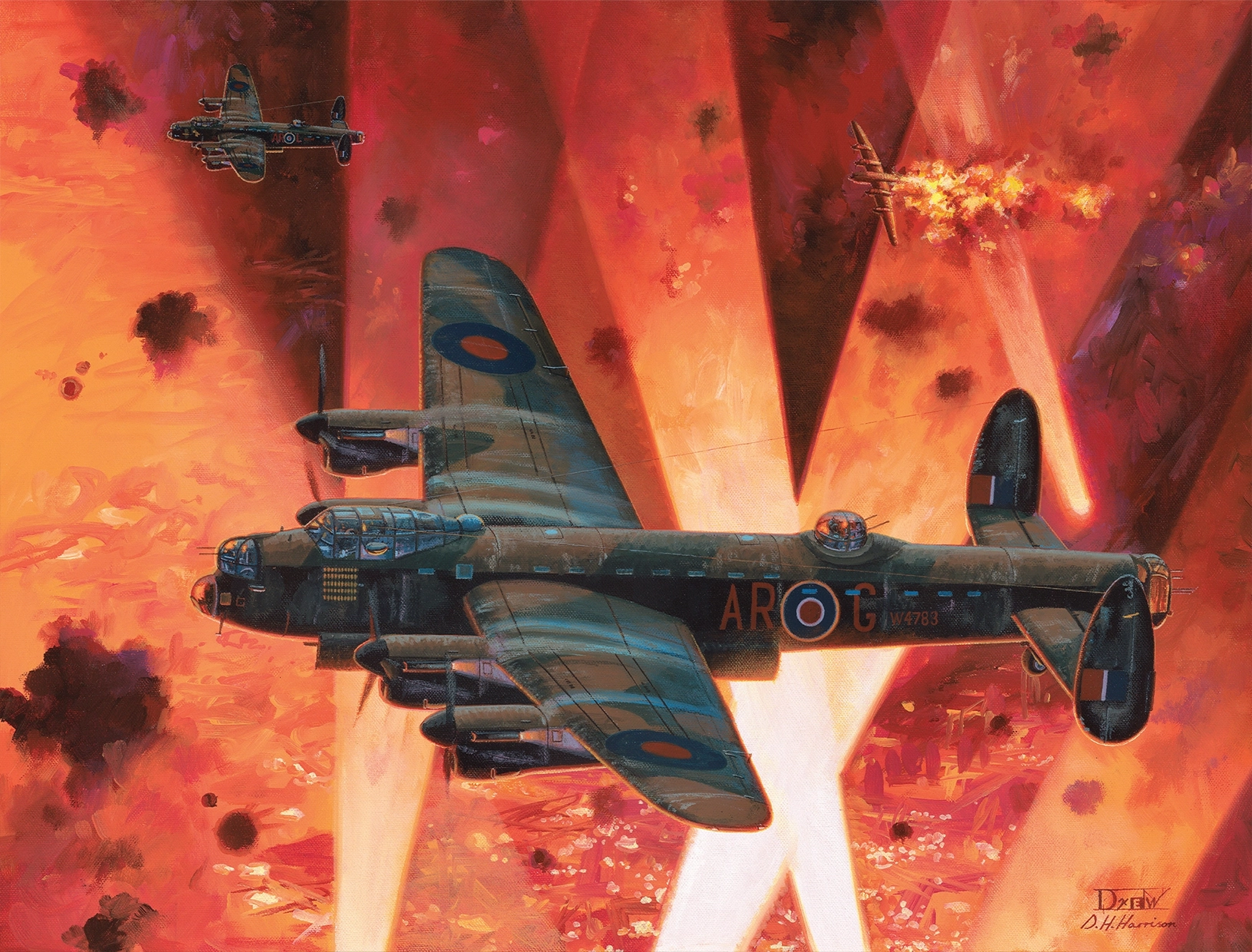
One Lancaster survived when so many did not. W4783, AR-G, ‘G for George’ flew around 90 operational missions with No. 460 Squadron between 1942 and 1944. Drew Harrison’s Into the Cauldron places this famous aircraft back where its story was forged: in the dangerous night skies over wartime Europe.
The Avro Lancaster became the principal heavy bomber of RAF Bomber Command during the latter half of the war. Normally carrying a crew of seven, it combined range, payload and adaptability and could carry a common bomb load of about 14,000 lb. Australian airmen served not only in designated RAAF squadrons such as Nos 460, 463 and 467, but throughout British and Commonwealth Bomber Command units.
No. 460 Squadron’s record illustrates both the scale and cost of the campaign. The squadron flew more bombing raids than any other Australian squadron and was credited with dropping 24,856 tons of bombs. Its operations ranged across Germany and occupied Europe. On D-Day, 6 June 1944, its Lancasters attacked targets near Utah Beach as Allied forces landed in Normandy.
G for George arrived at No. 460 Squadron in October 1942. Its first operation was against Mannheim on 6 December. Over the following sixteen months it flew missions to Berlin, Hamburg, Cologne, Essen, Turin, La Spezia and many other targets, including the August 1943 raid on the V-weapon research site at Peenemünde. Its final operation was against Cologne on 20 April 1944. After surviving around 90 operations, it was withdrawn, flown to Australia and used in the 1945 Third Victory Loan campaign. Today it is preserved by the Australian War Memorial, a physical link to the Australians who served, and those who did not return.
Campaign Facts
No. 460 Squadron RAAF was formed in Britain in November 1941 under the Empire Air Training Scheme and converted to the Avro Lancaster in 1942. Australian aircrew served throughout RAF Bomber Command, as well as in designated RAAF squadrons. According to Air Force records, 3,486 Australians were killed while serving with Bomber Command. No. 460 Squadron suffered 1,018 fatal casualties, including 589 Australians, and lost 181 aircraft on operations. The squadron was credited with dropping 24,856 tons of bombs, the greatest tonnage of any Australian squadron.
Read more
W4783, known as ‘G for George’, joined No. 460 Squadron in October 1942 and flew around 90 operational missions over Germany, Italy and occupied Europe. The aircraft is now preserved in the Australian War Memorial’s National Collection. The survival of G for George was exceptional, as the aircraft completed repeated operations during one of the most dangerous phases of the bomber offensive. The Australian War Memorial notes that no crew member was lost while flying in George itself, although many former crew members were later killed while flying other aircraft.
Lancaster: Into the Cauldron
Drew Harrison’s Into the Cauldron is the third work in BrandNet’s Iconic Aviation Collection. Rather than paint a generic Lancaster, Harrison chose one of the most important surviving Australian-associated aircraft of the Second World War: G for George.
Read more
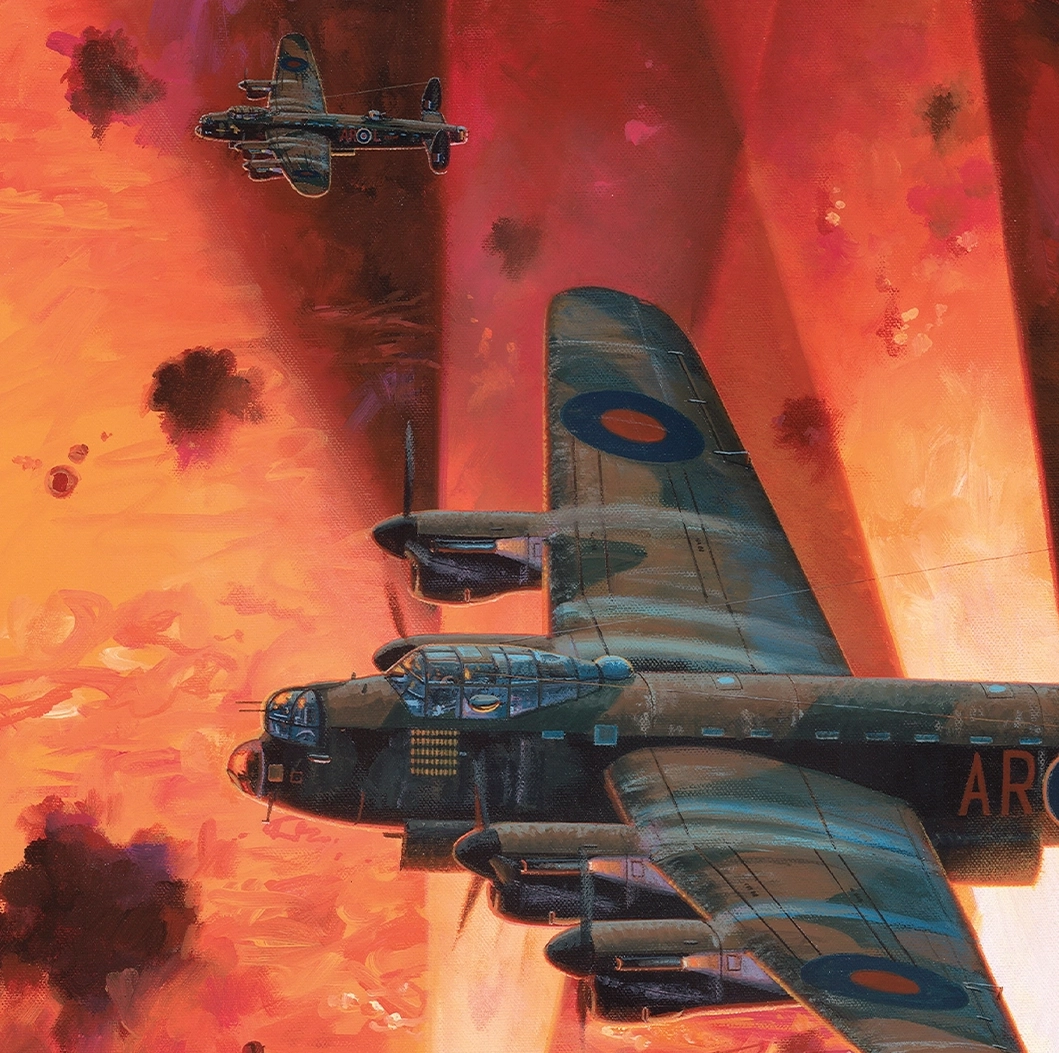
The painting returns George to the environment that made it famous, a Bomber Command night operation over mainland Europe. Darkness is broken by searchlights, ground fire and the glow below, while the Lancaster presses forward through a sky filled with danger.
The decision to centre the composition on G for George gives the artwork two layers. It is a dramatic Lancaster image, but it is also a portrait of a real survivor. The aircraft exists today in the Australian War Memorial, allowing viewers to move directly from Harrison’s interpretation of wartime flight to the preserved machine itself.
Historical Accuracy
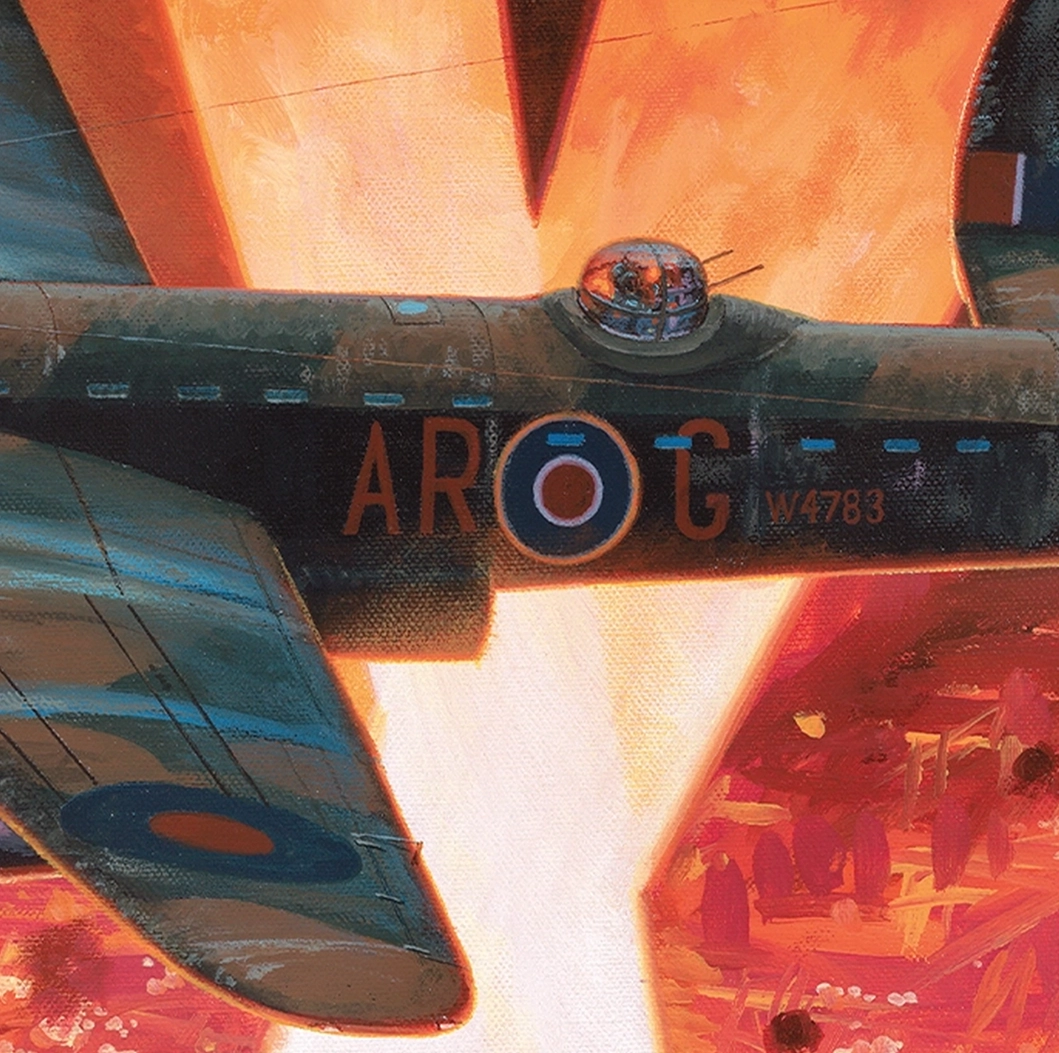
Into the Cauldron centres on an identifiable aircraft: Avro Lancaster Mk I W4783, squadron code AR-G, known as ‘G for George’. The Australian War Memorial records its service with No. 460 Squadron RAAF and its extensive operational history across Germany, Italy and occupied Europe.
Read more
Harrison’s scene is a dramatic representation of a night operation rather than a reconstruction of one specific sortie. The aircraft, markings, wartime setting and Bomber Command context are historically grounded; the exact arrangement of aircraft, searchlights, anti-aircraft fire and the landscape below serves the composition.
This distinction allows the artwork to convey a truth larger than one mission. Bomber crews repeatedly entered heavily defended airspace at night, navigating through darkness and weather while facing anti-aircraft guns, searchlights and night fighters. The title Into the Cauldron captures that recurring experience without claiming the painting records a single named raid.
A survivor of the bomber offensive
The central aircraft is W4783, AR-G, one of the best-known Lancasters associated with Australian aircrew. Delivered to No. 460 Squadron in October 1942, George flew around 90 operations before being withdrawn in April 1944. Its targets included Berlin, Hamburg, Cologne and the Peenemünde V-weapon research site. Few operational Lancasters survived such sustained service.
Bomber Command’s battlefield
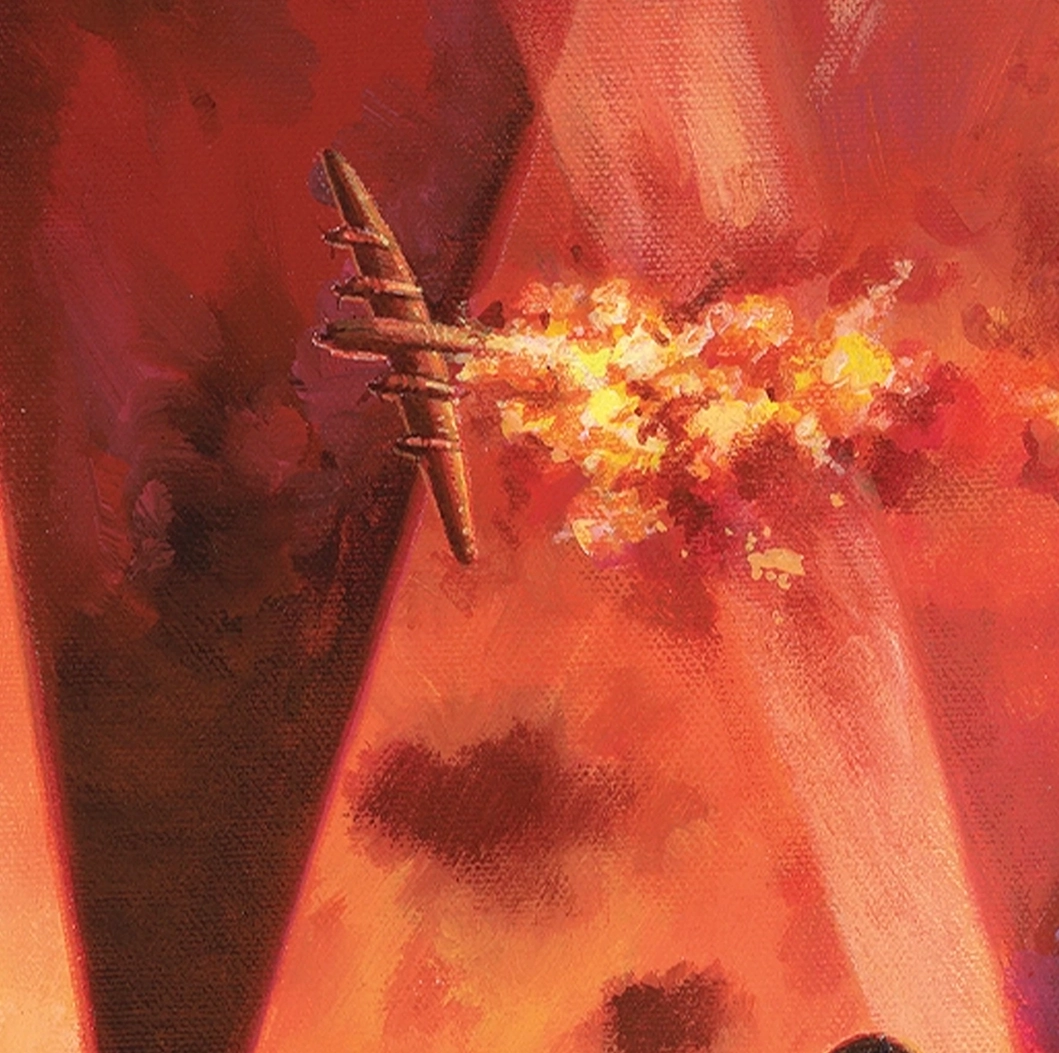
Harrison surrounds the Lancaster with the darkness, searchlights and defensive fire that defined the night bombing campaign. Bomber Command crews faced hazards before they even reached a target: weather, icing, navigation errors, mechanical failure and collision. Over enemy territory came radar-directed anti-aircraft fire, searchlights and night fighters. The painting compresses those dangers into one visual environment.
Seven men inside one aircraft
Behind the Lancaster’s imposing shape was a crew normally comprising pilot, navigator, bomb aimer, wireless operator, flight engineer, mid-upper gunner and rear gunner. Their survival depended upon each other. Missions could last many hours, much of them in darkness, with each crew member carrying a specialised responsibility. The aircraft may dominate Harrison’s image, but the human story gives the Lancaster its meaning.
Drew Harrison
Drew Harrison is an Australian aviation and military artist known for detailed research and cinematic composition. For the Iconic Aviation Collection, Harrison was commissioned to interpret six aircraft whose stories span very different periods of Royal Australian Air Force history.
Read more
The Lancaster demanded a different atmosphere from the F-111 or Hercules. Into the Cauldron is built around darkness, vulnerability and tension. The aircraft is powerful, but the surrounding sky makes clear that power did not make its crew safe. Harrison’s contemporary style allows historical detail and emotion to coexist. Accurate aircraft identity anchors the work, while light, colour, viewpoint and movement communicate something archival photography cannot easily convey: the feeling of a heavy bomber moving into a hostile night.
Artist’s Notes
The Lancaster is one of the most recognisable aircraft of the Second World War, but Harrison’s subject is not simply the machine. By choosing G for George and placing it within a dangerous night operation, the painting connects the aircraft to the Australians of Bomber Command and the extraordinary risks they accepted. The title Into the Cauldron describes the transition from relative safety into defended enemy airspace. Searchlights and anti-aircraft fire are not decorative additions; they are visual devices that narrow the world around the aircraft and reinforce the sense that the crew is flying deliberately into danger.
Detailed Artwork Description
The Lancaster moves through a dark European night, its four-engine silhouette immediately recognisable. G for George is the visual anchor, while the landscape and defensive fire below establish the operational setting. Searchlights cut through the darkness and create shafts of hard illumination. Flak and the glow of the target area add depth beneath the aircraft, while the night palette allows small points of light to carry unusual visual weight.
The composition draws the viewer forward with the aircraft. There is no comfortable distance from the action: George is already committed to the operation. That sense of movement makes the title literal, the crew is entering the cauldron, with the dangers of the route, target and return journey still ahead.
The original Into the Cauldron
The original Drew Harrison artwork from the Iconic Aviation Collection is preserved within the BrandNet Archives. It is the unique source work from which the Lancaster limited-edition canvas, paper and aluminium artworks were developed.
Read More
As one of the six smaller original aviation paintings commissioned for the Iconic Aviation Collection, Into the Cauldron connects BrandNet’s commissioned-art history with one of Australia’s most significant surviving wartime aircraft stories.
Own a part of the story
Into the Cauldron was translated into limited-edition artwork formats and also forms part of the six-aircraft Iconic Aviation Medallion Collection. Products currently available are shown below; the individual Lancaster medallion and Lancaster mug are excluded because the current collection page marks them SOLD OUT.
 Click to enlarge
Lancaster Bomber Limited Edition Canvas Artwork
The canvas edition gives Harrison’s night composition a strong gallery presence, with the dark sky, searchlights and G for George reproduced as a complete artwork.
View the Artwork →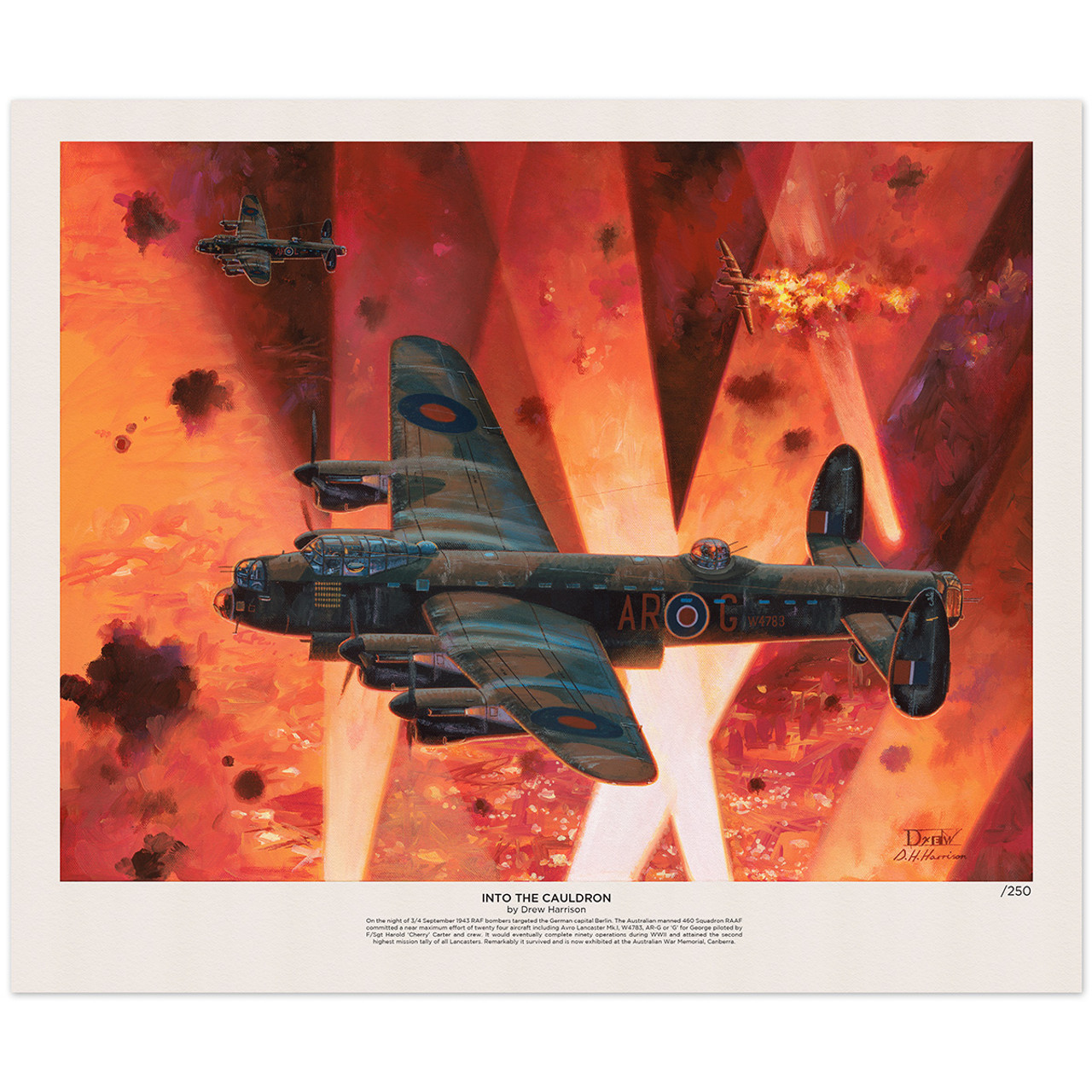 Click to enlarge
Lancaster Bomber Limited Edition Print
The fine-art paper edition is a traditional collector format that preserves the tonal detail of the night scene and the aircraft markings while allowing the owner to choose the final framing presentation.
View the Artwork → Click to enlarge
Lancaster Bomber Limited Edition Aluminium Artwork
The aluminium format creates a crisp contemporary presentation and provides a material connection to the metal airframe of the Lancaster itself.
View the Artwork → Click to enlarge
Air Force 100 Iconic Aviation Limited Edition Medallion Set of 6
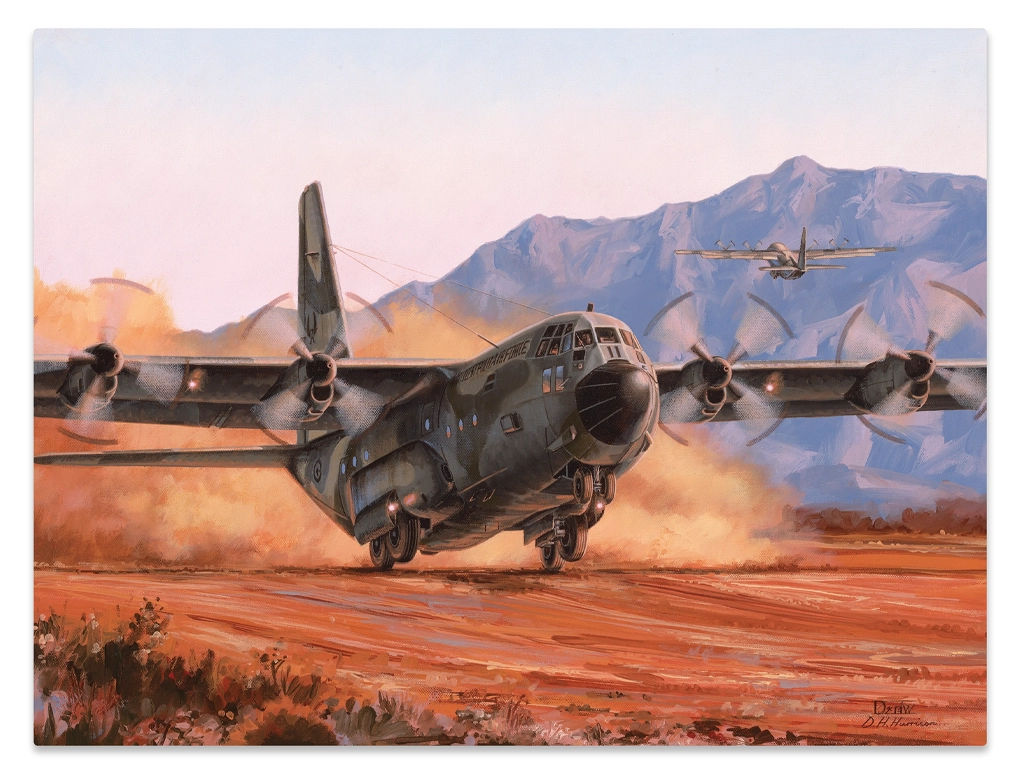
The complete set brings together all six aircraft from Drew Harrison’s Iconic Aviation Collection, F-111C, C-130 Hercules, Avro Lancaster, P-51D Mustang, Catalina and CAC Sabre. Minted from brass alloy with a highly polished silver finish, the medallions use full-colour details from Harrison’s artworks together with raised aircraft schematics.
View the Set →History, artwork and collecting
Explore the history behind the Lancaster Artwork, the choices and decisions made by the artist, and the Archive and Limited Edition pieces created from the commission.
The Aircraft
Why is the Lancaster so important to Australian wartime history?
Thousands of Australian airmen served in Bomber Command, and Lancaster-equipped RAAF squadrons carried the bombing campaign deep into occupied Europe and Germany. Australians served throughout RAF Bomber Command, including in Nos 460, 463 and 467 Squadrons flying Lancasters. Air Force records 3,486 Australian deaths in Bomber Command, an extraordinary proportion of Australia’s combat losses for a comparatively small group of servicemen.
What was No. 460 Squadron?
It was an Australian-manned RAAF squadron serving under RAF Bomber Command in Britain. Formed in November 1941, No. 460 Squadron initially flew Wellingtons before converting to Lancasters. It flew more bombing raids than any other Australian squadron and dropped the greatest tonnage of bombs, but also suffered the highest fatal casualties of any Australian squadron.
Who or what was G for George?
G for George was Avro Lancaster Mk I W4783, coded AR-G, operated by No. 460 Squadron RAAF. It joined the squadron in October 1942 and flew around 90 operational missions before retiring in April 1944. It was later flown to Australia and is now preserved in the Australian War Memorial’s National Collection.
How many men normally crewed a Lancaster?
Seven. The normal crew comprised pilot, flight engineer, navigator, bomb aimer, wireless operator, mid-upper gunner and rear gunner. Each role was specialised, and the crew’s survival depended on close coordination throughout missions that could last many hours.
Why were Bomber Command operations so dangerous?
Crews faced weather, mechanical failure, collision, anti-aircraft fire, searchlights and night fighters , often for hours at a time. Air Force notes that during the worst period crews had less than a 50 per cent chance of surviving a standard tour of 30 operations. G for George’s ability to complete around 90 operations was therefore exceptional.
What happened to G for George after the war?
It was withdrawn from combat in 1944, flown to Australia and later preserved by the Australian War Memorial. George arrived in Australia in November 1944, was allocated RAAF serial A66-2 and toured eastern Australia during the 1945 Third Victory Loan campaign. Its survival means Australians can still stand beside an aircraft that actually flew through the Bomber Command campaign.
The Commission
Does Into the Cauldron show a specific raid?
No. It is a historically grounded representation of a Lancaster night operation. G for George is a real and identifiable aircraft, but the complete scene is composed to convey the recurring dangers of Bomber Command operations rather than reproduce one photograph or one precise moment.
Why did Drew Harrison choose G for George?
Because it provides an unusually strong Australian connection to the Lancaster story. The aircraft served with No. 460 Squadron RAAF, completed an exceptional number of operations, survived the war and is preserved at the Australian War Memorial. It links wartime history, national memory and the present-day viewer.
What does the title Into the Cauldron mean?
It describes bomber crews deliberately entering an intensely dangerous operational environment. A ‘cauldron’ suggests heat, violence and confinement. In Harrison’s painting the night sky, searchlights and defensive fire visually close around the aircraft, expressing the risk of pressing onward toward a defended target.
Why is the artwork so dark?
Because Bomber Command’s heavy-bomber offensive was predominantly fought at night. Darkness offered protection but also created its own hazards. Navigation, formation, weather and identification became more difficult, while searchlights and fires could suddenly expose an aircraft. Harrison uses darkness as both historical setting and emotional atmosphere.
The Collection
Which Lancaster artwork editions are currently available?
The current collection lists canvas, fine-art paper and aluminium editions for purchase. The canvas is $249 and limited to 100; the paper print is $195 and limited to 250; and the aluminium artwork is $169 and limited to 250.
Can I still buy the Lancaster medallion by itself?
The current Lancaster collection page marks the individual Lancaster medallion SOLD OUT. The Lancaster remains available within the Air Force 100 Iconic Aviation Limited Edition Medallion Set of 6, which brings together all six aircraft in the Iconic Aviation series.
What is included in the Iconic Aviation Medallion Set of 6?
Six limited-edition medallions representing the F-111C, C-130 Hercules, Avro Lancaster, P-51D Mustang, Catalina and CAC Sabre. The proof-quality medallions are minted from brass alloy, finished in highly polished silver and combine full-colour extracts from Drew Harrison’s artworks with raised aircraft schematics. Only 1,000 complete sets were made and the current price is $225.
Are any individual Iconic Aviation medallions still available?
Yes. Current Military Shop listings show individual P-51D Mustang and CAC Sabre medallions available at $45 each. For future Mustang and Sabre Archive pages, those individual medallions can therefore be included alongside the complete six-medallion set, subject to a final live availability check before publication.
Archive Editions
What makes an early-numbered Lancaster edition collectable?
It identifies a piece from the beginning of a finite release connected directly to Harrison’s original commission. A verified low edition number, together with the artist’s signature where applicable, certificate and BrandNet provenance, gives the artwork a documented position within the original release.
What should remain with an Archive Edition?
The edition number, certificate, artist information and original presentation material should remain with the artwork wherever possible. The archive record should also identify whether the piece is canvas, paper or aluminium because each format has a different edition size and specification.
How does the medallion set fit within the artwork collection?
TIt translates all six commissioned paintings into a single numbered collector set. Rather than reproducing the complete artworks at large scale, each medallion uses imagery from Harrison’s paintings and an aircraft schematic. The set therefore connects all six Iconic Aviation subjects within one limited-edition object.
Why preserve the original Into the Cauldron with the editions?
The original records the commission; the editions record how the work was shared with collectors. Together they preserve BrandNet’s role in commissioning a contemporary interpretation of an important Australian wartime story and in creating the numbered collection that followed.
Into the Cauldron: A survivor carries the story
The Lancaster is remembered for its power and its extraordinary wartime capability, but its Australian story is inseparable from the young men who flew in Bomber Command and the terrible losses they endured.
By centring Into the Cauldron on G for George, Drew Harrison gives that story a tangible focal point. The real aircraft survived around 90 operations and survives still. Preserving Harrison’s original alongside its limited editions allows the BrandNet Archives to connect contemporary commissioned art with an aircraft, squadron and generation whose service remains part of Australia’s national memory.
Explore the BrandNet Archives →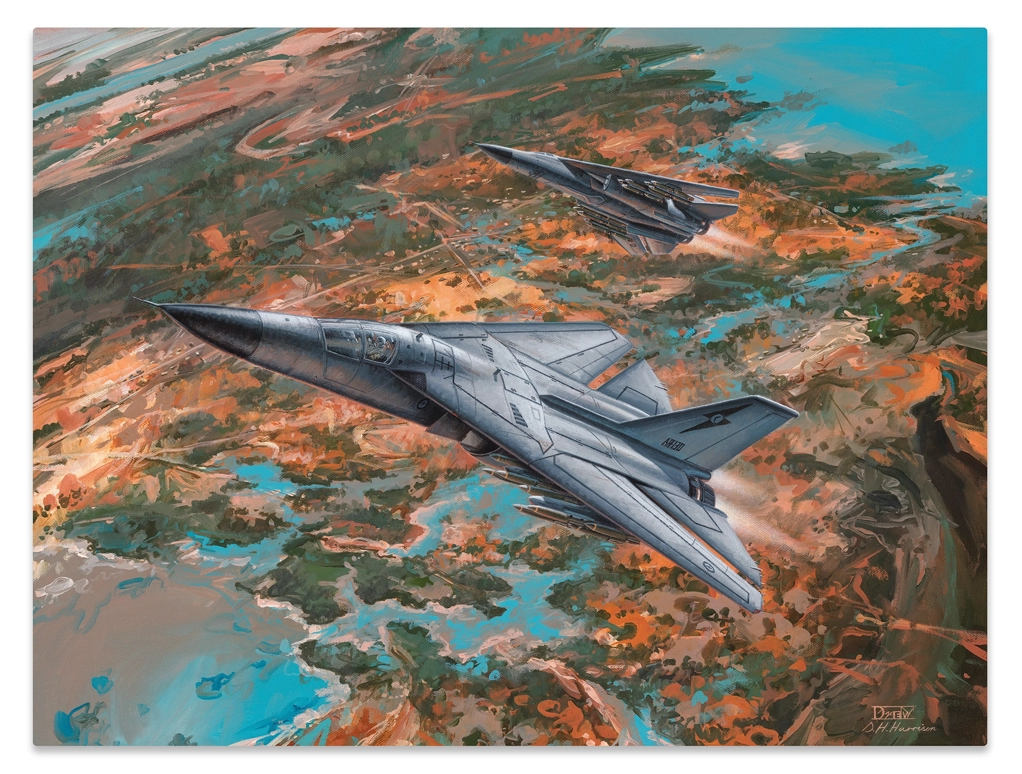
Explore more Australian military stories, art and collectables
The Battle of The Nek is one story within a much larger archive of commissioned military artworks, historically significant pieces, low-number Archive Editions and Limited Edition collections.
Explore The BrandNet Archives