

Combined Arms Contact
Vietnam 1969
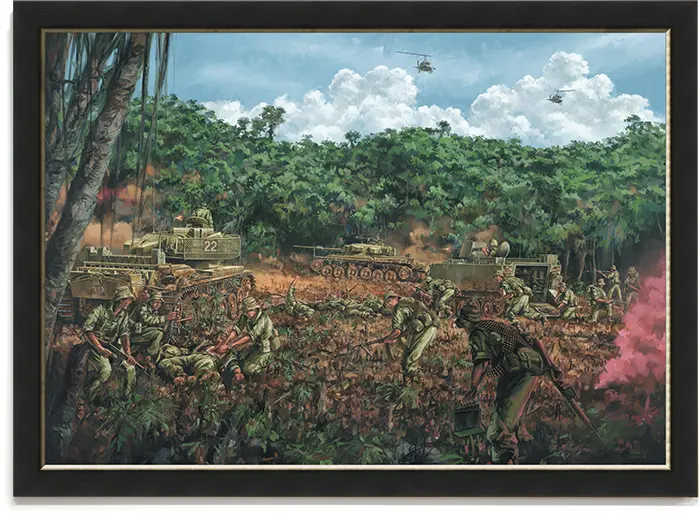
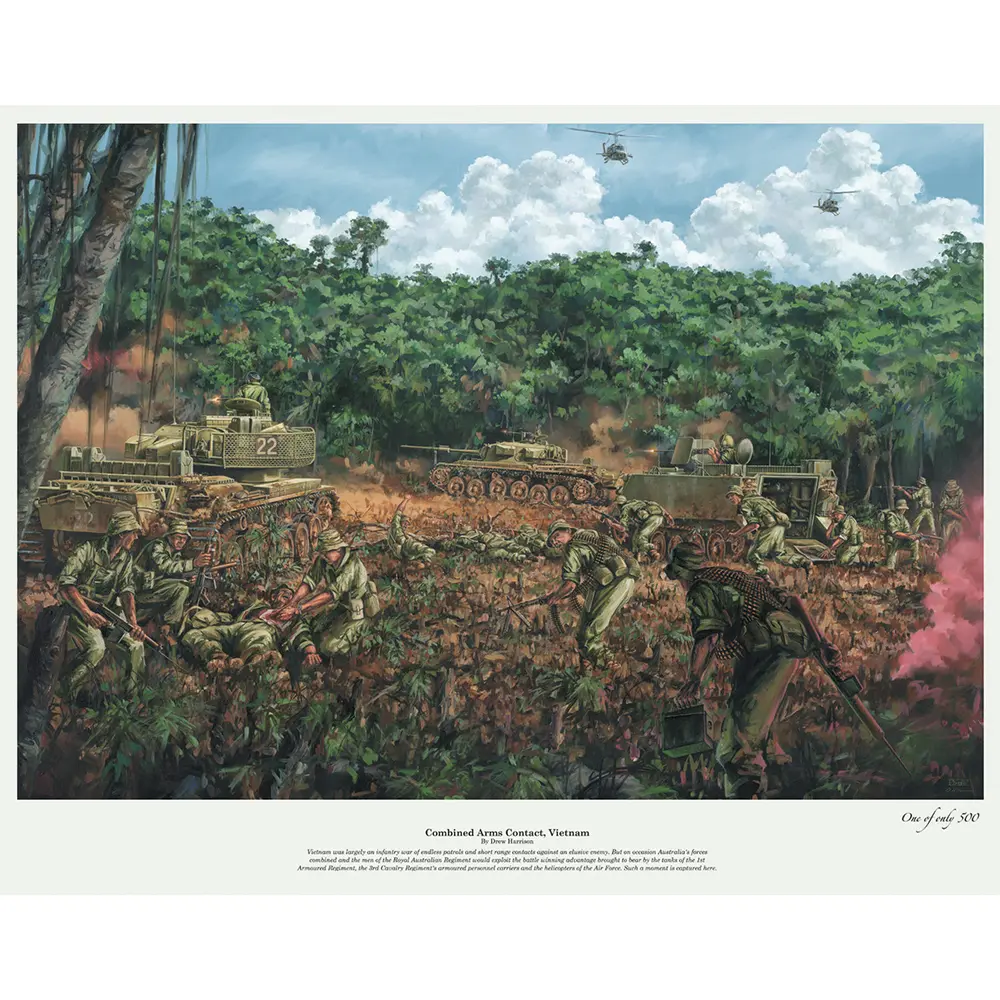
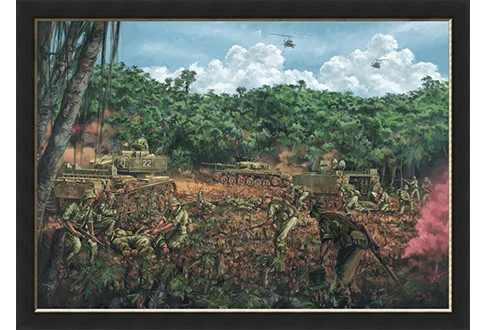

Infantry in contact. Centurion tanks and M113s pressing forward. RAAF Iroquois overhead. A vivid study of the power of Australian combined arms in Vietnam.
Discover the people, events and research behind each commissioned work.
View the original commissioned artwork and, where available, enquire about acquisition.
Discover and purchase rare #1–#10 Archive Editions and historically significant retained pieces.
Explore related Limited Edition lapel pins, medallions and art.
Australian military cooperation in the jungle
For Australian infantry in Vietnam, much of the war was fought on foot: long patrols through jungle, rubber plantations and villages, followed by sudden short-range contacts against an enemy skilled at concealment and ambush. From 1966 the 1st Australian Task Force operated from Nui Dat in Phuoc Tuy Province, using Australian counter-insurgency tactics and supported by armour, artillery, aviation, engineers and logistics.
By 1969 that support had become increasingly powerful. Centurion tanks of the 1st Armoured Regiment had arrived in Vietnam in 1968 and proved their value in terrain where some had doubted heavy armour could operate. M113 armoured personnel carriers of the 3rd Cavalry Regiment gave infantry mobility, protection and fire support, while artillery and RAAF No. 9 Squadron Iroquois helicopters could add further weight to a contact.
Combined Arms Contact Vietnam 1969 is not presented as one named battle. It is a representative engagement created by artist Drew Harrison with military historian Graham Wilson to show how these elements could work together. Infantry of the Royal Australian Regiment fight from the jungle floor while Centurions and an M113 bring direct fire and protection, machine gunners move forward, and RAAF Hueys enter the fight overhead. The painting turns the idea of 'combined arms' into a single, readable scene.
Read the history in more detail
The Australian commitment to South Vietnam began with advisers in 1962 and expanded substantially during the decade. In 1966, 1st Australian Task Force established its base at Nui Dat in Phuoc Tuy Province. Initially built around two infantry battalions, the force later expanded and operated with its own supporting armour, artillery, aviation, engineers and other specialist units.
The Centurion’s arrival in 1968 materially increased the firepower available to Australian infantry. Department of Veterans’ Affairs histories note that tanks became an important support weapon despite the difficult climate, jungle and mine threat. M113 APCs, already serving with Australian forces, provided mobility across varied terrain and could support dismounted troops with their own weapons.
The value of combined arms was demonstrated repeatedly. At Binh Ba in June 1969, for example, Australian infantry, Centurion tanks, M113 APCs, artillery and helicopter support were used in a fierce two-day action. The official Anzac Portal history describes the combined firepower of the armoured vehicles as decisive and records the Centurions as a 'battle winning factor'. Harrison’s painting should not be labelled as Binh Ba, but the battle provides a strong historical example of the kind of mutually supporting action the artwork was commissioned to explain.
Campaign Facts
- 1st Australian Task Force established its base at Nui Dat in Phuoc Tuy Province in 1966.
- Australian infantry spent much of the campaign patrolling and conducting short-range operations against Viet Cong and North Vietnamese forces.
- Australian Centurion tanks arrived in Vietnam in February 1968 and served with the 1st Armoured Regiment.
- M113 armoured personnel carriers served with Australian cavalry units and provided mobility, protection and fire support.
- No. 9 Squadron RAAF operated Iroquois helicopters in Vietnam in support of Australian forces.
- The artwork was commissioned in 2013 from Drew Harrison with military historian Graham Wilson.
- The scene is representative of combined-arms action in 1969; it is not identified by the original collection material as a single named battle.
Read more
Between 1962 and 1973 almost 60,000 Australians served in Vietnam across the Army, Royal Australian Air Force and Royal Australian Navy. The artwork narrows that much larger story to the battlefield relationship between infantry and supporting arms — showing why a contact could change when armour and air support were brought into the fight.
Not one battle but many
Combined Arms Contact was developed specifically to explain the interaction of Australian infantry, armour and air support. Military Shop records that BrandNet engaged Drew Harrison and military historian Graham Wilson in 2013 to create a detailed original artwork showing the difference armour, artillery and air support could make when Australian forces fought as a combined force.
The painting brings together infantry of the Royal Australian Regiment, Centurion tanks of the 1st Armoured Regiment, an M113 armoured personnel carrier of the 3rd Cavalry Regiment and RAAF Iroquois helicopters. The original explanatory text also identifies M60 machine gunners advancing under the protection and fire support of the armoured vehicles.
Read more
These elements are historically consistent with Australian operations in Phuoc Tuy in 1969. DVA records Centurion tanks of B Squadron, 1st Armoured Regiment supporting infantry in dense jungle in April 1969, and M113 APCs of B Squadron, 3rd Cavalry Regiment operating near Binh Ba in June. RAAF Iroquois were also a familiar part of Australian operations. The page should nevertheless describe Harrison’s scene as a representative combined-arms engagement, not attach it to Binh Ba or another specific action unless the original commission records explicitly do so.
Combined Arms Contact Vietnam 1969
In 2013, BrandNet commissioned military artist Drew Harrison and military historian Graham Wilson to create an artwork that could tell a particular story of the Vietnam War: what happened when Australian infantry did not have to fight alone.
The result is deliberately dense with action. Infantrymen are engaged at close range against an enemy fighting from the jungle. Centurion tanks and an M113 press into the contact, adding protection and heavy firepower. M60 gunners move forward. Above them, RAAF Iroquois helicopters extend the action into the air.
Read more

Boots in the bush
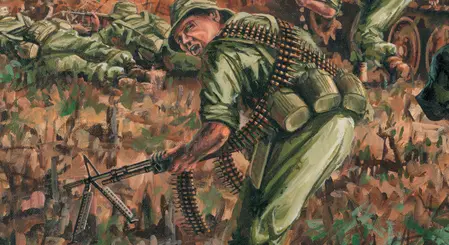
The Royal Australian Regiment infantrymen remain at the centre of the contact, reflecting a campaign in which patrolling and close-range fighting were fundamental to the Australian experience.
Read more
The artwork begins with the vulnerability of soldiers on the ground. Jungle restricts visibility, the enemy is concealed, and the contact is close. This establishes why supporting arms matter: they give the infantry options, protection and firepower that are difficult to generate alone.
Centurion and M113
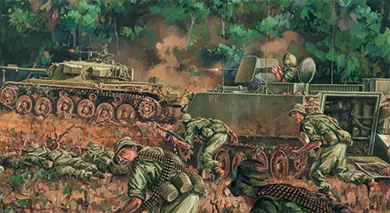
Centurion tanks of the 1st Armoured Regiment and the M113 of the 3rd Cavalry Regiment bring protection, mobility and direct fire into the engagement.
Read more
Australian experience in Vietnam demonstrated that armour could operate effectively even in terrain considered difficult for tanks. Centurions could attack fortified positions and provide close fire support, while M113s moved troops and added their own weapons to the fight.
Support from above
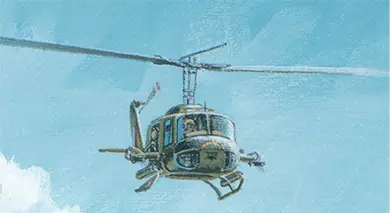
RAAF Iroquois helicopters carry the story into the air, representing the aviation support that became inseparable from the image of the Vietnam War.
Read more
No. 9 Squadron RAAF operated Iroquois helicopters in Vietnam in troop lift, resupply, medical evacuation and other support roles. Their inclusion gives the painting a broader combined-force character and visually links the ground battle to the aviation effort overhead.
Drew Harrison
Drew Harrison is an Adelaide-based Australian artist whose formal training in illustration developed into a broad practice spanning aviation, landscape, wildlife and contemporary narrative art. Acrylic is his preferred medium, allowing him to combine fine detail with strong colour, atmosphere and movement.
His aviation work has received recognition in Royal Australian Air Force Heritage Awards, with works entering the Service’s permanent collection. Harrison later brought that technical discipline into military art, combining meticulous historical detail with a more contemporary sense of composition.
Read more
Combined Arms Contact is particularly suited to Harrison’s strengths. The painting has to explain machinery, weapons, people and tactics without becoming a diagram. His illustrative background helps make each component legible, while colour, movement and overlapping action bind them into one coherent engagement.
Artist's Notes
The commission asked Harrison to show the battle-winning value of combined arms. The resulting work therefore contains multiple stories within the same frame: infantry under pressure, tanks and APCs bringing fire support, machine gunners moving, casualties being treated and helicopters entering the fight.
Read Harrison's full artist's notesDetailed Artwork Description
The jungle creates a compressed battlefield. Infantrymen occupy the foreground, fighting an enemy largely hidden by vegetation. Their proximity to the viewer makes the contact immediate and human.
Behind and around them, the armoured vehicles change the scale of the scene. The Centurion brings the weight of its gun and armour; the M113 adds protected mobility and fire support. The infantry and vehicles overlap visually rather than appearing as separate subjects, reinforcing the central combined-arms idea.
Above, the Iroquois helicopters open the composition and add another dimension to the engagement. The result is not a portrait of one platform or one regiment. It is a portrait of cooperation under fire.
Read more
The painting rewards close inspection because its story is distributed across the canvas. Individual figures and machines can be isolated as episodes, but the intended meaning only becomes complete when the viewer returns to the full image and sees them acting together.
The original Combined Arms Contact Vietnam 1969
The original commissioned acrylic artwork by Drew Harrison is preserved within the BrandNet Archives. It is the unique source work from which the Combined Arms Contact limited-edition prints and associated collector pieces were developed.
Read more
The original is the centre of the collection: the work created by Harrison to bring the infantry, armour and air-support story together before it was translated into limited-edition prints and collectables. Confirm the original’s physical dimensions and framing from the archive record before publication.
Specialist delivery, insurance and installation requirements can be arranged directly with the purchaser.
Acquire the Original Enquire About the ArtworkThe first numbers
Selected early-numbered editions retained from the original release form part of the BrandNet Archives.
Read more
For this collection, the framed print was limited to 250 and the unframed print to 500; the full-size canvas was limited to 100.
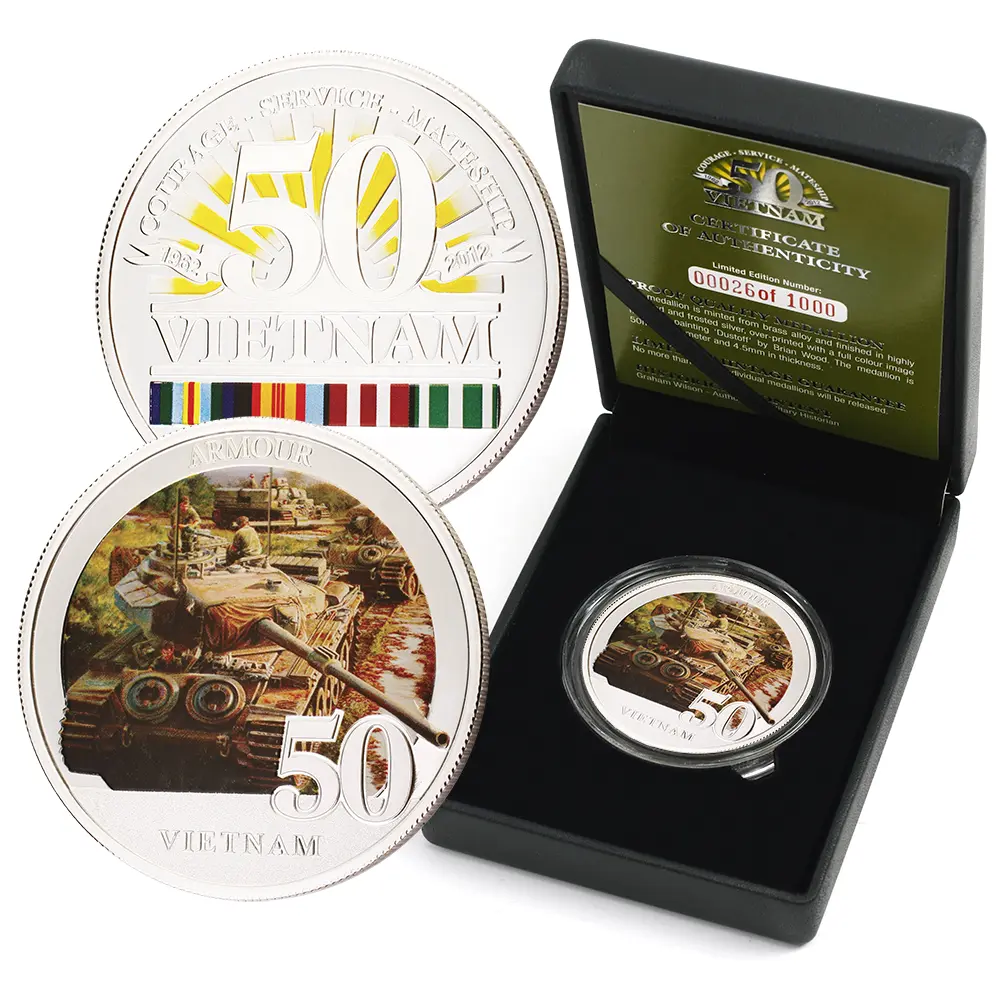
Armour Vietnam 50th Ltd Edition Medallion — Archive Editions #1–#10
Features a photo-quality detailed artwork of 'Centurions in Vietnam' by celebrated Australian artist Barry Spicer, capturing the essence of courage, service, and mateship. BrandNet's retained examples carry certificate numbers #1 through #10.
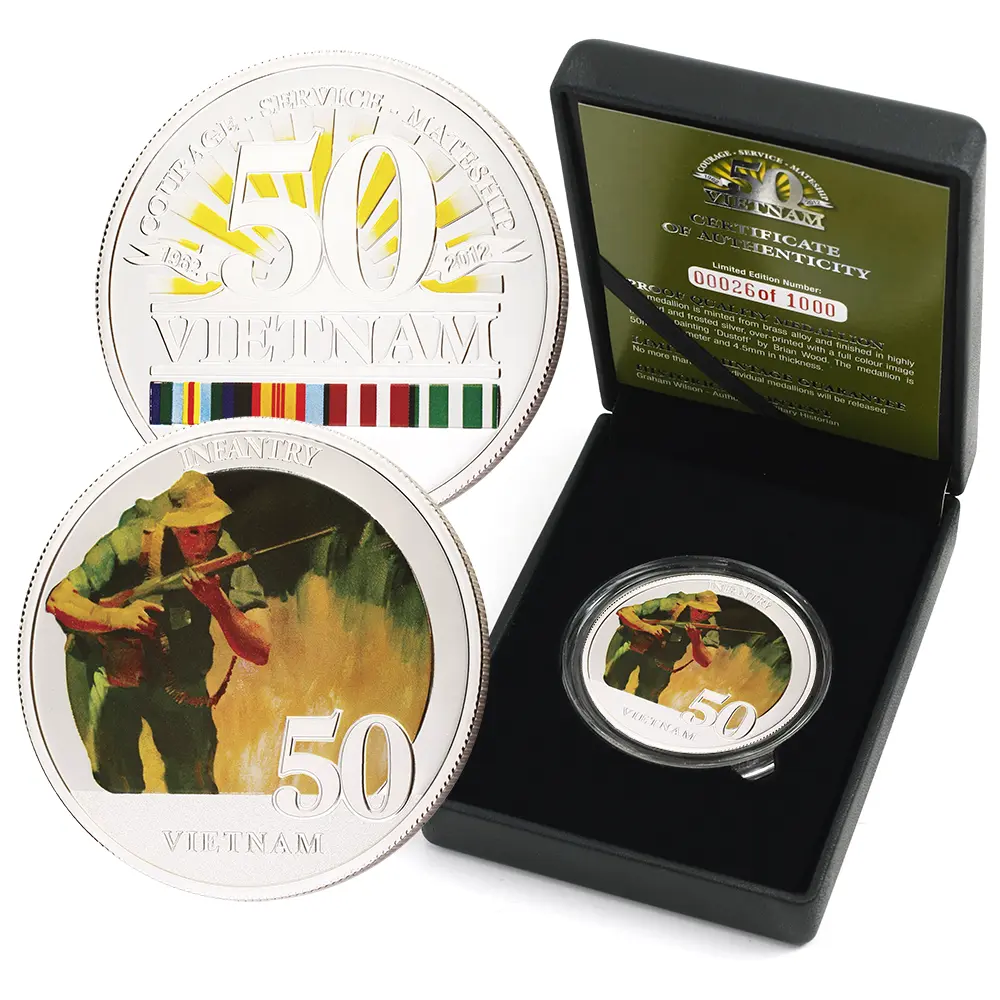
Infantry Vietnam 50th Ltd Edition Medallion — Archive Editions #1–#10
The highlight of this medallion is the photo quality detailed artwork of 'Contact' painted by Ken McFadyen, the official Australian war artist in Vietnam. BrandNet's retained examples carry certificate numbers #1 through #10.
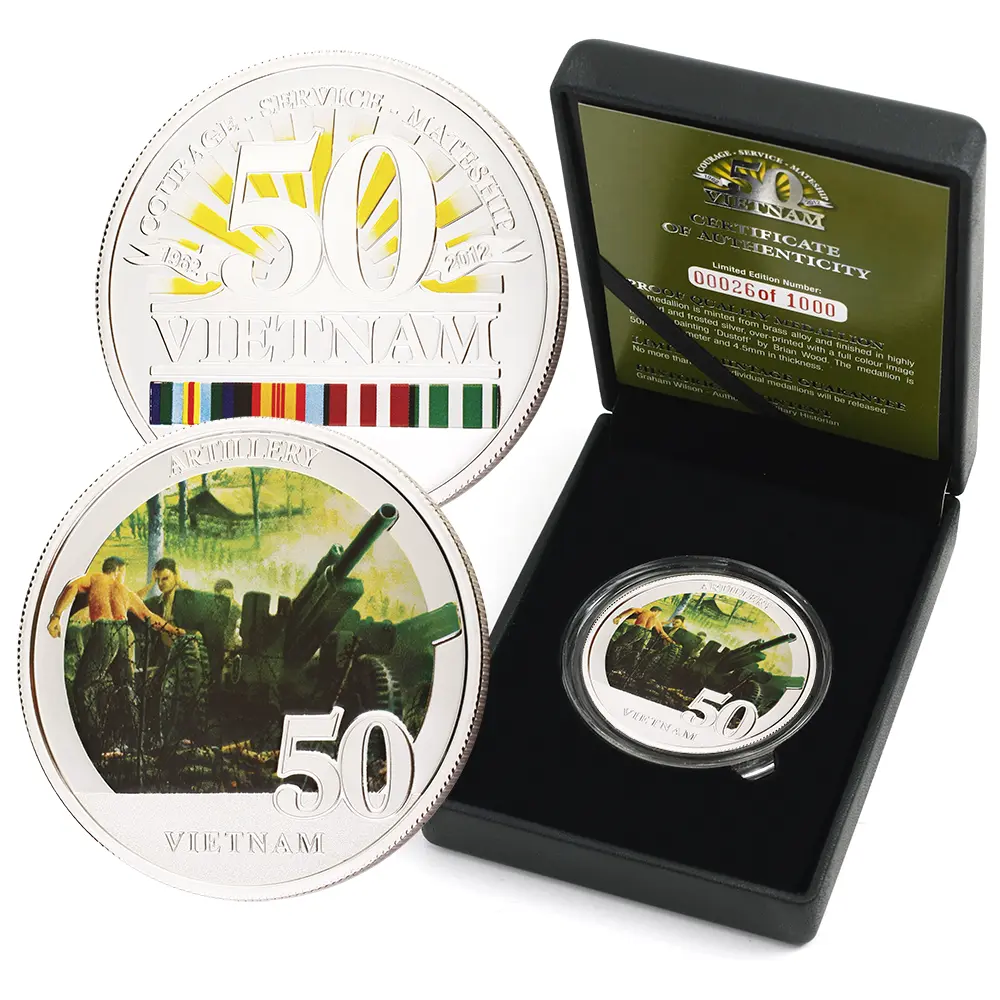
Artillery Vietnam 50th Ltd Edition Medallion — Archive Editions #1–#10
Crafted from a brass alloy and finished in highly polished silver, this medallion showcases photo-quality detailed artwork from 'Task Force Vietnam' by renowned Australian artist Brian Woods. BrandNet's retained examples carry certificate numbers #1 through #10.
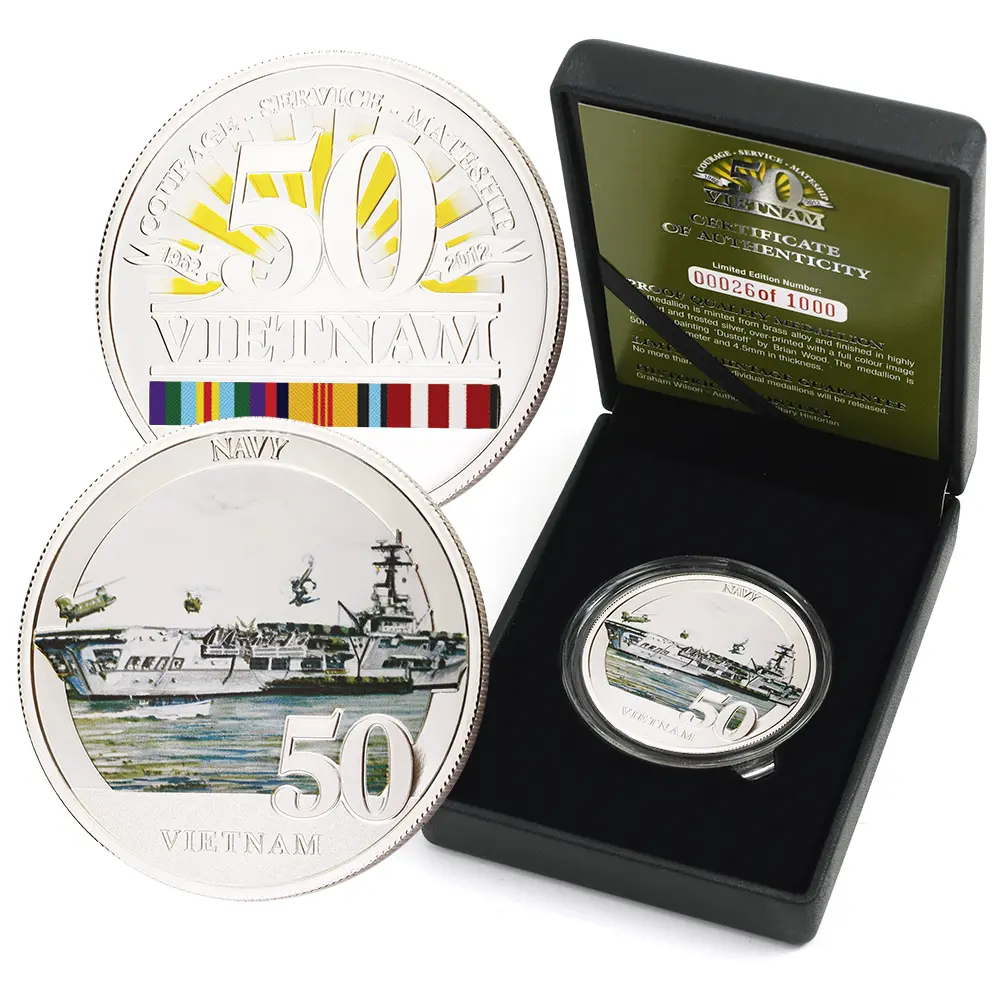
Navy Vietnam 50th Ltd Edition Medallion — Archive Editions #1–#10
This Limited Edition proof quality medallion minted from brass alloy and finished in highly polished silver, features photo quality detailed artwork of 'HMAS Sydney' painted by Peter Blenkinsopp, a celebrated Australian artist. BrandNet's retained examples carry certificate numbers #1 through #10.
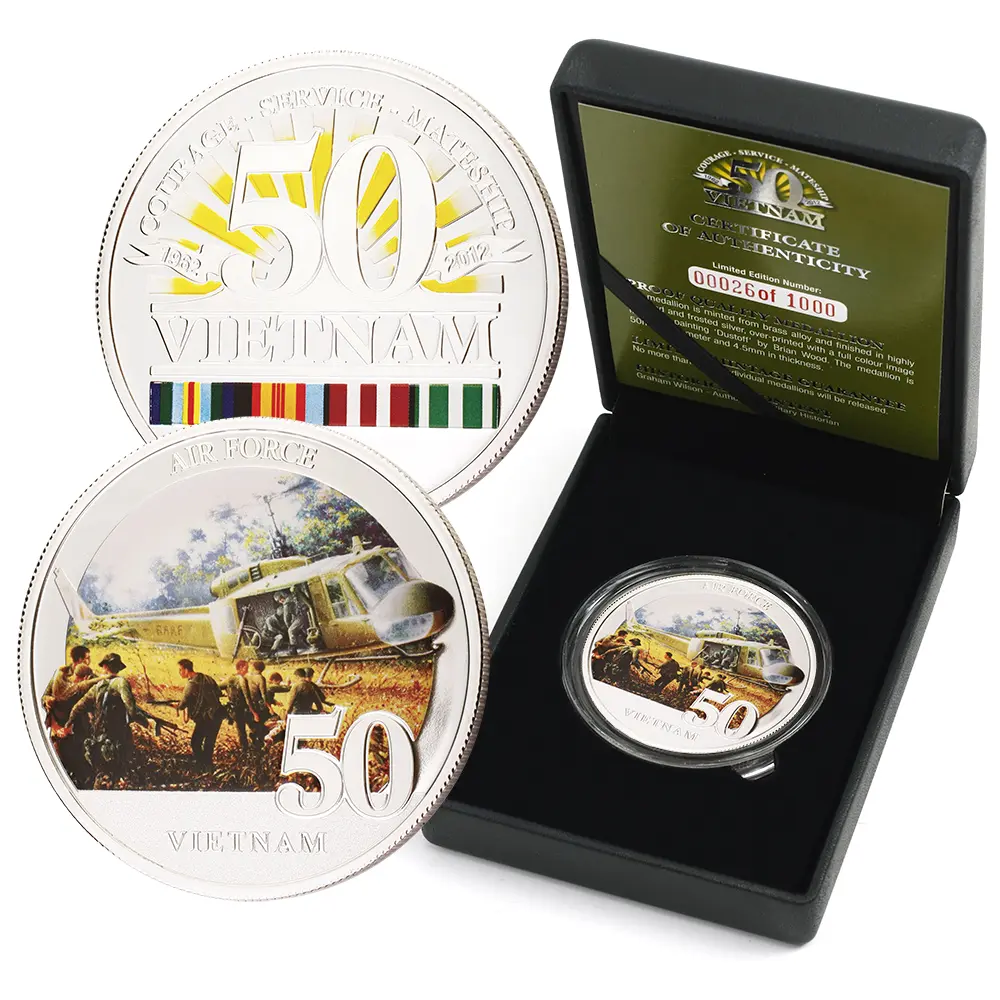
Air Force Vietnam 50th Ltd Edition Medallion — Archive Editions #1–#10
The detailed artwork of 'Dustoff' by celebrated Australian artist Brian Woods showcases the rich history and significance of the Vietnam War on this stunning limited edition medallion. BrandNet's retained examples carry certificate numbers #1 through #10.
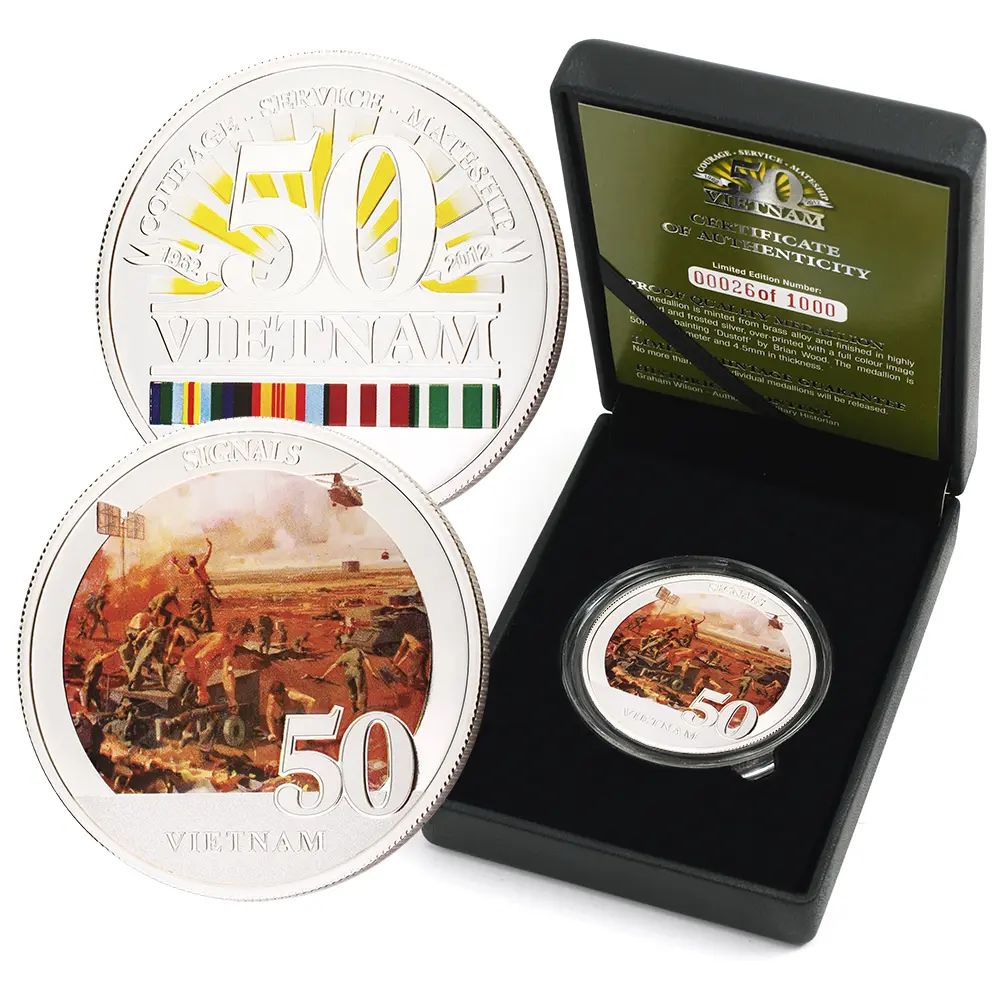
Signals Vietnam 50th Ltd Edition Medallion — Archive Editions #1–#10
The highlight of this medallion is the detailed artwork of 'Signals in Vietnam' painted by Ken McFadyen, the official Australian war artist in Vietnam. BrandNet's retained examples carry certificate numbers #1 through #10.
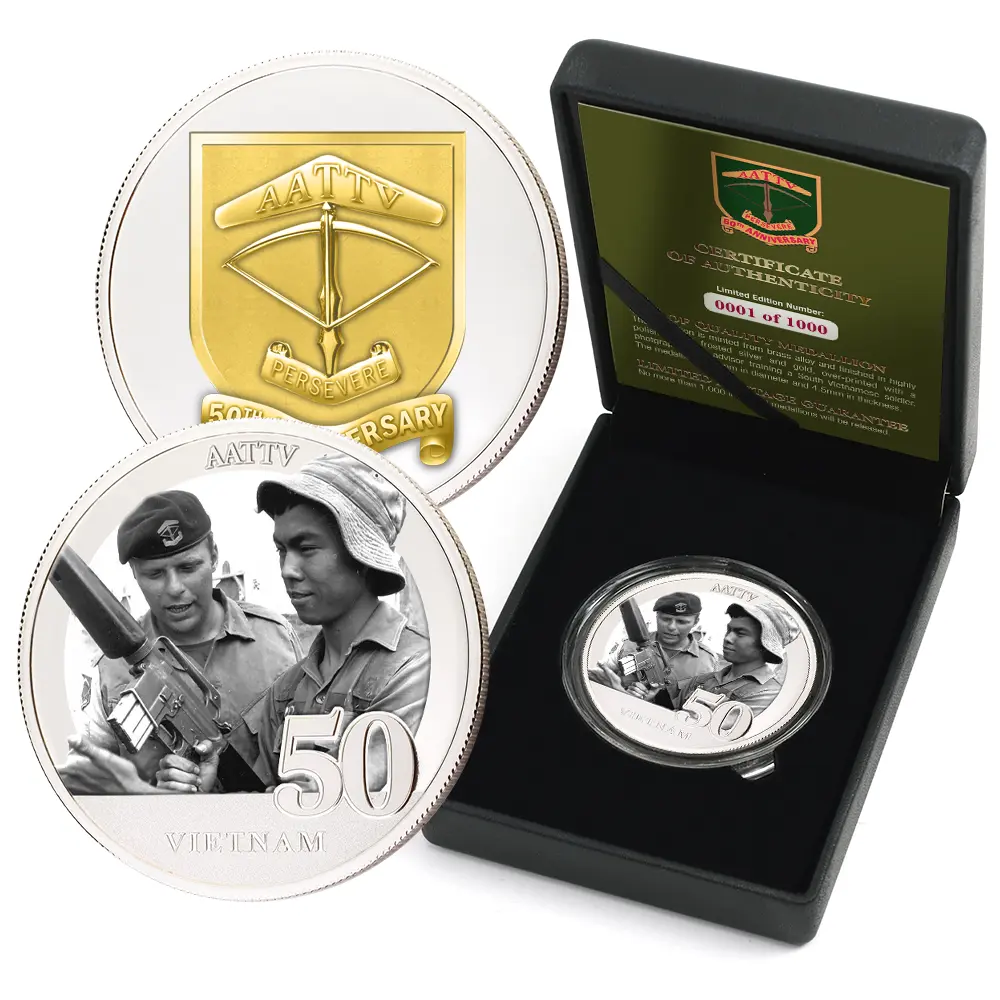
AATTV Vietnam 50th Ltd Edition Medallion — Archive Editions #1–#10
This gold and silver plated proof quality medallion features a photo of an AATTV advisor instructinf a South Vietnamese soldier. BrandNet's retained examples carry certificate numbers #1 through #10.
Own a part of the story
Harrison’s original painting became the foundation for three principal limited-edition artwork formats.
 Click to enlarge
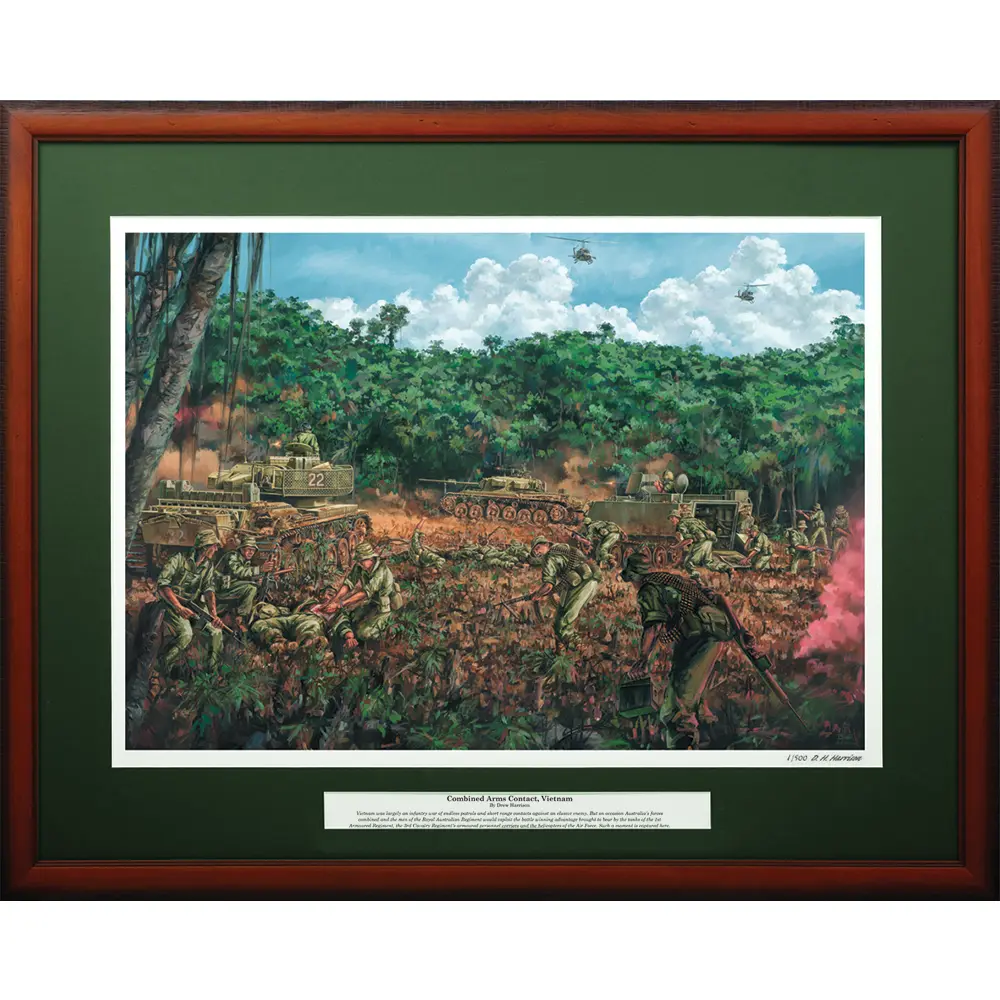
Combined Arms Contact Limited Edition Unframed Print
An archival-quality unframed print, numbered as one of only 500. Recorded size: 610 × 490 mm.
Read more
The unframed edition preserves the complete commissioned image while allowing the collector to select their own framing and presentation.
 Click to enlarge
Combined Arms Contact Limited Edition Framed Print
An archival-quality framed print, hand signed and numbered by Drew Harrison. Limited to 250. Recorded size: 780 × 590 mm.
Read more
The canvas retains the scale and density of Harrison’s original composition, allowing the infantry, armour and helicopters to be read both as individual details and as one combined engagement.
 Click to enlarge
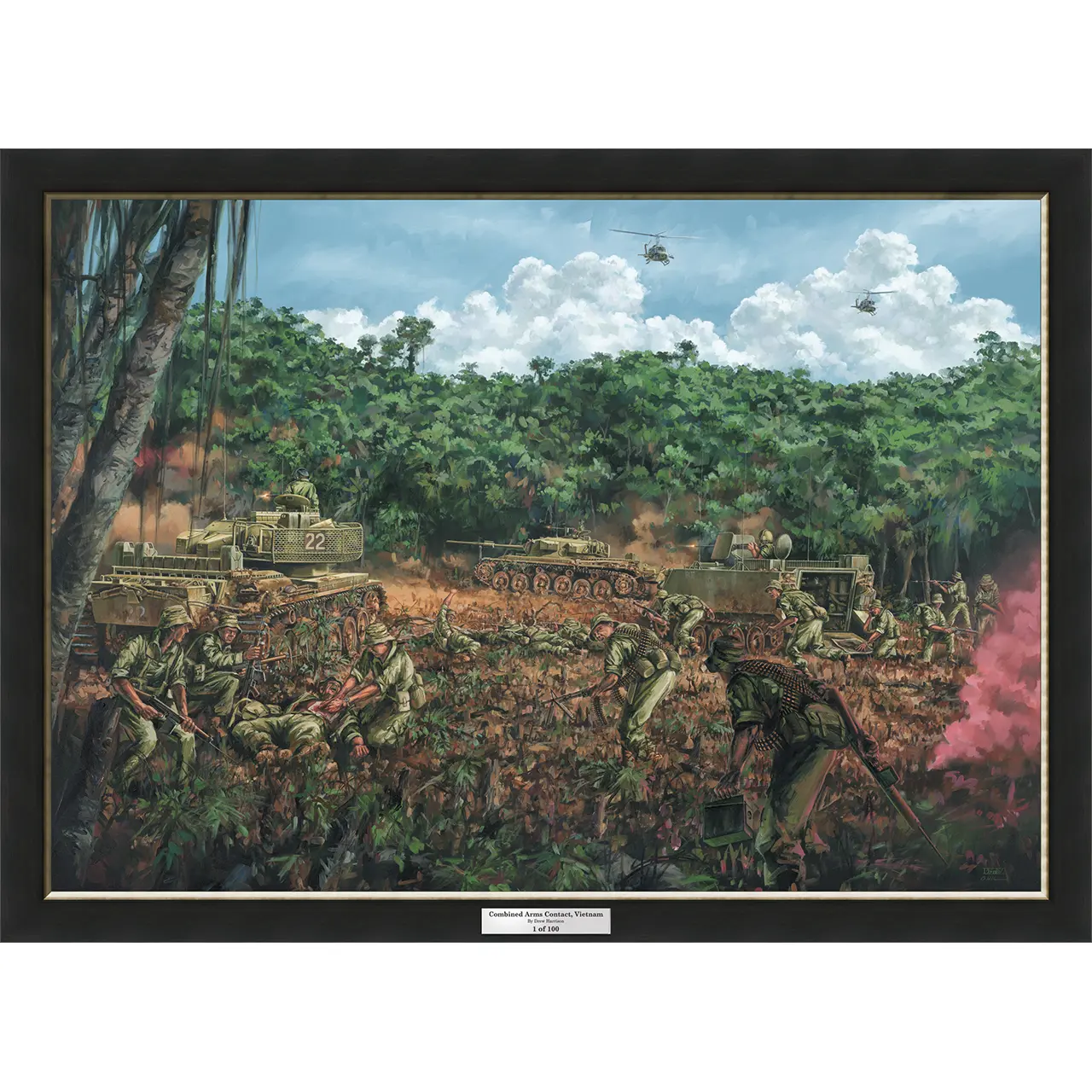
Combined Arms Contact Limited Edition Full Size Canvas Edition
A full-size canvas reproduction housed in a solid timber frame. Limited to only 100. Recorded size: 1545 × 1130 mm.
Read more
The canvas retains the scale and density of Harrison’s original composition, allowing the infantry, armour and helicopters to be read both as individual details and as one combined engagement.
 Click to enlarge
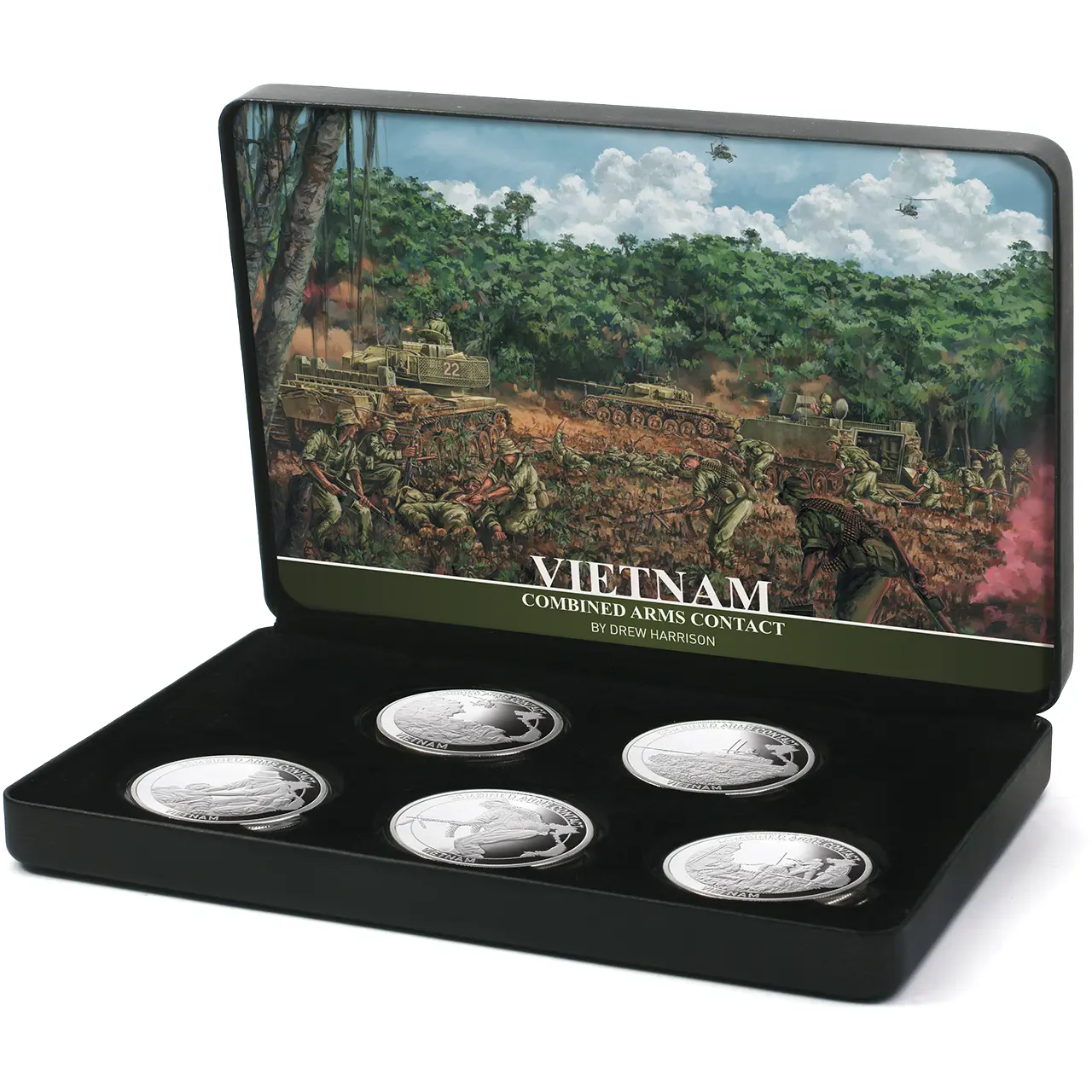
Combined Arms Contact Limited Edition Medallion Set
Elements of the Combined Arms Contact Vietnam 1969 artwork reproduced in proof-quality silver-plated medallions. Featuring 'Pushing Ahead Under Fire', 'Controlling the Fight', 'Saving Life Under Fire', 'Centurion in the Fight', and 'Huey Joins the Fight'
View the set →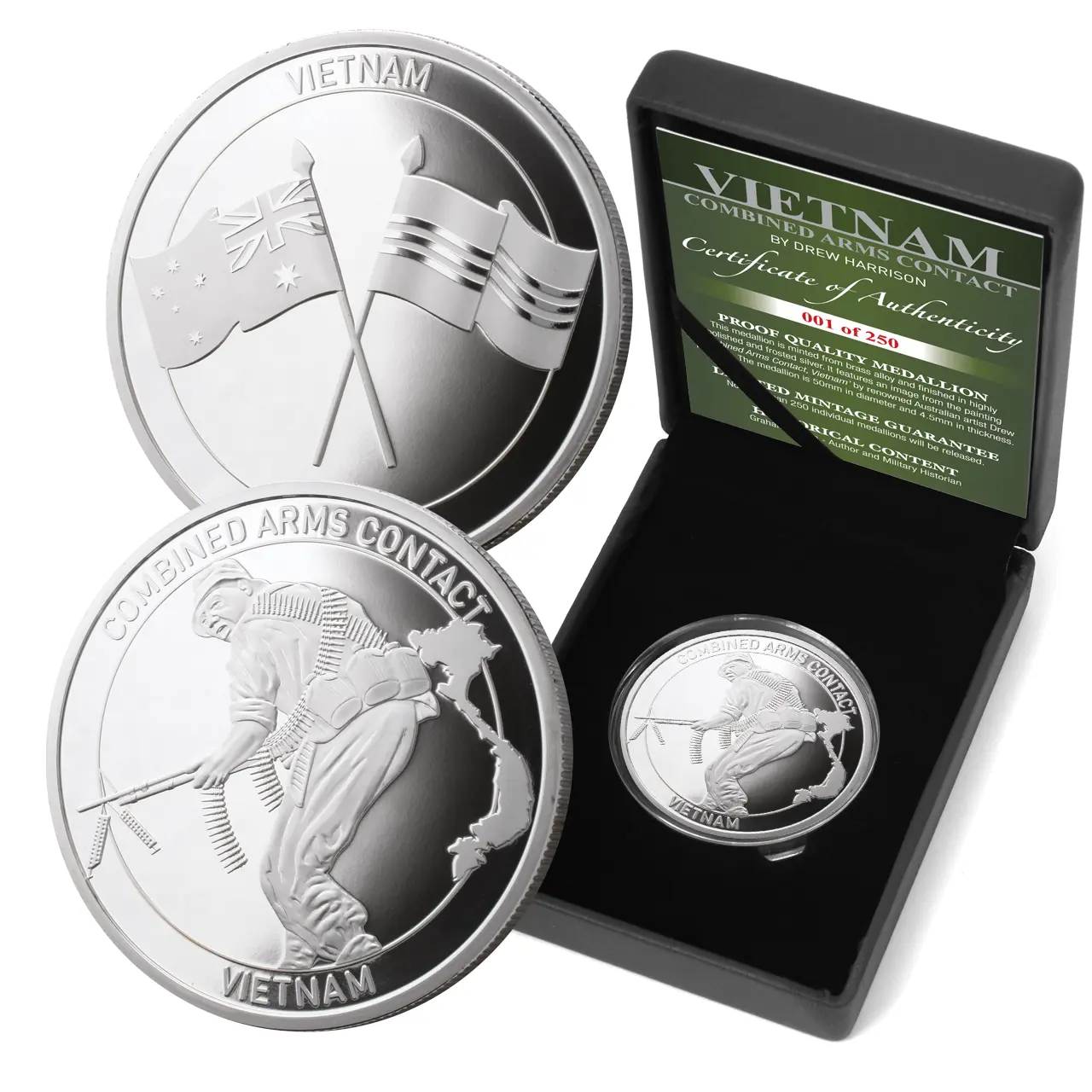 Click to enlarge
Combined Arms Contact Pushing Ahead Under Fire Medallion
The central infantryman of the artwork as he moves towards the enemy.
View the medallion →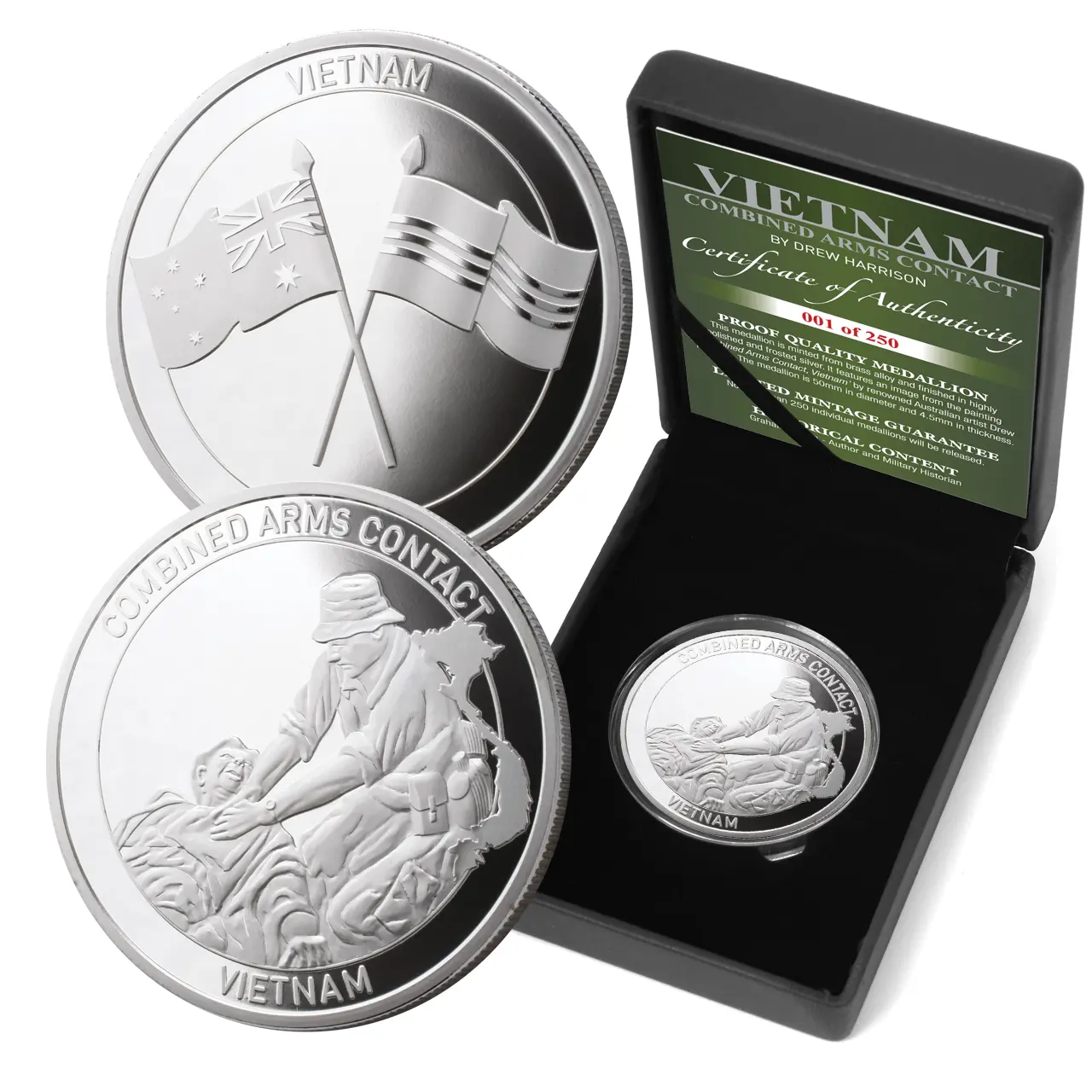 Click to enlarge
Combined Arms Contact Saving Life Under Fire Medallion
A field medic works to save the life of his comrade, all while in danger himself.
View the medallion →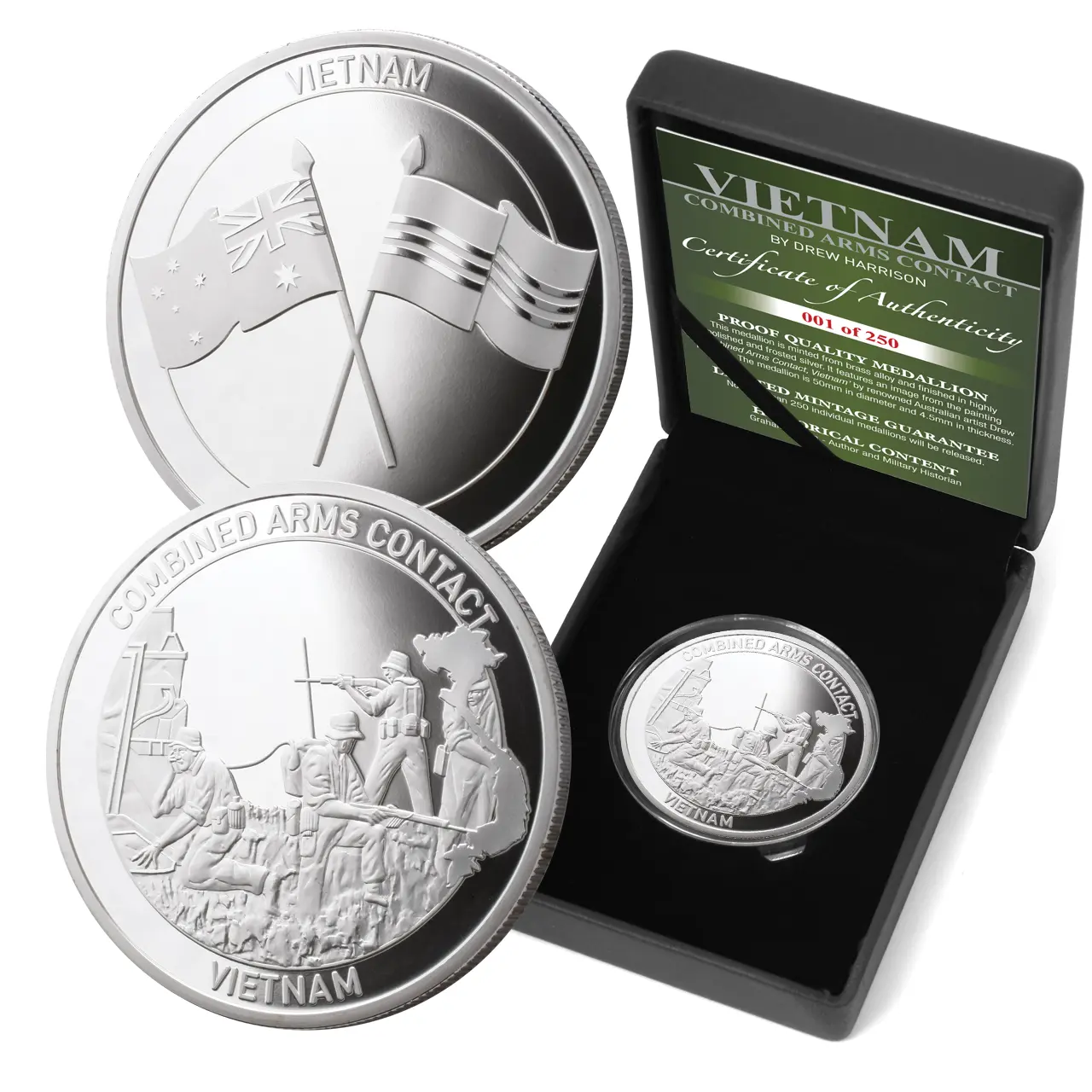 Click to enlarge
Combined Arms Contact Controlling the Fight Medallion
In the midst of battle, the platoon commander works to coordinate the troops at his command.
View the medallion →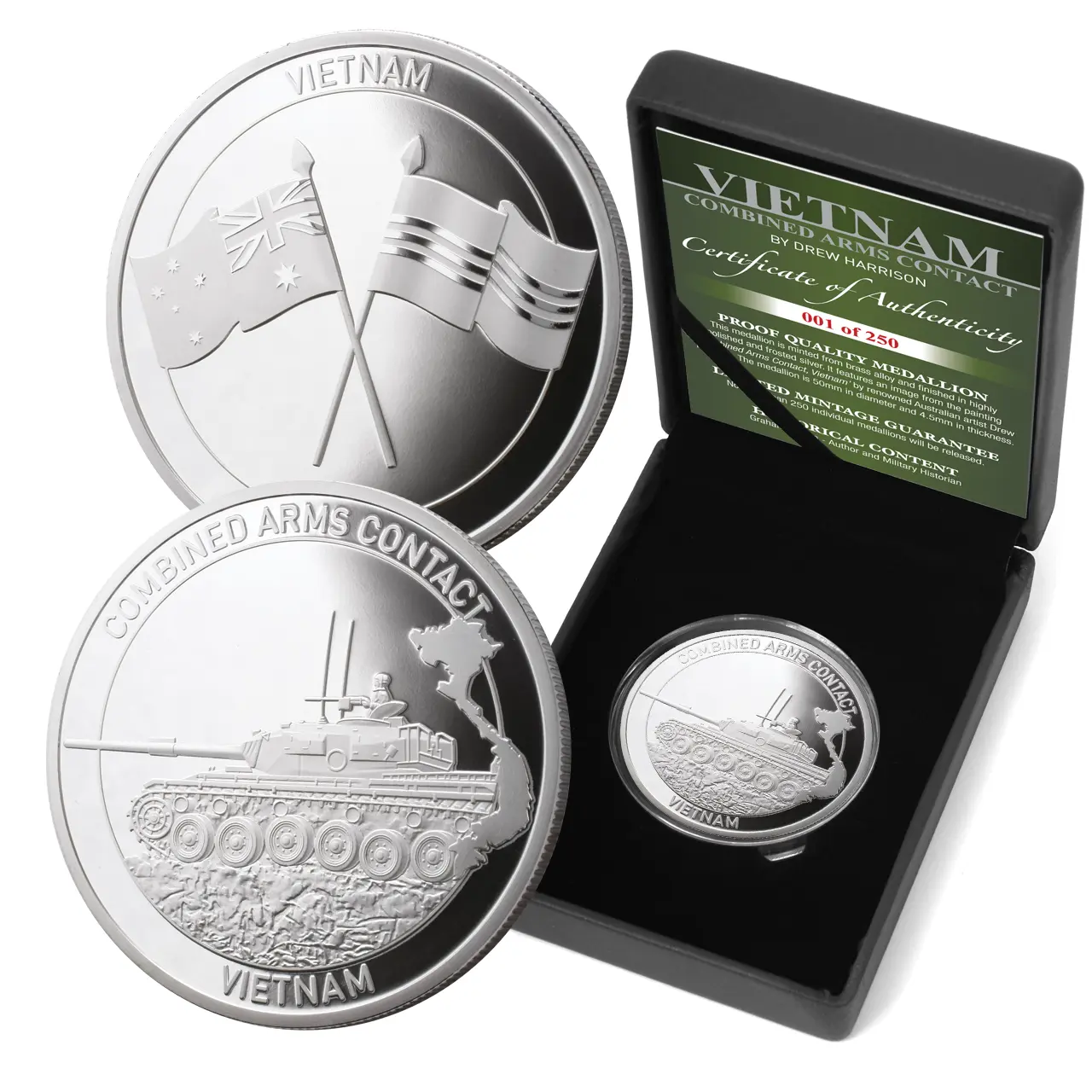 Click to enlarge
Combined Arms Contact Centurion in the Fight Medallion
The might of Australian aromour on full display. Centurions provided troop cover and massive firepower.
View the medallion →Click to enlargeInfantry Vietnam 50th Ltd Edition Medallion
The highlight of this medallion is the photo quality detailed artwork of 'Contact' painted by Ken McFadyen, the official Australian war artist in Vietnam.
View the medallion →Click to enlargeAATTV Vietnam 50th Ltd Edition Medallion
A photo of an Australian advisor training a South Vietnamese soldier finishes this stunning medallion. AATTV - "The Team".
View the medallion →History, artwork and collecting
Explore the military history behind the charge, the choices Drew Harrison and Graham Wilson made in reconstructing the scene, and the Archive and Limited Edition pieces created from the commission.
History
What does 'combined arms' mean?
Combined arms is the coordinated use of different military capabilities so that each supports the others.
Read more
In this painting, infantry, Centurion tanks, an M113 APC and RAAF Iroquois are shown as parts of one engagement. The point is not simply that several types of equipment are present, but that their different strengths can be brought together in the same fight.
Was Vietnam mainly a war of large battles for Australian soldiers?
No. Much of the Australian experience involved patrolling and short-range contacts in difficult terrain.
Read more
Australian battalions spent long periods patrolling Phuoc Tuy, seeking to disrupt Viet Cong movement, bases and support networks. Major actions occurred, but the daily pattern of the campaign was often patrol, ambush, search and sudden contact.
Why was Phuoc Tuy Province important?
It became the principal Australian area of operations after 1st Australian Task Force established Nui Dat in 1966.
Read more
Phuoc Tuy gave the Australian task force its own operational area and allowed it to apply Australian doctrine more independently. Nui Dat became the main task-force base, with logistics support centred on Vung Tau.
When did Australian Centurion tanks arrive in Vietnam?
Elements of the 1st Armoured Regiment arrived with Centurion tanks in February 1968.
Read more
There had been debate over whether heavy tanks were suitable for Vietnam. Operational experience demonstrated their value in supporting infantry and attacking fortified enemy positions, despite jungle, climate, mines and RPG threats.
Is the painting the Battle of Binh Ba?
No. The original collection describes it as a representative combined-arms engagement in 1969, not as Binh Ba.
Read more
Binh Ba is nevertheless a useful historical example of combined arms in action. In June 1969 Australian infantry fought with Centurion tanks, M113 APCs, artillery and helicopter support, and official accounts describe the armour’s firepower as decisive.
The Commission
Why was the artwork commissioned?
Drew Harrison worked with historian and retired Army Warrant Officer Graham Wilson, analysing the battle before deciding how to represent it.
Read more
Military Shop records that Drew Harrison and military historian Graham Wilson were engaged in 2013 to create a detailed original artwork around this idea. The commission was therefore interpretive as well as commemorative.
Which units are represented?
The collection identifies the Royal Australian Regiment, 1st Armoured Regiment, 3rd Cavalry Regiment and RAAF Iroquois.
Read more
Together they allow the painting to represent infantry, tanks, armoured personnel carriers and aviation within one contact. The scene is representative rather than a roll-call of one historically documented battle group.
Why is the enemy difficult to see?
The concealed enemy reflects the close jungle fighting and ambush threat that characterised many Australian contacts.
Read more
The original collection text describes infantrymen fighting an enemy 'from the shadows'. Visually, this places the viewer with the Australian troops and makes the supporting firepower of armour more significant.
Why are the vehicles so prominent?
Because the painting’s central subject is the difference supporting arms can make to infantry in contact.
Read more
The Centurions and M113 are not background decoration. They embody the tactical argument of the commission: armour can provide cover, direct fire and mobility that changes the balance of a close-range engagement.
The Collection
What limited-edition art formats were produced?
The collection includes a full-size canvas, a framed print and an unframed print.
Read more
The full-size canvas was limited to 100, the hand-signed framed print to 250, and the unframed print to 500. Their recorded dimensions are 1545 × 1130 mm, 780 × 590 mm and 610 × 490 mm respectively.
Were other Combined Arms Contact collectables produced?
Yes. The artwork was also used across medallions and other collector products.
Read more
The broader collection included limited-edition medallions and other merchandise derived from details in the painting.
Archive Editions
What makes an early-numbered print different?
It comes from the beginning of a finite numbered edition and has a clearly documented place within the original release.
Read more
The image does not change with the number, but collectors may value the provenance of an early edition. BrandNet’s retained #1–#10 pieces should only be promoted after the physical number and certificate have been verified.
Is the framed print signed?
Yes. The collection page states that the framed print is hand signed and numbered by Drew Harrison.
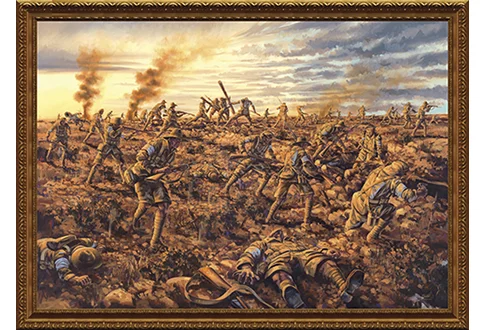
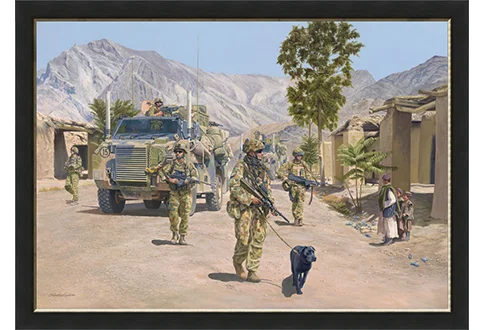
Combined Arms Contact — the Vietnam story in one frame
Combined Arms Contact Vietnam 1969 holds a distinctive place in the BrandNet Archives because its subject is not one aircraft, vehicle, regiment or battle. It is the relationship between them — the way Australian infantry, armour and aviation could combine their strengths in the difficult conditions of Vietnam.
Read more
Preserving Harrison’s original artwork alongside early-numbered editions keeps both parts of the commission together: the historical story the painting was created to explain, and the limited collection through which that story was shared with veterans, families and collectors.
Combined Arms Contact Vietnam 1969
After early discussions with historian and retired Army warrant officer, Graham Wilson, it was agreed the subject of a Vietnam painting should encompass and focus on the varied Australian involvement. Although the conflict is often remembered and represented as a helicopter war, Graham was keen to also emphasise the role of infantry and supporting armour.
While researching from an Australian perspective it became apparent the overall legacy and public perception of the Vietnam War has generally been misrepresented by many films. While the subject and actions depicted in such features may have indeed been a reflection of American strategy it was a roundly different affair for their Australian allies. Often, working in small patrols, the Australian troops employed effective counter-insurgency tactics developed from earlier actions in Malaya and Borneo. These well honed techniques were aimed at confronting and then beating the enemy at their own game. When required, heavy artillery could be called upon either to clear tracts of jungle or support the infantry. The ubiquitous Iroquois helicopter also provided cover from the air or when quick ‘extraction’ from a combat zone was required. These were all facets of the Australian experience and elements worthy of depiction.
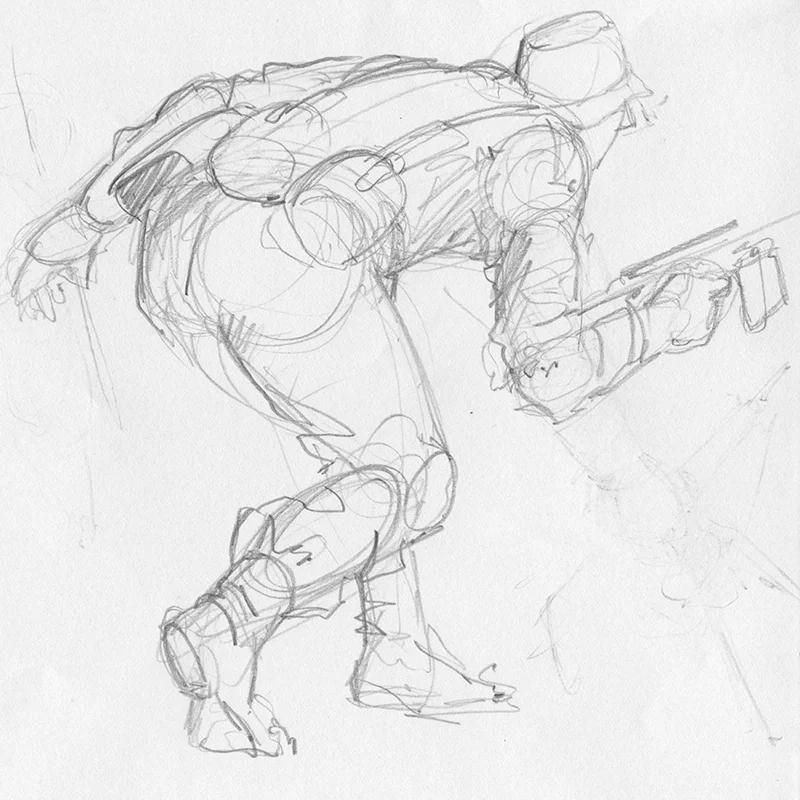
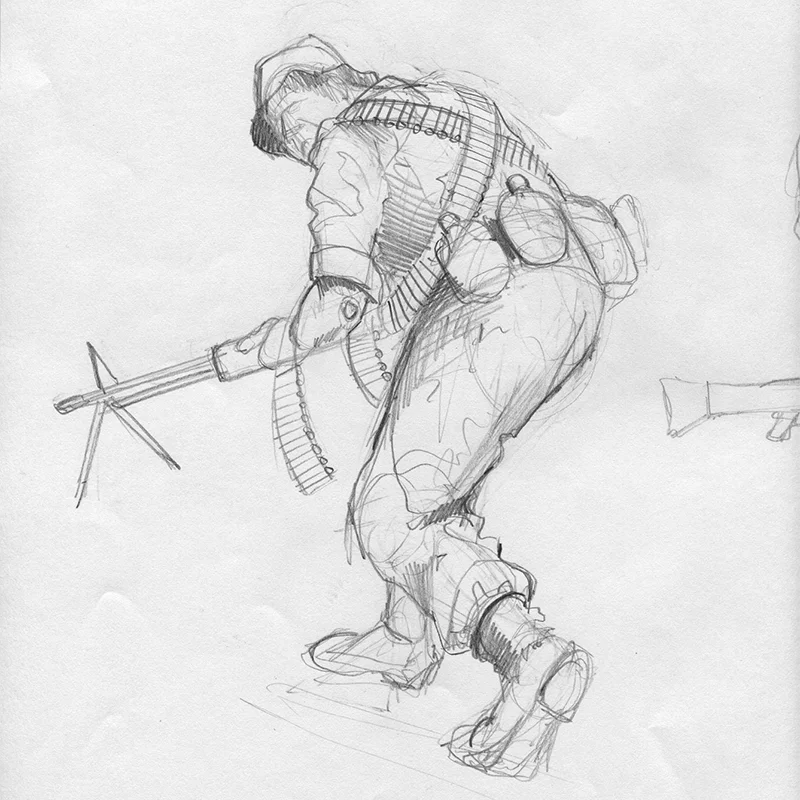
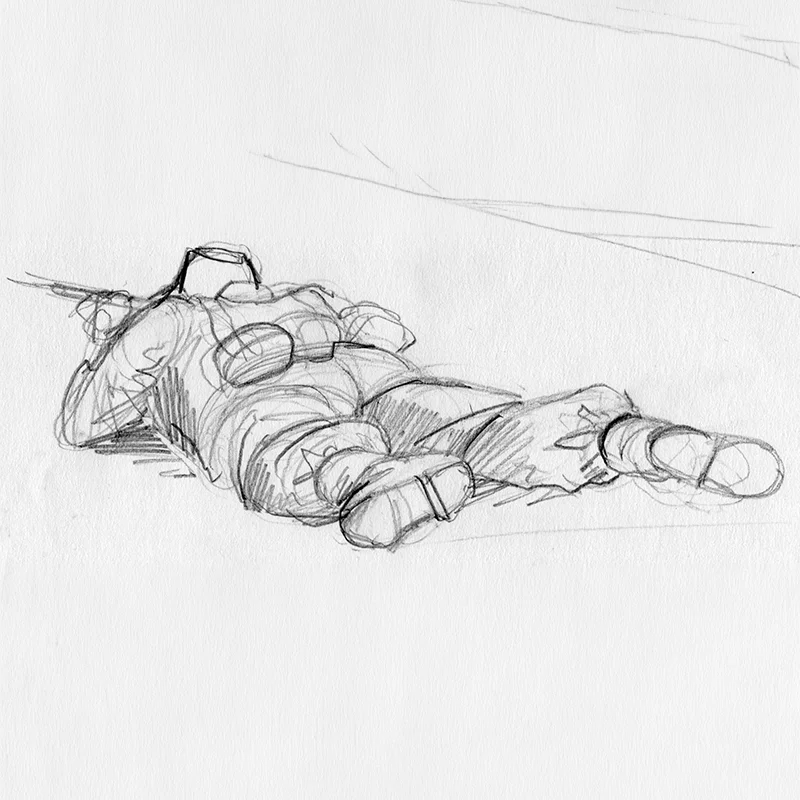
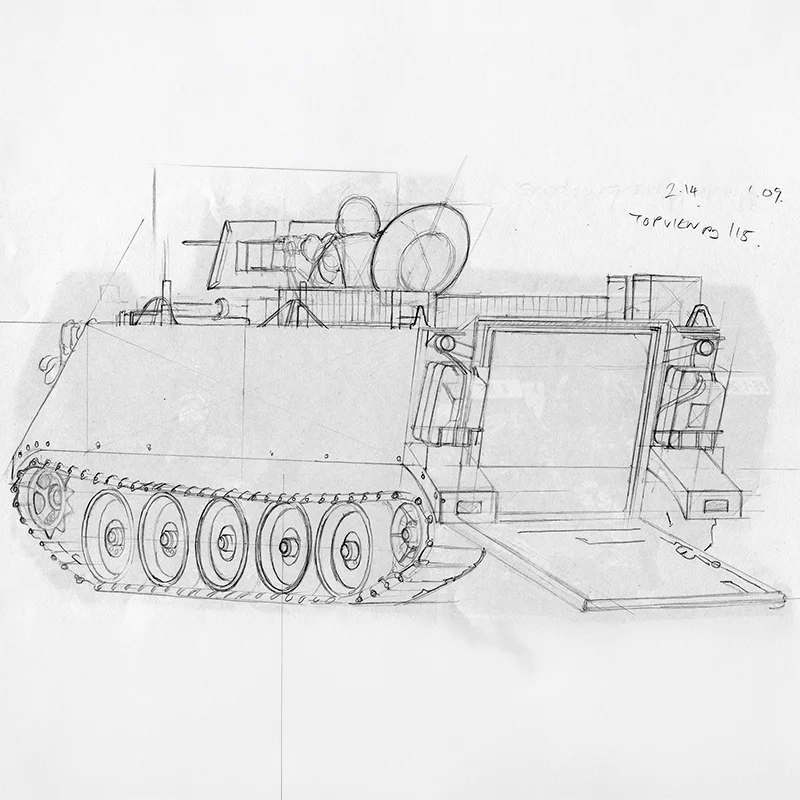
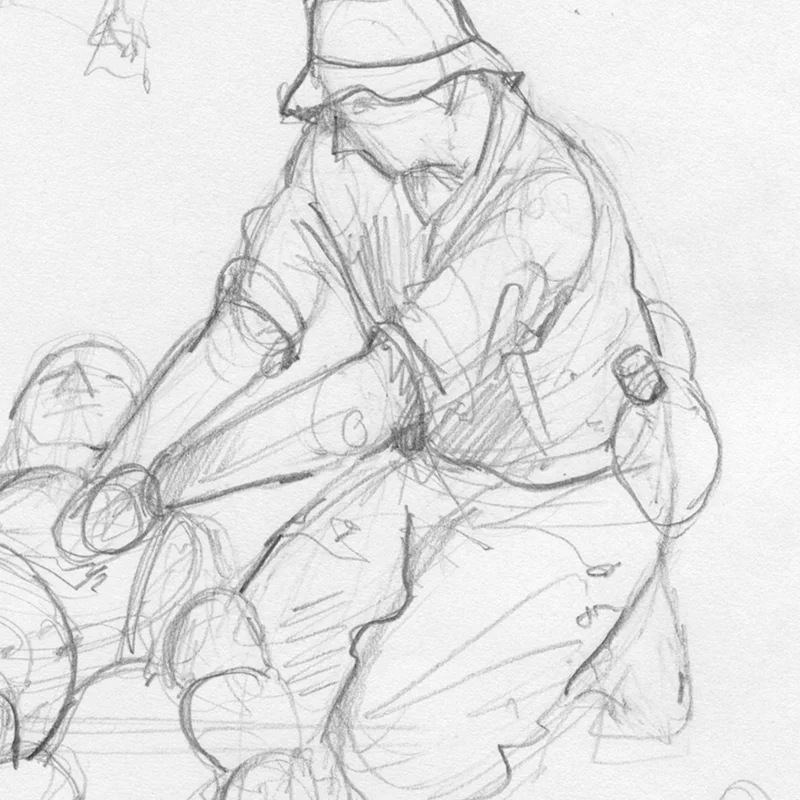
During my research I was directed to a superb photographic book titled ‘Mud and Dust’ by Michael K. Cecil. The title was undoubtedly drawn from an apt quote on the back cover in reference to Vietnam – “It’s the only place in the world where you can be bogged down in mud up to your neck and get dust in your eyes” (Letter from Private Douglas Bishop, AWM PR91/018). Contained within the pages of Cecil’s book are many photos of Australian vehicles and artillery in action. The overriding sense of Vietnamese landscape derived from the book was the ever present mud, dust and impenetrable jungle. Many a picture shows the heavy and powerful mechanized armour bogged down or the tracks completely caked with sludge. It is also interesting to note that the mudguard protectors on both the Australian Centurion tanks and Armoured Personnel Carriers (APC) were quickly removed in the field for this very reason!
It was important to highlight how the average foot soldier fared in these very trying conditions as well as revealing several aspects of combat. Not least of which was the role played by section and platoon commanders and medics in the field. These form part of the vignettes within the middle and foreground. While the big gun Centurion tanks and APC provide some cover for the troops on the battlefield RAAF Iroquois helicopters, including gunship, rush to the jungle clearing to offer support.
I was keen to make the landscape a key and almost overwhelming feature of the painting. From the initial sketches it was my intention to try and immerse the viewer in the scene, almost like peering through the jungle. Once again I drew great inspiration from the work of former war artist Ivor Hele. Through his New Guinea paintings of late WWII he had a knack of twisting and distorting bodies into the landscape so that figures became hard to discern and often seemingly entangled in jungle. In my depiction the ‘eye’ is intended to be drawn into the middle ground where a Centurion tank provides covering fire. From this point other elements of the landscape become recognizable from the injured soldier and medic to ammunition carrier in the foreground shadows.
I approach each painting with a fresh perspective and the colour palette is equally important in setting the tone and feeling of a picture. In many ways a time of day helps to determine the balance of light, shade and atmosphere. Vietnam patrols with mechanized armour were ordinarily during daylight hours. Even so, I was keen to heighten the sense of heat and humidity into the picture and decided to temper ever present levels of cool, daylight green from the jungle, personnel and equipment, with the reddish brown mud and dust. The position of the pink/orange marker was also deliberately considered. Such a vibrant and contrasting colour could be a distraction and was therefore located off centre and to the extreme right. This softens the impact and also links nicely with the intended purpose of incoming helicopters. Similarly this striking colour was an effective counterbalance to green and helped lift the silhouetted foreground information.
In many ways the painting of combat in Vietnam was far removed from my previous depiction of Australian troops at Lone Pine, Gallipoli almost 55 years earlier. Landscape, equipment and tactics all changed during the intervening years, not to mention the additional combined experiences of the Second World War and Korean War, however, these should not diminish the sacrifice and valour displayed by Australian personnel during Vietnam.
Drew Harrison - 2013Drew Harrison
Drew Harrison is a practicing artist based in Adelaide, South Australia. His formal illustrative training has provided a solid background for his evolution into contemporary artist. Acrylic paint is Drew's medium of choice and a material that he has adeptly mastered for creating a wide range of works.
Early projects in the field of illustration included several publications such as the children's book A Horse and More. An interest in flight led to a successful period of detailed aviation painting and regular prizes in the Royal Australian Air Force Heritage Awards. These works have since become part of the Service's permanent collection. With an eye for the vast Australian sky, his observational landscapes of the Adelaide Hills are a continued exploration of light, shade and vivid hues. Similarly, these traits are noticeable in Drew's wildlife paintings whereby the very essence of a subject is often manipulated and twisted to a new level. He has found success in all of these fields as either a prize winner or finalist in national competitions. Public acclaim has also been achieved with people's choice awards and highly commended paintings.
Colour, shape, form and texture remain strong hallmarks of his work, however these elements have recently been coupled with a unique and often satirical conceptualisation of 21st century living. In narrative based, expansive series such as Project Icarus, Chasing American Dreams, and the forthcoming Chaos Theories, darker themes have been explored using contemplative and realist subject matter and drawing on influence from pop art. Central to each work is an examination of humanity although this is often represented subliminally via mechanical and inanimate objects.
The current foray into military art represents a culmination of Drew's varied experience across multiple artistic techniques. On return to the field of fine art he has been able to draw influence from a pedigree of artists within this specialised area. However, there remains a characteristically fresh and unique atmosphere within each painting as well as his meticulous eye for historical detail and accuracy.
Drew has exhibited in several group exhibitions and his paintings are represented in private collections. He is also an experienced art tutor who has gained a reputation for effectively communicating and demonstrating practical art knowledge for many years.