

Black Hawk
Sunset
More than three decades of Australian Black Hawk service — from battlefield air mobility and special operations to peacekeeping, rescue and humanitarian relief.
Discover the people, events and research behind each commissioned work.
View the original commissioned artwork and, where available, enquire about acquisition.
Discover and purchase rare #1–#10 Archive Editions and historically significant retained pieces.
Explore related Limited Edition lapel pins, medallions and art.
Decades of service
The Sikorsky S-70A-9 Black Hawk entered Australian service in the late 1980s to replace the ageing Iroquois as a battlefield utility helicopter. Initially operated by No. 9 Squadron, Royal Australian Air Force, the Black Hawk capability transferred to Australian Army Aviation in 1989, beginning a relationship that would span more than three decades.
Its great strength was versatility. Black Hawks moved soldiers and equipment, supported reconnaissance and special operations, evacuated casualties and carried out search-and-rescue tasks. They also became familiar beyond combat operations, delivering humanitarian assistance and disaster relief when communities in Australia and overseas needed rapid access to places that were difficult to reach.
Australian Black Hawks served on operations across the region and beyond, including Cambodia, Bougainville, East Timor, Fiji, Pakistan and Papua New Guinea. They supported the 5th and 6th Aviation Regiments and specialist counter-terrorism capabilities, while generations of pilots, loadmasters, technicians and support personnel built their working lives around the aircraft.
By the time the S-70A-9 reached the end of Australian service in 2021, the Black Hawk had become one of the defining aircraft of modern Australian Army Aviation. Black Hawk Sunset was created to commemorate that service — not simply the helicopter, but the people, units, operations and losses bound to its story.
Read the history in more detail
Australia accepted its first S-70A-9 Black Hawks in 1987, with No. 9 Squadron RAAF introducing the type before battlefield helicopter responsibility transferred to Army. The aircraft’s core role was air mobility: getting troops, equipment and supplies where they were needed, often quickly and into difficult or insecure locations. Its utility also extended to reconnaissance, casualty evacuation, aerial support, rappelling, fast roping and external-load work.
The fleet accumulated a broad operational history. Australian War Memorial records show Army Black Hawks supporting United Nations electoral operations in Cambodia in 1993. Later deployments included Bougainville, INTERFET and subsequent operations in East Timor, Fiji, humanitarian assistance in Pakistan and Papua New Guinea, and extensive domestic support. In these roles the same aircraft type could move soldiers one day and deliver aid or rescue civilians on another.
That history also carried loss. The 1996 Black Hawk collision near Townsville killed 18 Australian servicemen — three from the 5th Aviation Regiment and fifteen from the Special Air Service Regiment. Other aircraft were lost in training accidents and on operations, including A25-221 during Operation Quickstep off Fiji in 2006. The end-of-service story therefore carries both achievement and remembrance. The Australian War Memorial now preserves A25-112 ‘Saracen’, itself a veteran of numerous peacekeeping and humanitarian missions, as part of the national collection.
Black Hawk Facts
- The S-70A-9 Black Hawk entered Australian military service in the late 1980s.
- No. 9 Squadron RAAF introduced the aircraft before battlefield helicopter responsibility transferred to the Australian Army in 1989.
- Black Hawks served principally with the 5th and 6th Aviation Regiments and also supported specialist counter-terrorism capabilities.
- Roles included troop and equipment transport, reconnaissance, casualty evacuation, search and rescue, humanitarian assistance and disaster relief.
- Australian Black Hawks deployed on peacekeeping and operational tasks in Cambodia, Bougainville, East Timor and Fiji.
- They also supported humanitarian missions including Pakistan and Papua New Guinea and disaster-response tasks within Australia.
- The Australian S-70A-9 era concluded in 2021.
- Black Hawk Sunset was created by Drew Harrison in 2021 as an end-of-service tribute.
Read more
The Black Hawk’s history cannot be reduced to one operation or one unit. Its significance comes from repeated use across very different missions — conventional troop movement, special operations support, peacekeeping, humanitarian aid, disaster response and training — and from the aircrew and ground personnel who kept the capability operating across more than three decades.
The Black Hawk story
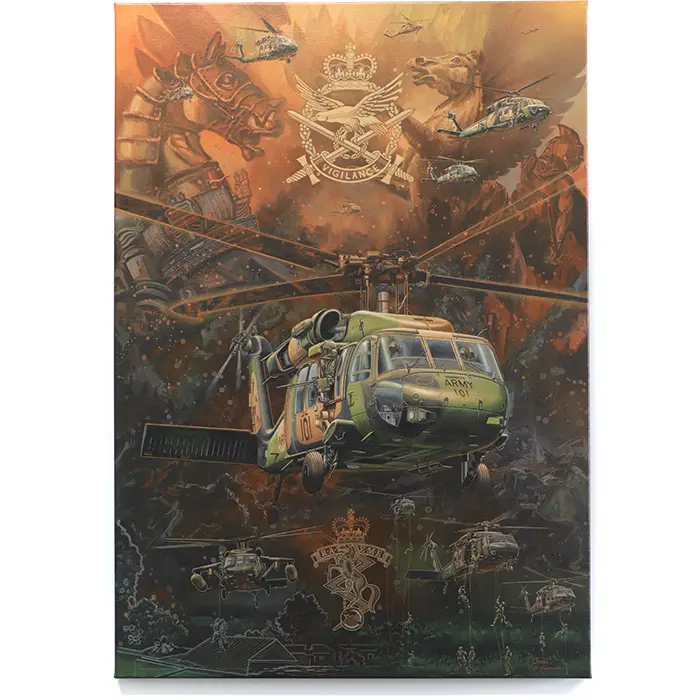
Black Hawk Sunset is a commemorative composite rather than a depiction of one moment in time. Drew Harrison deliberately brought together aircraft, unit heraldry and operational scenes from across the S-70A-9’s Australian service between 1987 and 2021.
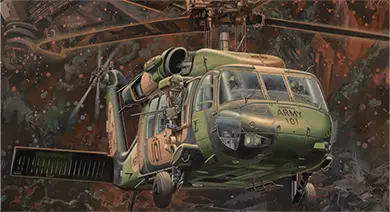
The central aircraft is A25-101 ‘Pegasus’, the first Australian S-70A-9 delivered to No. 9 Squadron RAAF in December 1987. It later served with both the 5th and 6th Aviation Regiments and participated in the RAAF Centenary Flypast in March 2021. Around it Harrison placed other significant airframes and the heraldry of the organisations connected to the Black Hawk story.
Read more
The upper composition includes A25-221, lost during Operation Quickstep in Fiji in 2006; A25-217, lost in a training accident near Oakey in 1992; and A25-110 ‘Armageddon’, preserved at the Army Aviation Museum at Oakey. The lower section includes A25-220 in a Queensland flood-rescue scene and pays tribute to A25-113 and A25-209, lost in the 1996 Townsville collision, as well as A25-216, lost in a 2004 training accident near RAAF Amberley. Harrison also varied equipment between aircraft to reflect changes and modifications across the 1987–2021 service period.
Black Hawk Sunset
Black Hawk Sunset began as an end-of-service commission, but Drew Harrison moved away from the idea of a conventional aviation painting. Instead of placing one helicopter in a realistic landscape, he built a layered portrait of the entire Australian Black Hawk story.
At its centre is A25-101 ‘Pegasus’. Around it sit the heraldic symbols of the 5th and 6th Aviation Regiments, No. 9 Squadron RAAF and Australian Army Aviation. Below, operational scenes move from flood rescue to tactical rappelling, while individual aircraft commemorate important moments, surviving airframes and losses.
Read more
Harrison’s solution allowed one artwork to carry several narratives at once: the aircraft as a machine, the units that operated it, the people who maintained it, the missions it performed and the personnel lost during its service. The portrait format was also designed so parts of the work could stand independently when adapted to wider-format products, while the complete painting remained visually coherent.

The first Australian Black Hawk
The central aircraft is A25-101, the first Australian S-70A-9 delivered to No. 9 Squadron RAAF in December 1987 and an aircraft that later served with both major Army Aviation regiments.
Read more
Its name, ‘Pegasus’, creates a natural connection to the 5th Aviation Regiment’s heraldry above the cockpit. Harrison also noted that A25-101 participated in the RAAF Centenary Flypast in March 2021, giving the aircraft a direct link between the beginning and closing years of the Australian Black Hawk story.
Bold, Valour and Aviation heritage
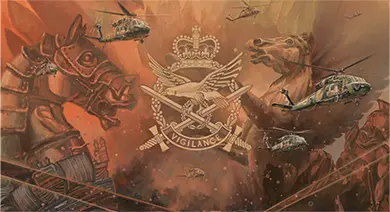
The upper section draws together the armoured horse of the 6th Aviation Regiment, the Pegasus and warrior of the 5th Aviation Regiment and the Australian Army Aviation badge.
Read more
The 5th Aviation Regiment carries the motto ‘Bold’ and uses Pegasus imagery; the 6th Aviation Regiment’s ‘Valour’ identity incorporates an armoured horse. Harrison also worked a Naval Crown into the composition as a reference to No. 9 Squadron RAAF, which introduced the Black Hawk before the capability transferred to Army.
The lower vignettes
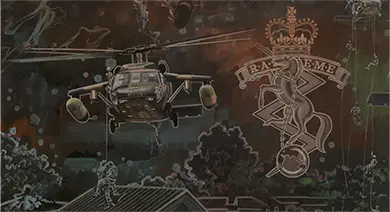
The lower section shifts from heraldry to people and operations: flood rescue, tactical insertion, the RAEME crest and aircraft associated with significant accidents and loss.
Read more
Harrison placed these scenes around the Royal Australian Electrical and Mechanical Engineers crest to recognise the ground crews and maintainers who kept the aircraft flying. The section also carries a quieter memorial role through the inclusion of airframes connected with the Townsville collision and other losses.
Drew Harrison
Drew Harrison is an Australian aviation and military artist whose work combines technical accuracy with a strong contemporary visual language. His earlier practice focused heavily on fixed-wing aviation, so the Black Hawk commission required him to immerse himself in Army Aviation history, unit heraldry, individual airframes and the operational life of a rotary-wing aircraft.
Rather than follow the conventions of traditional aviation art, Harrison drew on graphic novels, movie posters, fantasy imagery and religious art to create a portrait with heightened drama. The result is intentionally layered and symbolic while remaining grounded in identifiable aircraft and historical detail.
Read more
Harrison’s research extended beyond the helicopter itself. The heraldry of 5th and 6th Aviation Regiments became central to the concept, as did the transition from No. 9 Squadron RAAF to Army Aviation, the contribution of RAEME personnel and the histories of specific airframes. This allowed the final work to operate both as an aviation image and as a broader tribute to the Black Hawk community.
Artist's Notes
Harrison’s first concepts were more traditional aviation scenes, but the project changed direction as he studied the heraldry of the units that had operated the Black Hawk. The imagery of Pegasus, the armoured horse and the Army Aviation crest suggested a more symbolic composition.
The painting evolved from landscape to portrait format. Harrison then designed the composition so the complete work could also be divided into three wider sections for use across the commemorative collection.
Read More
The palette comes from the Black Hawk itself: tan, green and black pushed into warmer oranges, reds and cooler green-blue tones. Harrison manipulated light and shade more freely than he would in a realist aviation painting, using a light source from the top of the composition to draw the aircraft upward and reinforce the sense of an era reaching its conclusion.
Detailed Artwork Description
At the centre, A25-101 dominates the composition. The aircraft rises vertically through the image, its rotor visually echoing the crossed swords of the Australian Army Aviation crest. Above and around it, the Pegasus and armoured horse frame the Black Hawk within the identities of the 5th and 6th Aviation Regiments.
Other airframes sit higher in the composition as individual points in the fleet’s history. The lower third changes visual language: realistic helicopter forms merge with looser, semi-monochromatic scenes of rescue and tactical operations, all grouped around the RAEME crest.
Cloud-like forms, splattered paint and overlapping layers suggest rotor wash, dust and movement. The imagery becomes less literal toward the edges, allowing the central aircraft to retain its authority while the surrounding scenes read almost as memories.
Read more
Harrison described taking deliberate liberties with lighting to shift focal points and create a heightened sense of drama. The result is neither a conventional squadron portrait nor a single operational scene. It is a visual archive — aircraft, heraldry, rescue, tactical operations, maintenance and remembrance compressed into one contemporary end-of-service work.
The original Black Hawk Sunset
The original Black Hawk Sunset by Drew Harrison is preserved within the BrandNet Archives. Created in 2021 for the S-70A-9 End of Service project, it is the unique source artwork from which the limited-edition Black Hawk Sunset collection was developed.
Read more
The original carries the complete layered composition before it was translated into paper, canvas, aluminium and other collector formats. Its importance lies not only in being Harrison’s source work, but in the depth of research embedded within it — individual airframes, unit heraldry, operational scenes and memorial references spanning the Black Hawk’s Australian service.
Specialist delivery, insurance and installation requirements can be arranged directly with the purchaser.
Acquire the Original Enquire About the Artwork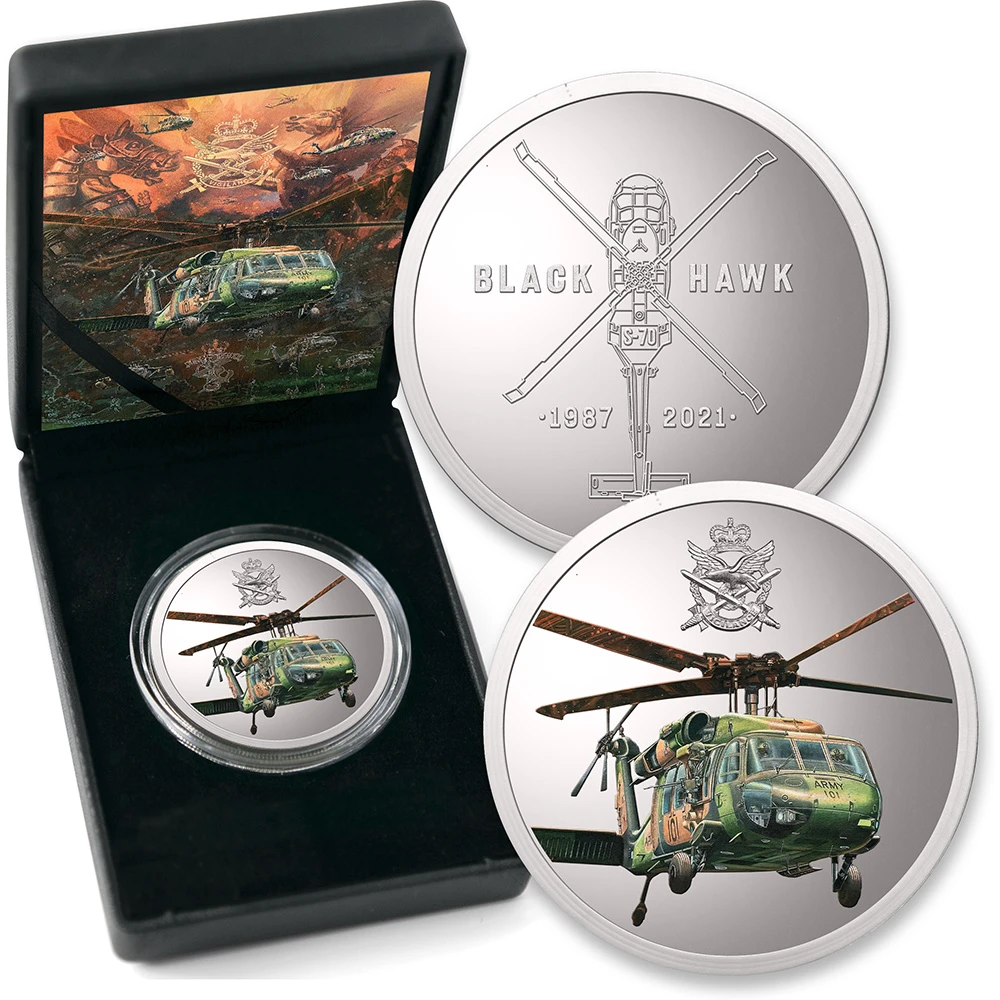
Own a part of the story
Black Hawk Sunset was adapted into several limited-edition art formats including limited edition prints, medallions, coffee mugs, and drink coolers.
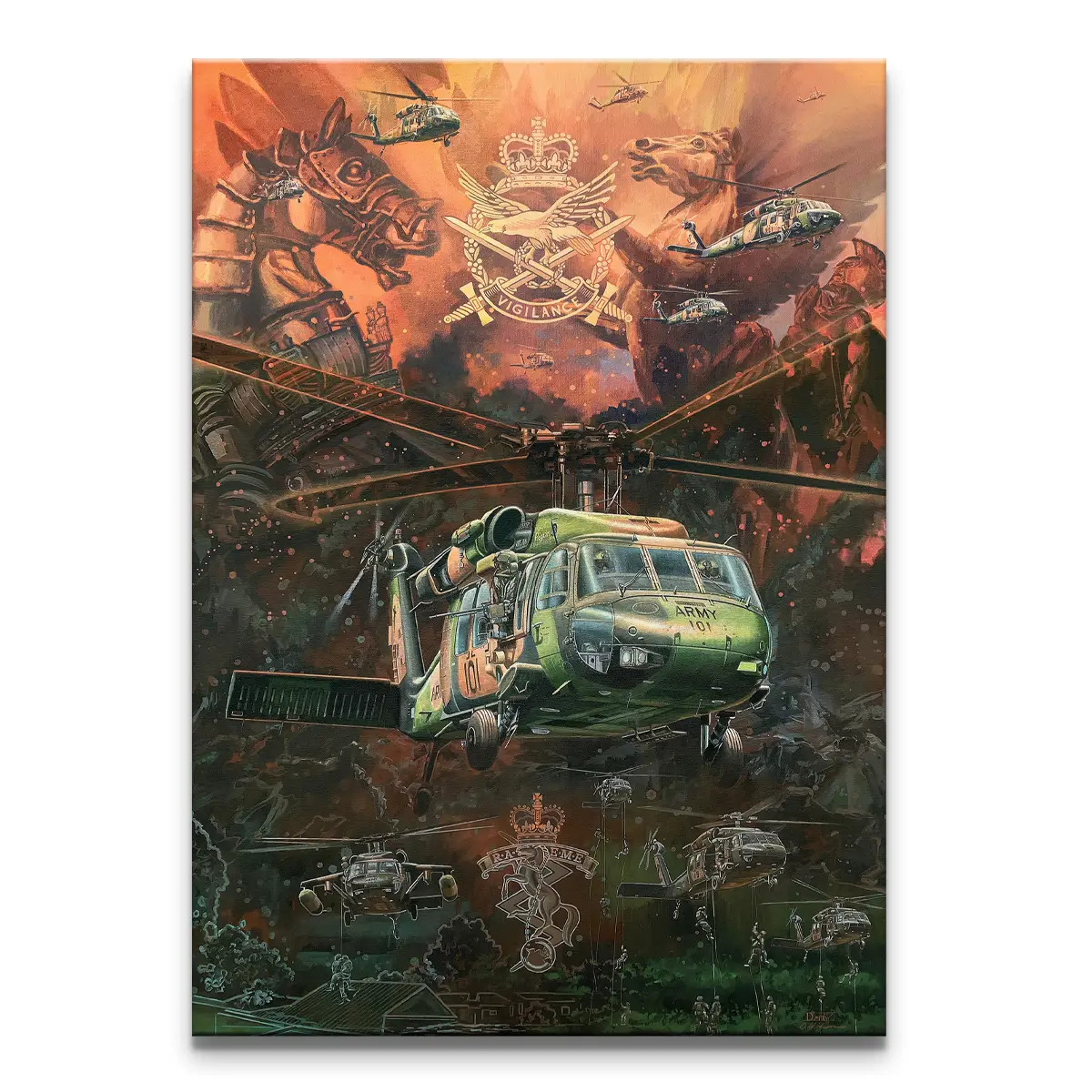 Click to enlarge
Black Hawk Sunset Limited Edition Canvas Print - 700 x 1000 mmm
Printed on Hahnemühle Daguerre Canvas with pigment inks and fade-tested for more than 75 years.
Read more
The largest current reproduction gives Harrison’s layered portrait the space it needs. Individual aircraft, heraldry and lower operational scenes remain legible while the complete composition retains the imposing vertical character of the original.
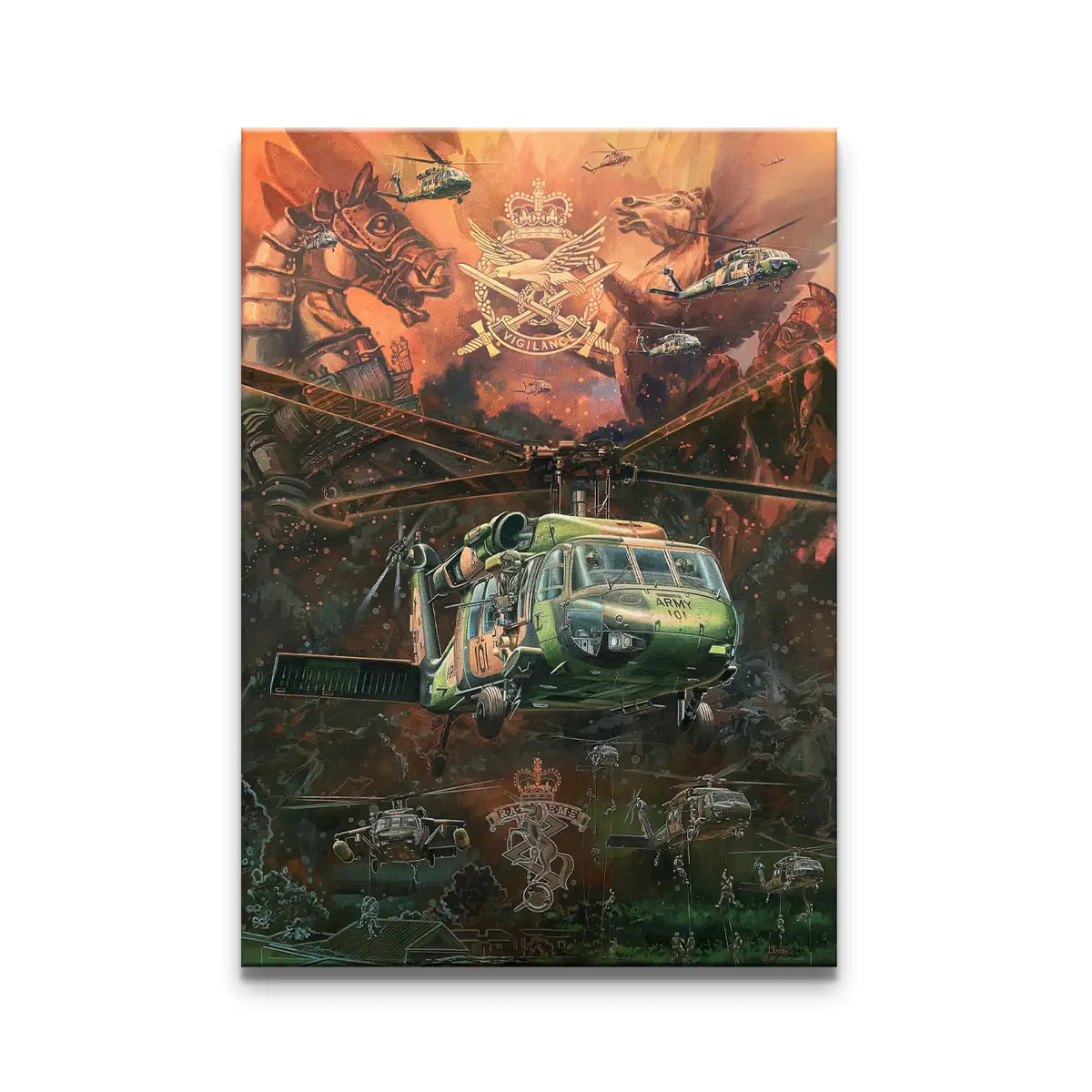 Click to enlarge
Black Hawk Sunset Limited Edition Canvas Print - 490 x 700 mmm
A medium-format Hahnemühle canvas reproduction of the complete artwork.
Read more
This edition retains the full Black Hawk Sunset composition in a more compact display size while preserving the warm palette, central A25-101 and the surrounding service imagery.
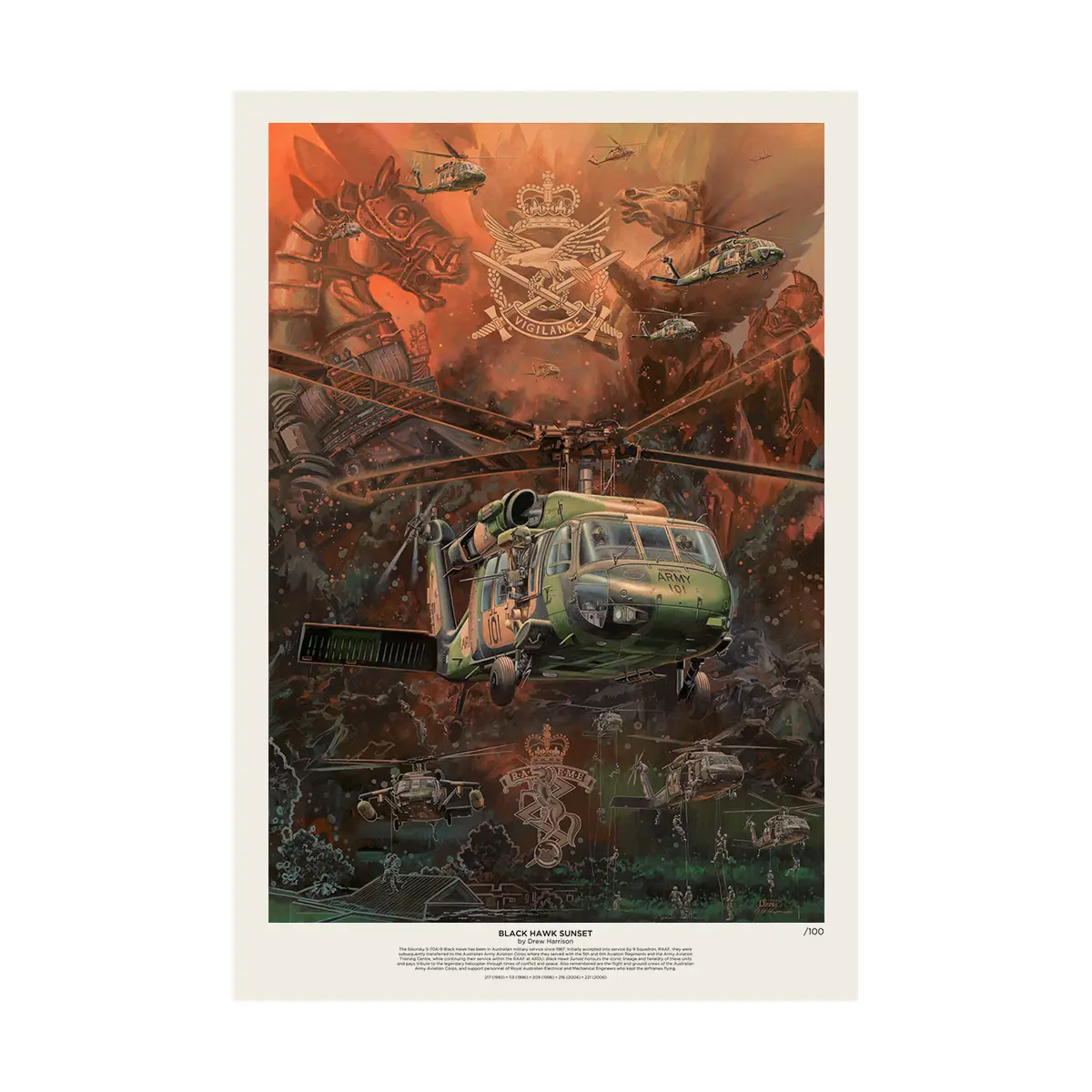 Click to enlarge
Black Hawk Sunset Limited Edition Paper Print - 490 x 700 mmm
Museum-quality 310 gsm True Rag Etching Paper printed with archival inks and tested for 75+ year fade resistance.
Read more
The paper edition emphasises fine line work and layered detail. It is particularly suited to collectors who want a traditional fine-art presentation and the flexibility to select their own framing.
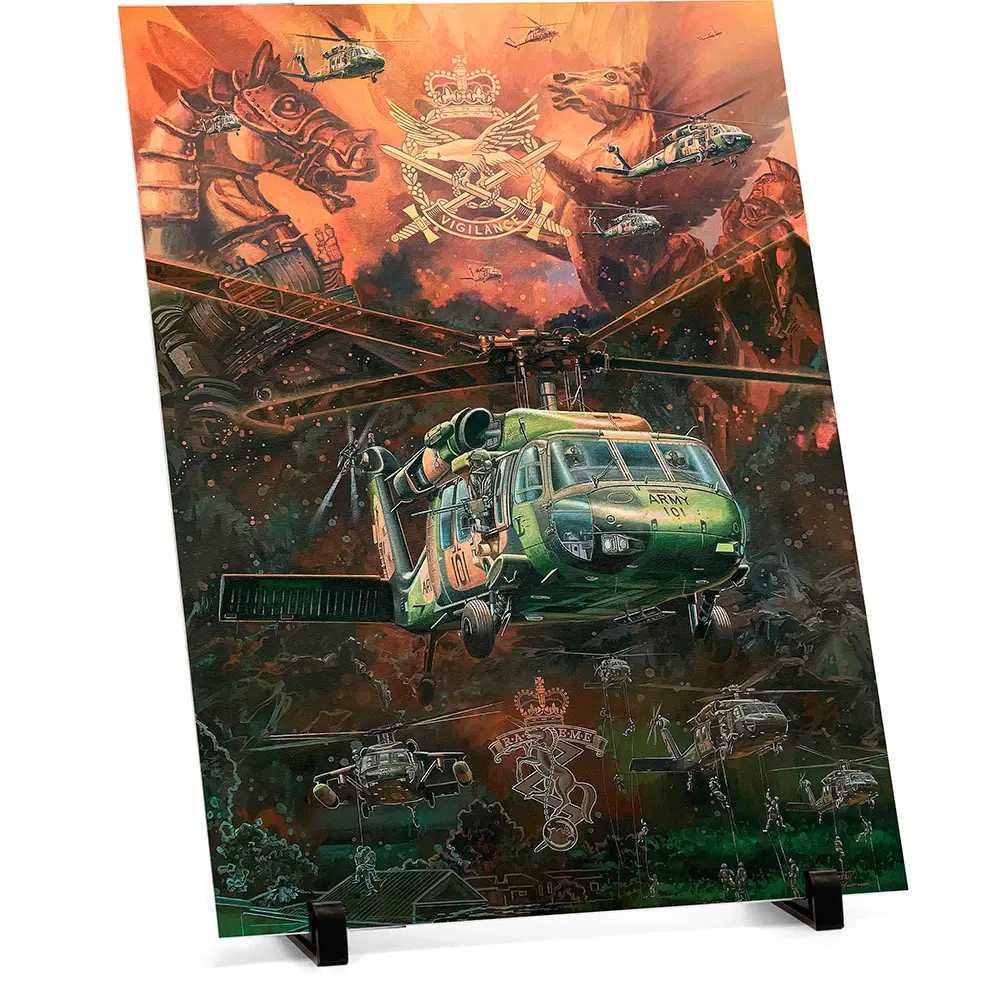 Click to enlarge
Black Hawk Sunset Limited Edition Aluminium Print
The complete artwork presented on 3 mm solid aluminium at 245 x 350 mm.
Read more
The aluminium surface gives the aviation artwork a crisp contemporary presentation. Its compact size makes it a distinct collector format rather than simply a smaller substitute for the canvas editions.
 Click to enlarge
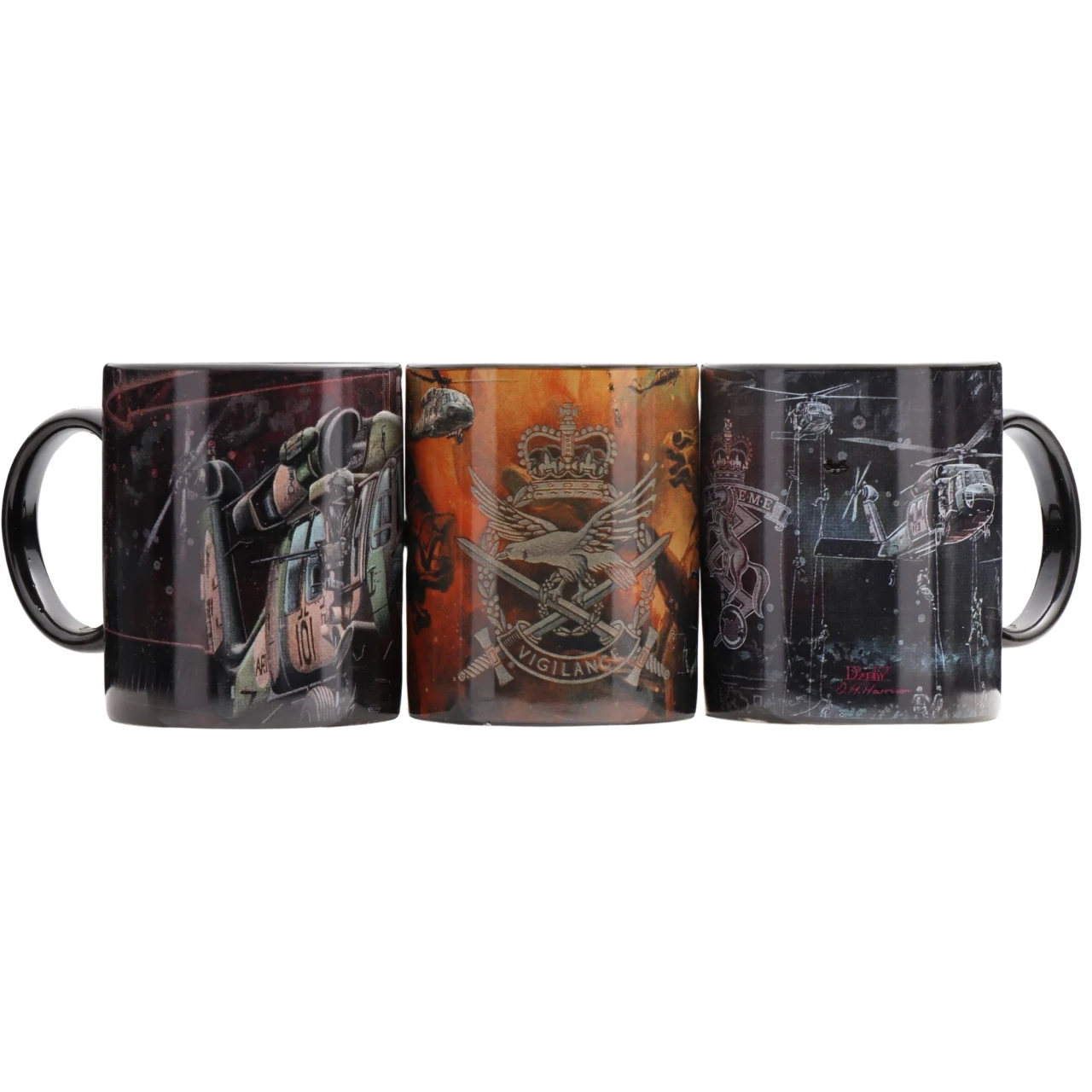
Black Hawk Sunset Limited Edition Coffee Mug Set
Three mugs designed so their artwork sections come together to recreate the complete Black Hawk Sunset image.
Read more
The mug set translates Harrison’s three-part product concept into a functional collectable. Each mug carries a section of the artwork; together the three reveal the complete composition.
History, artwork and collecting
Explore the military history behind the charge, the choices Drew Harrison and Graham Wilson made in reconstructing the scene, and the Archive and Limited Edition pieces created from the commission.
History
When did the Black Hawk enter Australian service?
The S-70A-9 entered Australian military service in the late 1980s, with the first aircraft delivered to No. 9 Squadron RAAF in 1987.
Read more
The RAAF introduced the Black Hawk as the replacement for the Iroquois battlefield utility helicopter. Responsibility for battlefield helicopters transferred to Army in 1989, after which the Black Hawk became closely identified with Australian Army Aviation.
What was the Black Hawk’s main role?
Its central role was battlefield air mobility — moving troops, equipment and supplies quickly into and around operational areas.
Read more
Its versatility allowed the aircraft to do much more: reconnaissance, casualty evacuation, rappelling and fast roping, external-load work, search and rescue, disaster relief and humanitarian support. That flexibility is a major reason the aircraft became such a familiar Army workhorse.
Where did Australian Black Hawks deploy?
Their operational history included Cambodia, Bougainville, East Timor, Fiji and humanitarian missions in Pakistan and Papua New Guinea.
Read more
Australian War Memorial records also document extensive domestic and regional use. Individual aircraft could accumulate very different histories over decades, moving between operational, peacekeeping, humanitarian and training tasks.
Why is the 1996 Townsville accident part of the story?
Because it was the Black Hawk fleet’s most devastating loss of Australian personnel.
Read more
During a night counter-terrorism training exercise near Townsville on 12 June 1996, two Black Hawks collided. Eighteen servicemen were killed — three from 5th Aviation Regiment and fifteen from the Special Air Service Regiment. Harrison includes the two airframes, A25-113 and A25-209, as a tribute within the lower section of the artwork.
Is an Australian Black Hawk preserved nationally?
Yes. A25-112 ‘Saracen’ is held by the Australian War Memorial.
Read more
Saracen served for more than three decades and deployed to Bougainville, East Timor, Fiji, Pakistan and Papua New Guinea. The Memorial acquired it in 2022, preserving both the aircraft and the stories of the people who flew, maintained and relied upon the Black Hawk.
The Commission
Why is A25-101 at the centre
It was the first Australian S-70A-9 and provides a natural focal point for a painting about the complete service story.
Read more
A25-101 ‘Pegasus’ was delivered to No. 9 Squadron RAAF in December 1987, later served with both 5th and 6th Aviation Regiments and took part in the RAAF Centenary Flypast in 2021. Its history effectively spans the Black Hawk era.
What do the horse and Pegasus represent?
They come from the heraldry of the 6th and 5th Aviation Regiments.
Read more
The 5th Aviation Regiment’s imagery includes Pegasus with a warrior and its motto ‘Bold’; the 6th Aviation Regiment uses an armoured horse with the motto ‘Valour’. Harrison used these symbols to frame the aircraft within the units that operated it.
Why is there a Naval Crown in the artwork?
It refers to No. 9 Squadron RAAF and the Black Hawk’s initial Air Force service.
Read more
Harrison incorporated the Naval Crown into the armoured horse. No. 9 Squadron’s heraldry includes an albatross and Naval Crown, reflecting earlier Fleet Co-operation origins. This gives the RAAF chapter a place within an artwork otherwise strongly associated with Army Aviation.
Why is the RAEME badge included?
To recognise the maintainers and technical personnel who kept the Black Hawk fleet flying.
Read more
Harrison grouped the lower operational scenes around the Royal Australian Electrical and Mechanical Engineers badge. It broadens the tribute beyond pilots and aircrew to the ground personnel whose work sustained the aircraft across decades of service.
Why does Black Hawk Sunset look different from traditional aviation art?
Harrison deliberately used a more contemporary, symbolic style influenced by graphic novels, movie posters, fantasy and religious art.
Read more
Rather than paint one realistic flight scene, he layered heraldry, individual aircraft and operational vignettes into a portrait-format composition. The approach allowed him to represent more than thirty years of history in a single image.
The Collection
What limited-edition artwork formats are currently available?
The collection includes a full-size canvas, a framed print and an unframed print.
Read more
The 1000 × 700 mm canvas is limited to 25, the 700 × 490 mm canvas to 100, the paper-print to 100, and the 350 × 245 mm aluminium artwork to 250.
Archive Editions
What makes an early-numbered Black Hawk Sunset edition collectable?
It documents a piece from the beginning of a small, finite release
Read more
This is especially relevant to the large canvas, where only 25 exist. A verified low edition number, together with its certificate and BrandNet provenance, gives the piece a clearly documented position within the original release.
Black Hawk Sunset — the end of an era preserved
Black Hawk Sunset occupies a distinctive place in the BrandNet Archives. It records a modern Australian aircraft whose service is remembered directly by thousands of people who flew in it, maintained it, deployed with it or saw it arrive when help was needed.
Read more
Drew Harrison’s painting preserves more than the silhouette of an iconic helicopter. It brings together the RAAF beginning, Army Aviation service, regimental identities, RAEME support, operational work, humanitarian missions and the losses carried by the Black Hawk community. Preserved with its limited editions, it forms a layered record of Australian S-70A-9 service from 1987 to 2021.