

Operation Slipper –
In Service Against Terrorism
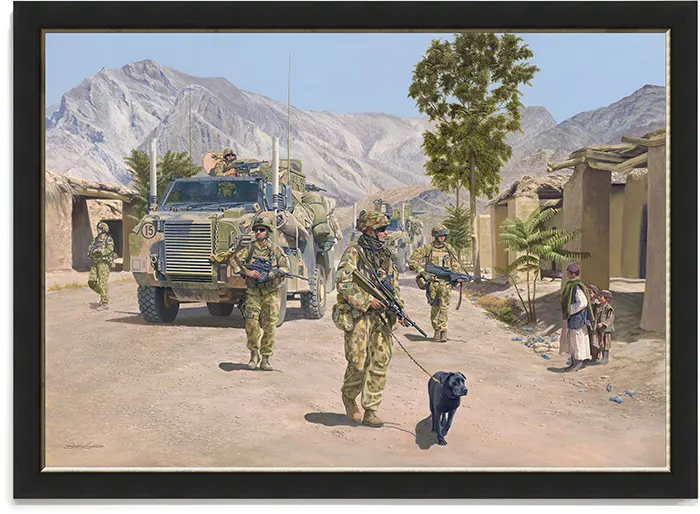
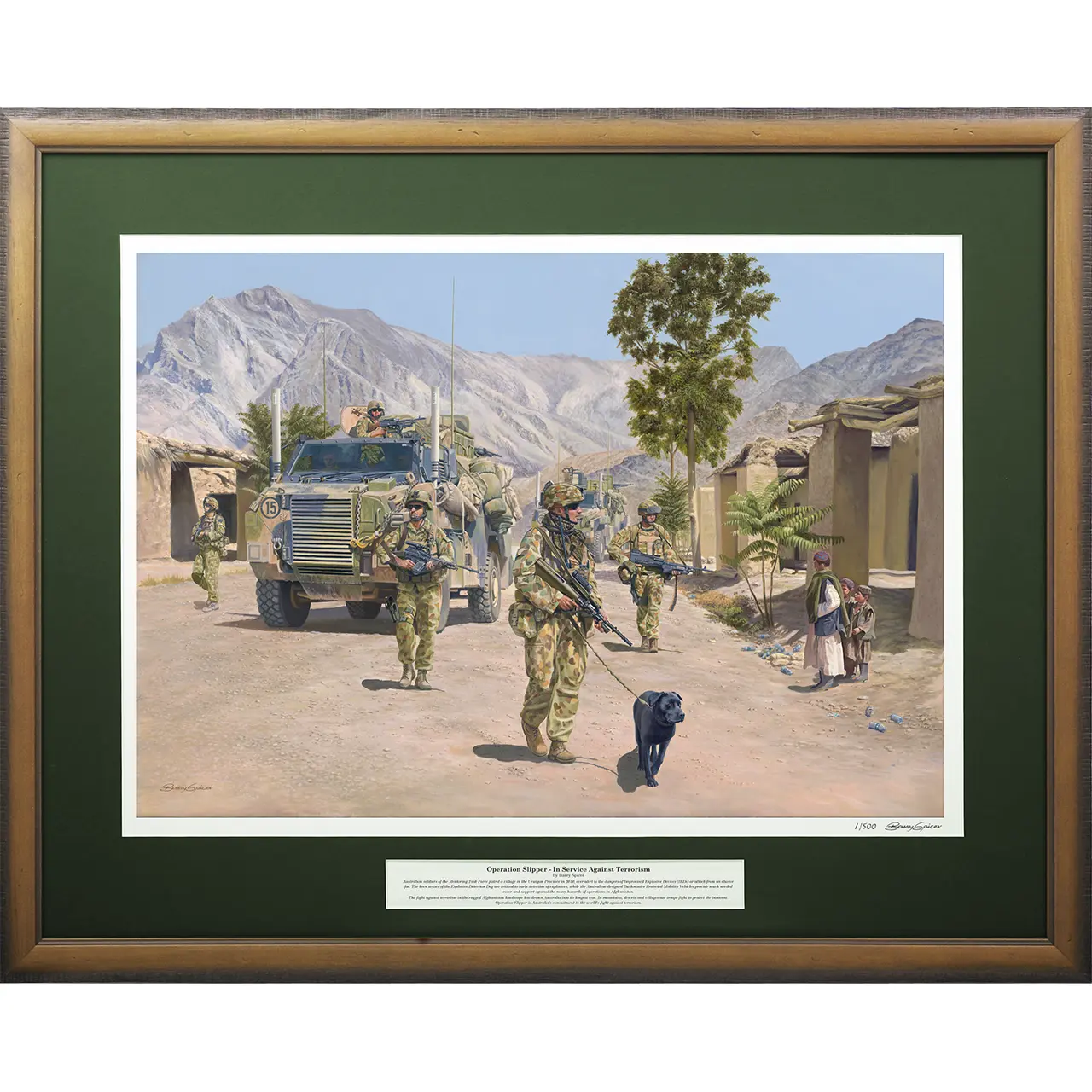
Australian soldiers on patrol in Uruzgan — alert to the unseen dangers of a long and demanding campaign.
Discover the people, events and research behind each commissioned work.
View the original commissioned artwork and, where available, enquire about acquisition.
Discover and purchase rare #1–#10 Archive Editions and historically significant retained pieces.
Explore related Limited Edition lapel pins, medallions and art.
Australia's longest confilct
Australia entered the war in Afghanistan in 2001 as part of the international response to the 11 September terrorist attacks in the United States. Under Operation Slipper, Australian Defence Force personnel served in Afghanistan and the wider Middle East Area of Operations in roles that changed significantly over more than a decade — from Special Forces operations to reconstruction, security, training and mentoring.
From 2006, much of Australia’s effort in Afghanistan was concentrated in Uruzgan Province. Australian troops worked alongside coalition forces and the Afghan National Army, operating from Tarin Kot and a network of patrol bases in difficult mountainous and rural terrain. The threat was persistent: insurgent attacks, roadside bombs and improvised explosive devices meant that even routine movement outside protected bases demanded constant vigilance.
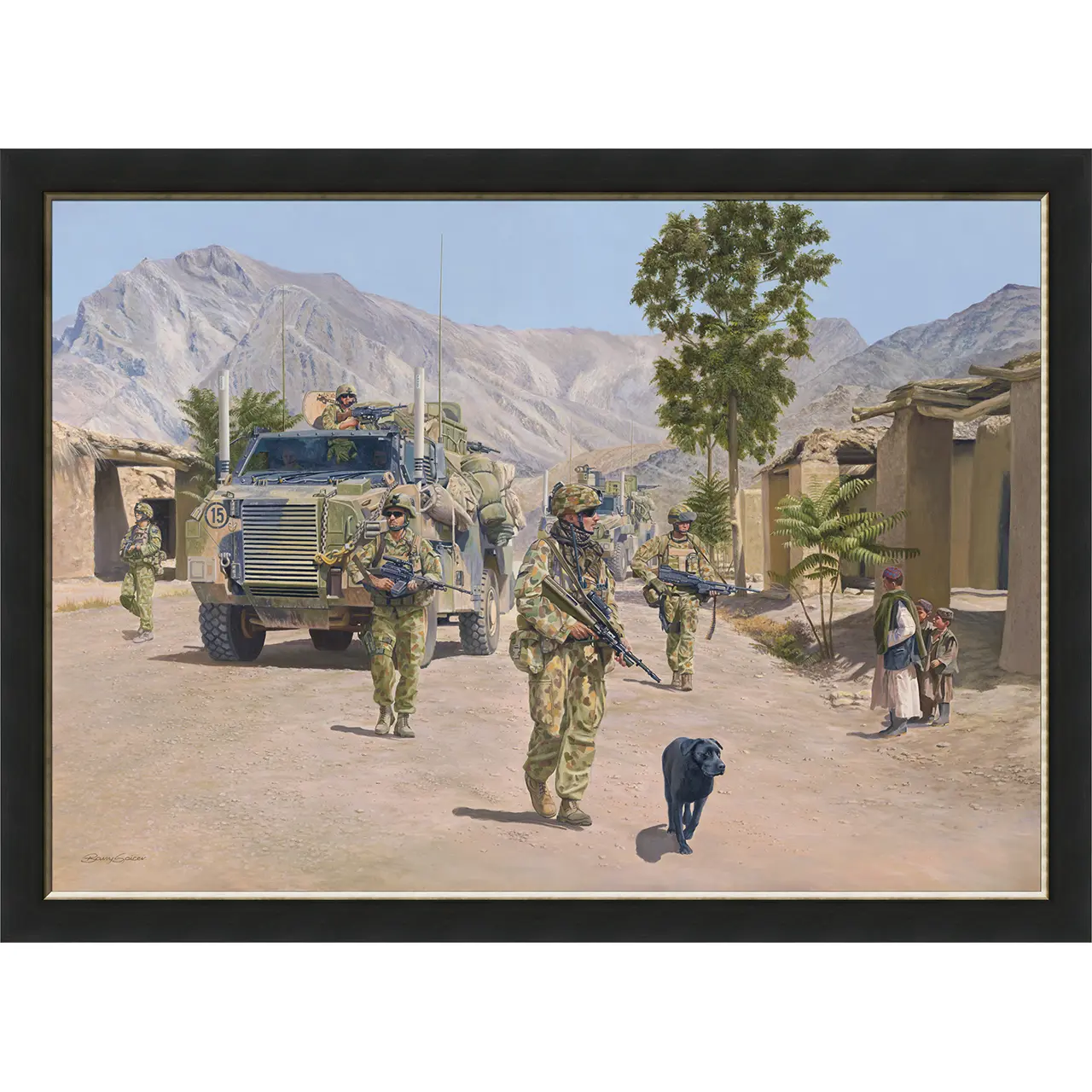
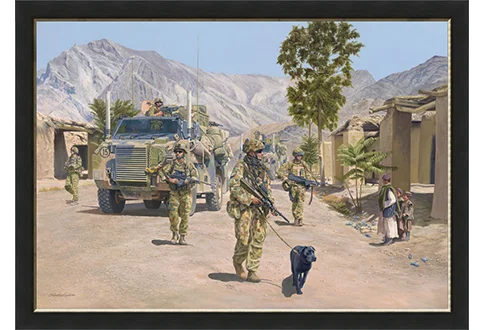
In 2010 the ADF established the Mentoring Task Force, combining combat operations with the task of developing the capability of the Afghan National Army in Uruzgan. It is this period that forms the historical setting for Barry Spicer’s painting — Australian soldiers moving through a village with an Explosive Detection Dog and Bushmaster Protected Mobility Vehicles, surrounded by the landscape and civilian population that shaped daily operations.
Read the history in more detail
Australia’s Afghanistan commitment evolved repeatedly. Early deployments centred on Special Forces. From 2006, Reconstruction Task Forces supported security and reconstruction in Uruzgan; these were followed by Mentoring and Reconstruction Task Forces and, in 2010, the Mentoring Task Force. Australian soldiers increasingly partnered with Afghan forces on patrols and operations while helping them develop the ability to plan, lead and sustain their own security tasks.
Uruzgan was a demanding environment. Patrols moved through valleys, villages and compounds where the distinction between routine activity and danger could change quickly. Improvised explosive devices were a constant threat, making protected mobility, combat engineering and Explosive Detection Dogs particularly important. Australian War Memorial records from the period show mentoring teams operating with Afghan soldiers, conducting patrols and clearance operations and, at times, coming under sustained insurgent attack.
Operation Slipper concluded on 31 December 2014. Military Shop’s commemorative material records that about 34,500 ADF personnel served in Afghanistan and the Middle East areas of operations between 2001 and the end of the operation. The Afghanistan war continued after Operation Slipper under subsequent Australian operations, with Australia’s final military withdrawal occurring in 2021.
Campaign Facts
- Operation Slipper was the name used for Australia’s contribution to operations in Afghanistan and the wider Middle East Area of Operations.
- Australia first deployed forces to Afghanistan in 2001.
- From 2006, Uruzgan Province became a major focus of the Australian commitment.
- The Mentoring Task Force was established in 2010 and conducted mentoring and combat tasks with the Afghan National Army in Uruzgan until late 2012.
- Australian forces operated alongside Afghan and coalition forces from Tarin Kot and patrol bases across the province.
- Operation Slipper ended on 31 December 2014.
- Approximately 34,500 ADF personnel served in Afghanistan and the Middle East areas of operations during Operation Slipper.
Read more
The campaign included far more than infantry patrols. Australian contributions included Special Forces, engineers, artillery, cavalry, aviation, logistics, medical, intelligence and support elements. The painting focuses deliberately on one recognisable part of that wider commitment: the soldiers and equipment of a village patrol during the mentoring phase in Uruzgan.
A representative scene
Spicer’s painting is a representative 2010 Mentoring Task Force patrol rather than a reconstruction of one named engagement. Its historical detail comes from the uniforms, weapons, vehicles, equipment and landscape selected to place the scene firmly within Australian operations in Uruzgan.
The soldiers wear Disruptive Pattern Combat Uniform, reflecting the conditions of the Uruzgan valleys. Their equipment includes weapons identified in the original artwork notes as the F88 Steyr, Minimi light support weapon and MAG58 general purpose machine gun, together with variations of combat body armour and load-carrying equipment used during the period.
Read more
The Australian-designed Bushmaster Protected Mobility Vehicles are historically significant to the scene because protected mobility was central to operations in an environment shaped by mines and IEDs. The Explosive Detection Dog likewise represents a specialised capability used to search for explosive threats. Local children and the village setting place the patrol within the civilian environment in which Australian and Afghan forces operated. The composition brings these elements together as a representative patrol, not as a claim that all of them were photographed together at one specific incident.
Operation Slipper – In Service Against Terrorism
The artwork was commissioned as a contemporary record of Australian service in Afghanistan. Rather than depict a major firefight, Barry Spicer chose the tension of a patrol: soldiers moving through a village, watched by local children, with Bushmasters behind them and an Explosive Detection Dog working ahead.
That choice gives the painting its character. Nothing dramatic has yet happened, but the patrol is alert. The danger is largely unseen — precisely the reality that made movement through Uruzgan so demanding.
Read more
The steep mountains establish the geography of Uruzgan while the village and children remind the viewer that Australian operations took place among local communities. The painting therefore holds several parts of the Afghanistan experience together: security, mentoring, protected mobility, the IED threat, interaction with civilians and the constant discipline of patrol work.

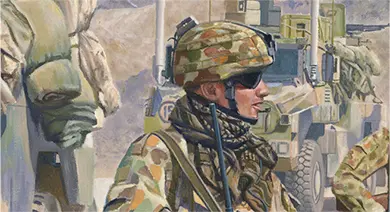
Vigilance rather than spectacle
The soldiers are shown moving and observing, not posed in combat. The scene captures the sustained alertness required outside protected bases.
Read more
By avoiding a named battle, Spicer makes the patrol representative of a much wider experience. Thousands of individual movements, searches, mentoring activities and security tasks formed the daily reality behind the larger campaign.
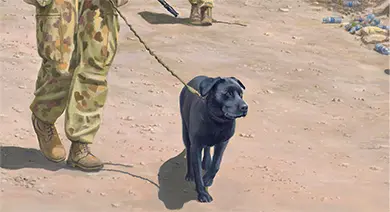
Searching for the unseen
The working dog is positioned as part of the patrol’s protection against the threat of improvised explosive devices.
Read more
IEDs became one of the defining hazards of the Afghanistan campaign. Detection dogs and their handlers provided a specialised capability for locating explosive threats before soldiers and vehicles moved through them.
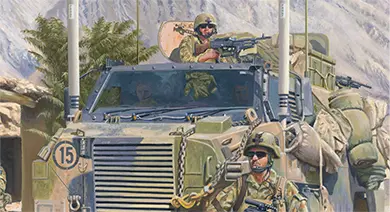
Protected Australian mobility
The Bushmaster Protected Mobility Vehicles provide a distinctly Australian presence and represent the importance of moving personnel with greater protection.
Read more
Bushmasters became closely associated with Australian operations in Afghanistan. Their inclusion is more than visual recognition: they represent the operational problem of moving through an environment where roadside bombs, mines and small-arms fire could turn routine travel into a dangerous task.
Barry Spicer
Barry Spicer is an Australian military and aviation artist based in Adelaide. His fascination with aircraft began in childhood after seeing the film The Battle of Britain, developing from drawing and airbrush work into oil painting and professional commissions.
Spicer’s work is characterised by close attention to military equipment and technical detail. He has described accuracy as an important part of his approach, while using atmosphere and composition to ensure the finished painting remains a story rather than simply a technical illustration.
Read more
Operation Slipper demonstrates that balance. The weapons, uniform, Bushmasters and working dog establish the period, but the painting’s real subject is the patrol itself — people moving through a landscape where the possibility of danger is present even when no enemy is visible.
Artist's Notes
Spicer places the Australian patrol against the steep mountains of Uruzgan and allows the village to remain an active part of the scene. Local children watch the soldiers pass, while the Explosive Detection Dog and Bushmasters reveal the precautions surrounding movement outside the base.
Read More
The detailed equipment rewards close viewing: DPCU, combat body armour, load-carrying equipment and the mix of Australian small arms all help locate the scene in 2010. These details should be used as interpretive points around the artwork, allowing visitors to move from the complete painting into the story contained within it.
Detailed Artwork Description
The eye first meets the soldiers on foot. They occupy the foreground and give the painting its human scale. Their spacing, weapons and posture suggest movement through the village rather than a staged portrait.
Behind them, Bushmaster vehicles provide weight and protection. The Explosive Detection Dog introduces another layer of tension: its work is directed toward a danger that cannot be seen. Children and village buildings place the patrol within the local population, while the mountains close the composition around the group
Read more
The strength of the work lies in what it does not show. There is no explosion, charging enemy or theatrical battle scene. Instead, the viewer is held in the uncertain interval in which soldiers must remain prepared for something that may or may not happen. That makes the painting a fitting record of the vigilance that defined much of the Australian experience in Uruzgan.
The original Operation Slipper – In Service Against Terrorism
The original oil painting by Barry Spicer is preserved within the BrandNet Archives. Measuring 1545 × 1130 mm, it is the unique source work from which the Operation Slipper limited-edition art collection was created.
Read more
At full scale, the original allows the viewer to see the equipment, landscape and individual figures at the level of detail Spicer intended. It also carries direct provenance to BrandNet’s Afghanistan commission and to the limited editions that followed.
Specialist delivery, insurance and installation requirements can be arranged directly with the purchaser.
Acquire the Original Enquire About the ArtworkThe first numbers
Selected early-numbered editions retained from the original release form part of the BrandNet Archives. Each available Archive Edition presents with its exact number, format, certificate and provenance.
Read more
For collectors, an early number adds another layer to a finite edition. The image is the same, but the documented edition number and direct BrandNet provenance connect the piece to the beginning of the original release.
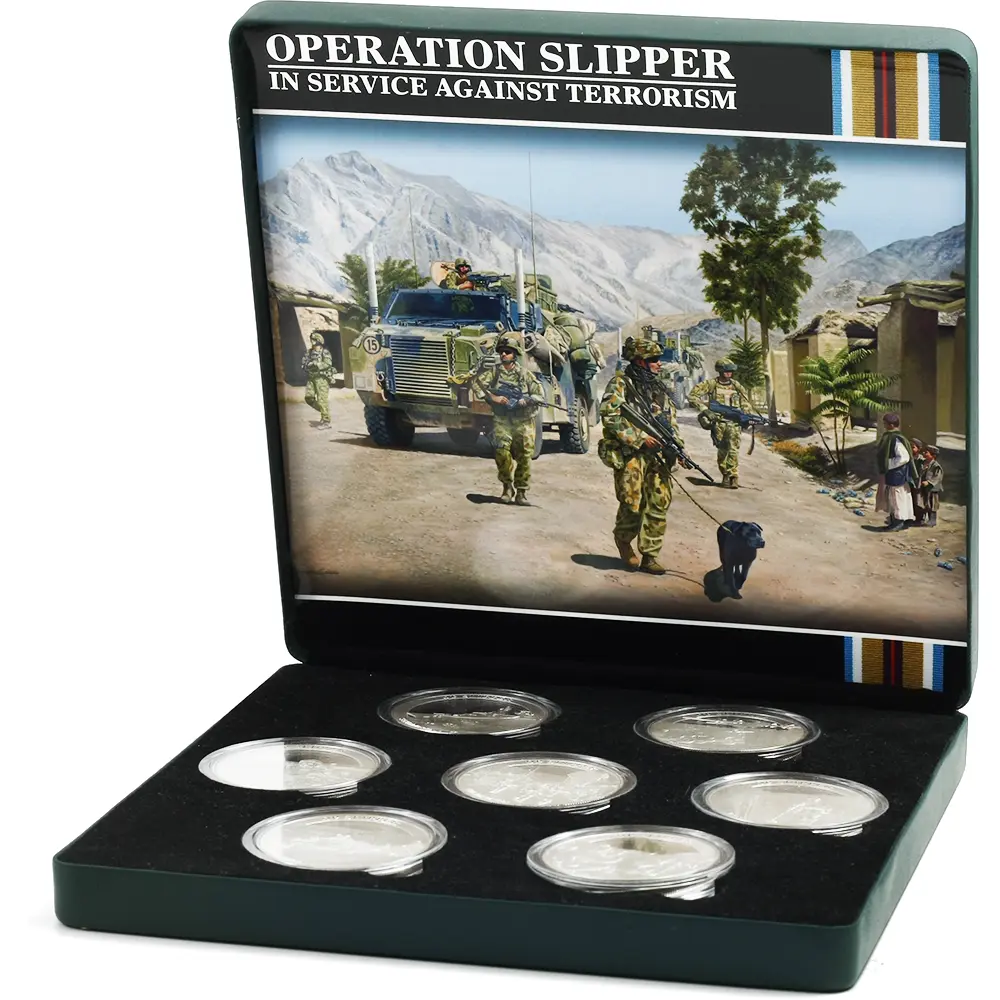
Afghanistan - Limited Edition Medallion Collection— Archive Editions #1–#10
A stunning seven medallion collection with each one each representing a different aspect of Australia's mission in Afghanistan. BrandNet's retained examples carry certificate numbers #1 through #10.
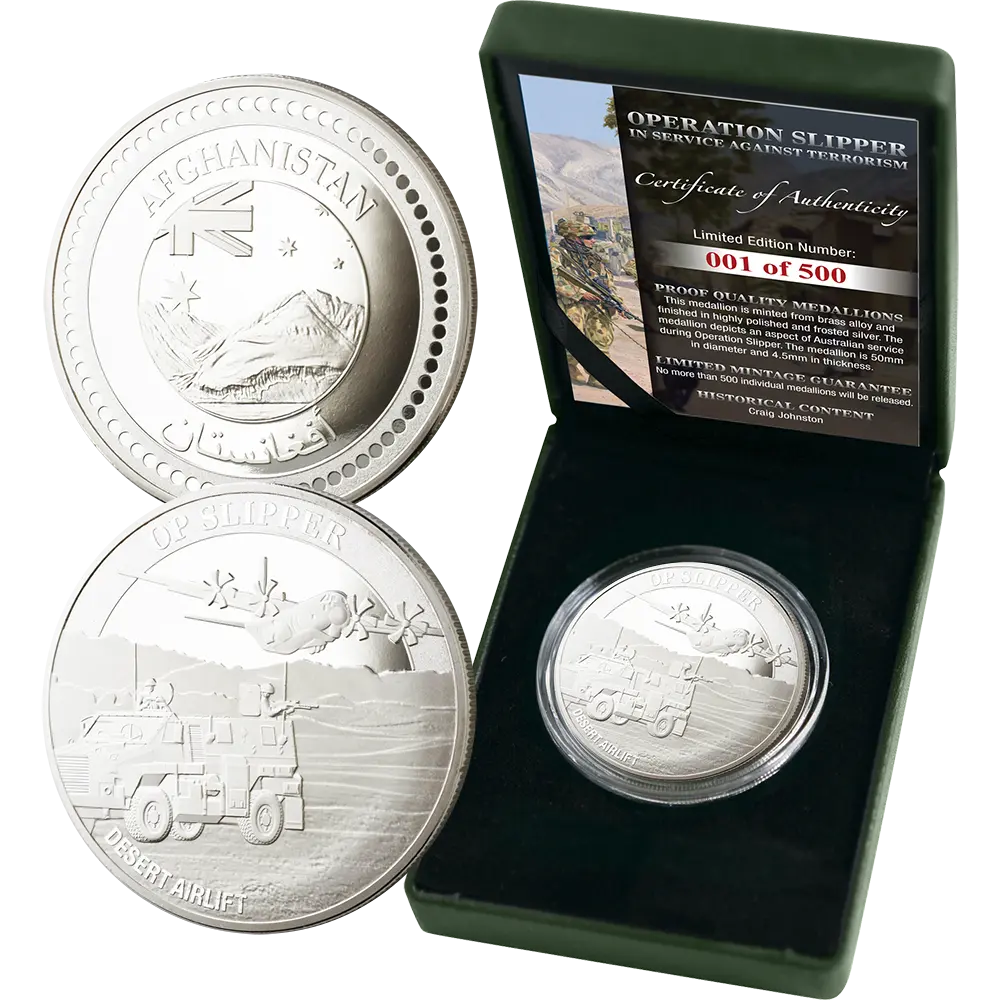
Afghanistan - Desert Air Lift Limited Edition Medallion — Archive Editions #1–#10
The proof-finish medallion captures an Australian C-130J taking off under cover of a Bushmaster PMV in Afghanistan, showcasing the bravery and skill of the pilots. BrandNet's retained examples carry certificate numbers #1 through #10.
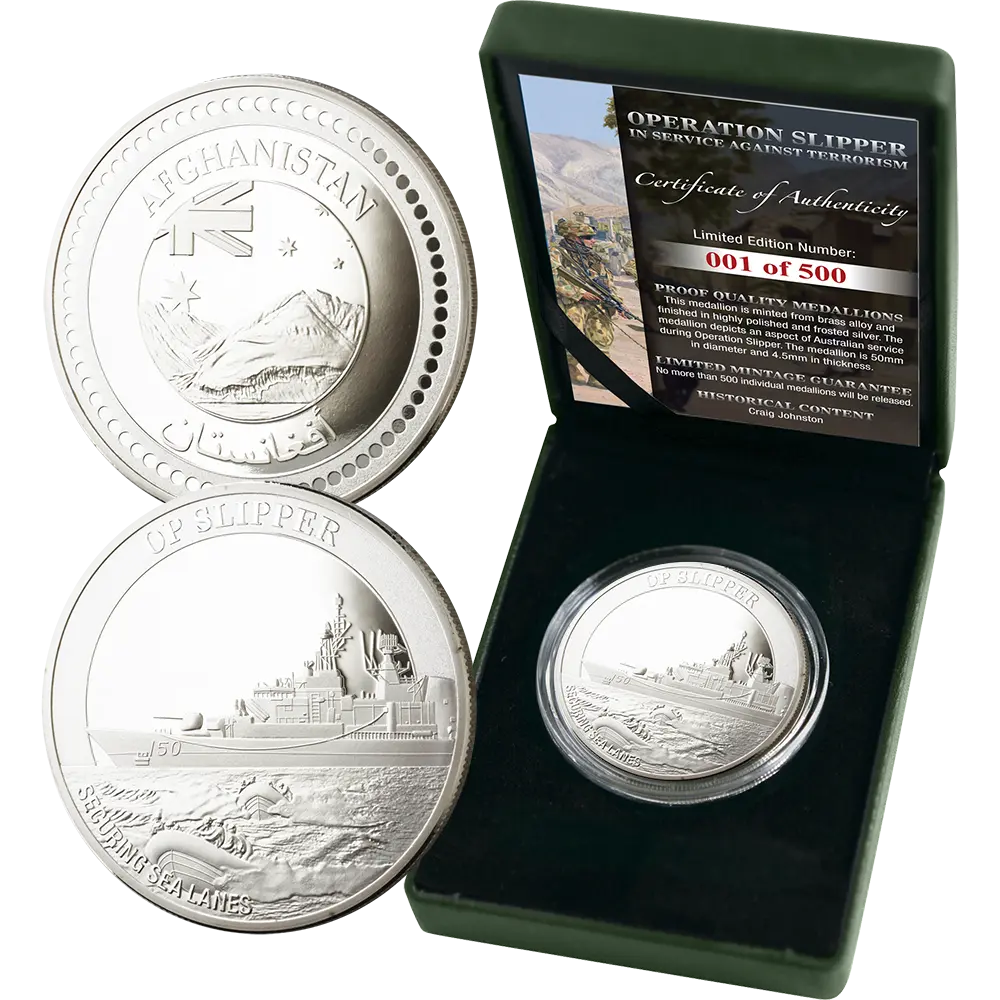
Afghanistan - Securing Sea Lanes Limited Edition Medallion — Archive Editions #1–#10
In this medallion two boarding vessels from HMAS Anzac speed towards an unseen ship in the arabian Sea. BrandNet's retained examples carry certificate numbers #1 through #10.
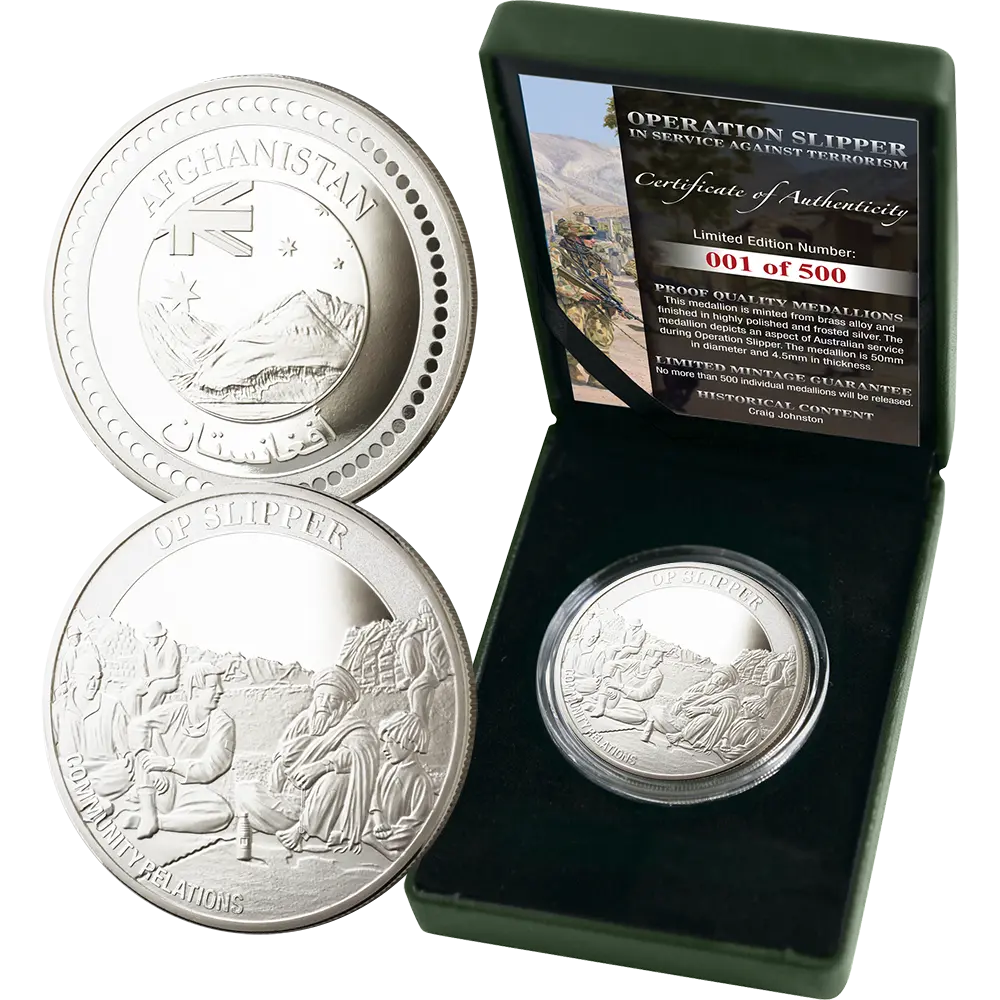
Afghanistan - Community Relations Limited Edition Medallion — Archive Editions #1–#10
Captured in this medallion is a Community Development Council (CDC) meeting, or shura, creating bridges between Australian forces and Afghan communities. BrandNet's retained examples carry certificate numbers #1 through #10.
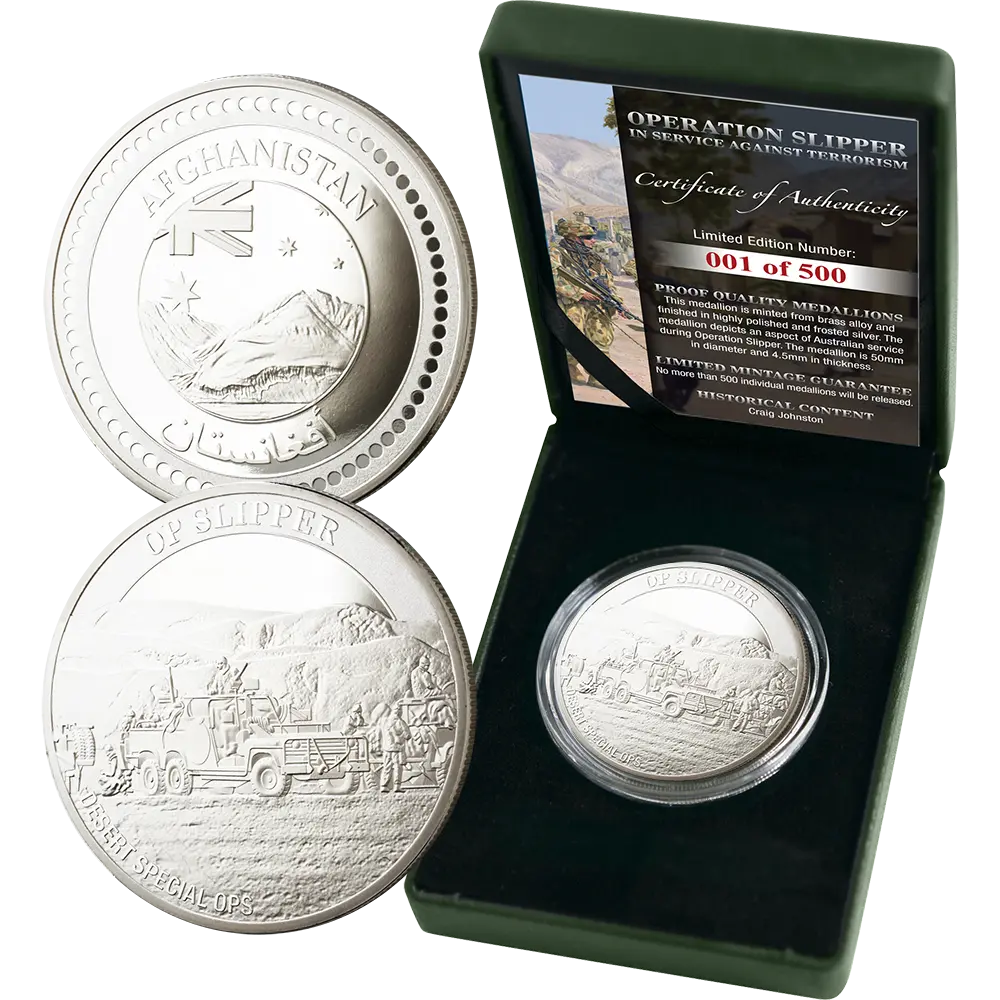
Afghanistan - Desert Special Ops Limited Edition Medallion — Archive Editions #1–#10
Highly trained Australian special forces troops operated extensively in Afghanistan. This medallion shows a group of operators preparing to move out. BrandNet's retained examples carry certificate numbers #1 through #10.
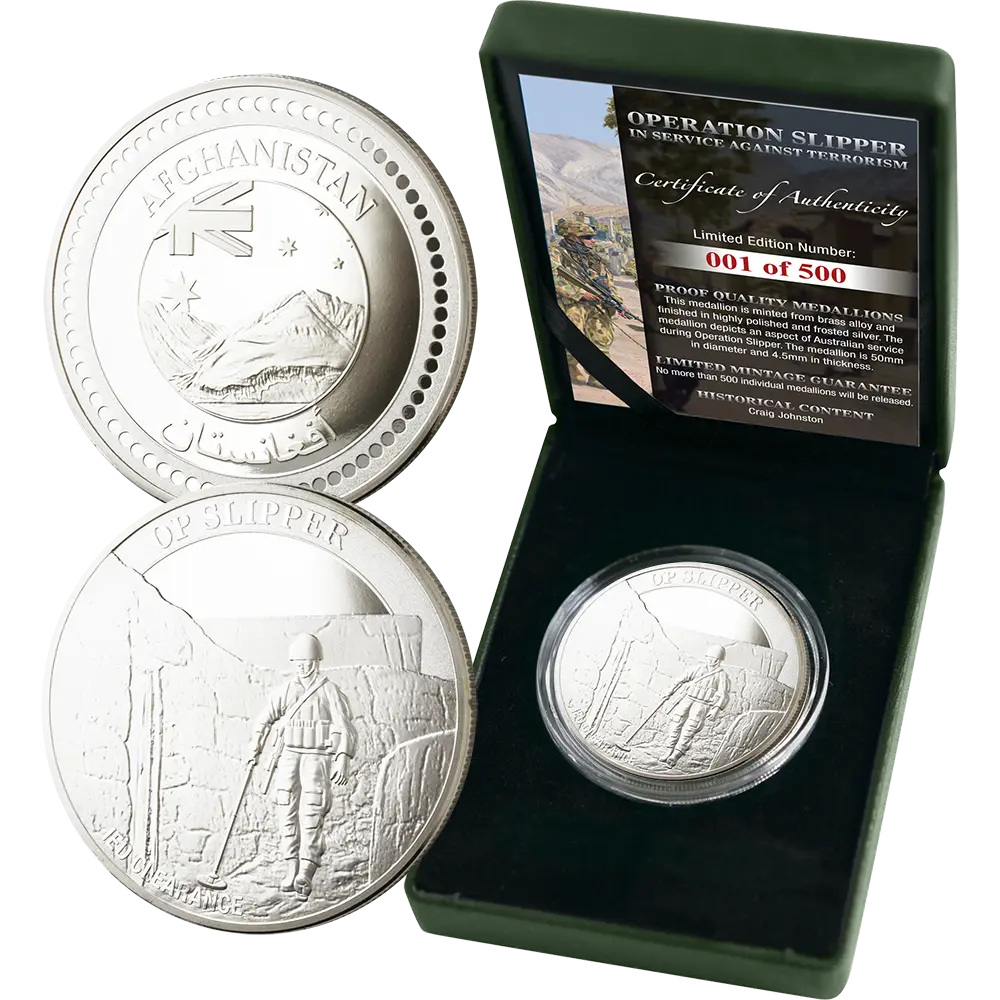
Afghanistan - IED Clearance Limited Edition Medallion — Archive Editions #1–#10
IEDs were a constant danger for Australian forces during the Afghanistan campaign. Captured in this medallion is one of many Combat Engineers tasked with locating and neutralising these threats. BrandNet's retained examples carry certificate numbers #1 through #10.
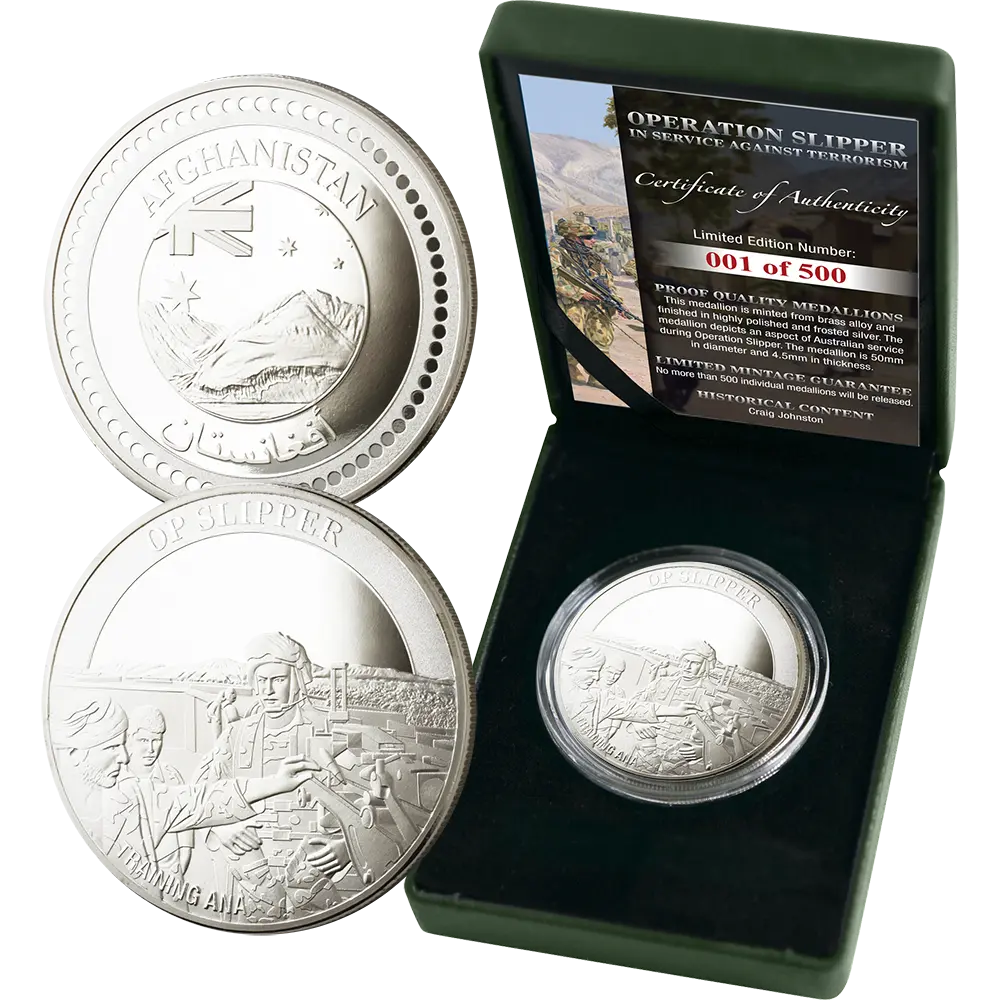
Afghanistan - Training Afghan National Army Limited Edition Medallion — Archive Editions #1–#10
This medallion showcases the mentoring role Australian troops took in Afghanistan, training local army and police in modern combat tactics. BrandNet's retained examples carry certificate numbers #1 through #10.
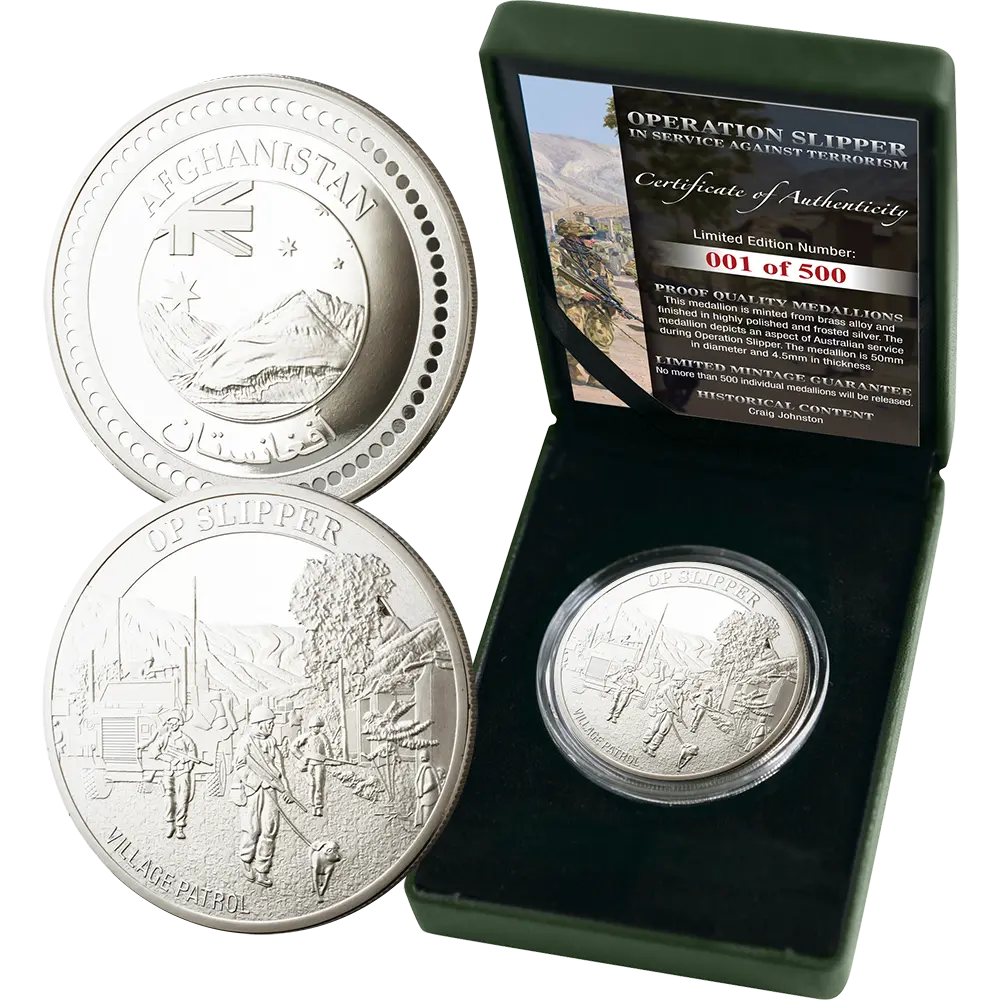
Afghanistan - Village Patrol Limited Edition Medallion — Archive Editions #1–#10
Based on Barry Spicer's artwork Operation Slipper – In Service Against Terrorism this medallion captures Australian soldiers on patrol in Uruzgan Province. BrandNet's retained examples carry certificate numbers #1 through #10.
Own a part of the story
Black Hawk Sunset was adapted into several limited-edition art formats including limited edition prints, medallions, coffee mugs, and drink coolers.
 Click to enlarge
Operation Slipper Full Size Framed Canvas Print
Printed on Hahnemühle Daguerre Canvas with pigment inks and fade-tested for more than 75 years.
Read more
The exceptional Operation Slipper Full Size Canvas Print is a limited-edition masterpiece that captures the essence of bravery and dedication.
 Click to enlarge
Operation Slipper Limited Edition Framed Print
A stunning archival quality framed print, hand signed by the artist.
Read more
This edition showcases the village patrol in Afghanistan, showcasing soldiers, bushmasters, and a loyal working dog.
Click to enlarge
Afghanistan IED Clearance Medallion
This limited edition medallion pays tribute to the courageous combat engineers who risked their lives to detect and neutralize Improvised Explosive Devices (IEDs) during the Afghanistan war.
View the medallion →
Click to enlarge
Afghanistan Desert Special Ops Medallion
An exceptional collectible that pays tribute to the brave soldiers of the Special Air Service Regiment (SASR) who fought against terrorism in Afghanistan.
View the medallion →
Click to enlarge
Afghanistan Training ANA Medallion
This limited edition medallion commemorates the crucial role of the Australian forces in training and mentoring the Afghan National Security Forces.
View the medallion →
Click to enlarge
Afghanistan Villiage Patrol Medallion
Based on Barry Spicer's artwork this limited-edition medallion commemorates the challenges faced by Australian troops during village patrols in Afghanistan, showcasing their unwavering vigilance in the face of unseen insurgents and IEDs.
View the medallion →
Click to enlarge
Afghanistan Community Relations Medallion
This limited-edition medallion represents the collaboration between Australian forces and Afghan communities, symbolizing the efforts made to build a more secure future together.
View the medallion →History, artwork and collecting
Explore the military history behind the charge, the choices Drew Harrison and Graham Wilson made in reconstructing the scene, and the Archive and Limited Edition pieces created from the commission.
History
What was Operation Slipper?
Operation Slipper was the name used for Australia’s contribution to operations in Afghanistan and the wider Middle East Area of Operations.
Read more
Australia first deployed forces in 2001. The commitment changed over time and included Special Forces operations, reconstruction, security, training, mentoring and support roles. Operation Slipper formally ended on 31 December 2014.
Why was Uruzgan important to Australia’s Afghanistan campaign?
From 2006, Uruzgan Province became the main focus of much of Australia’s ground commitment in Afghanistan.
Read more
Australian personnel operated from Tarin Kot and patrol bases across the province, working with coalition forces and the Afghan National Army. Their tasks included reconstruction, security, mentoring and combat operations in difficult rural and mountainous terrain.
What was the Mentoring Task Force?
The Mentoring Task Force partnered with Afghan National Army units in Uruzgan while also conducting combat and security operations.
Read more
Established in 2010, the MTF built on earlier Australian reconstruction and mentoring task forces. Its purpose was increasingly to help Afghan forces develop the ability to plan and conduct their own operations. The painting is set during this phase of the campaign.
Why were IEDs such an important part of the Afghanistan experience?
Improvised explosive devices were a persistent threat to soldiers and vehicles moving outside protected bases.
Read more
IEDs could be concealed along roads, tracks and approaches used by patrols. Their threat influenced how Australian forces moved and explains the importance of Bushmasters, combat engineers and Explosive Detection Dogs in both the historical campaign and Spicer’s painting.
How many Australians served under Operation Slipper?
About 34,500 ADF personnel served in Afghanistan and the Middle East areas of operations between 2001 and the end of Operation Slipper.
Read more
The figure spans a wide range of roles across Army, Navy and Air Force. It also sits within a broader national effort that included Australian Federal Police, public servants and civilian support.
The Commission
Does the painting show a particular battle?
No. It represents an Australian Mentoring Task Force patrol in Uruzgan in 2010 rather than one named engagement.
Read more
The representative approach allows Spicer to combine characteristic elements of the deployment — village patrols, local civilians, the mountainous landscape, Bushmasters, an Explosive Detection Dog, period weapons and the constant need for vigilance.
Why depict a patrol rather than a firefight?
Patrolling captures the sustained, day-to-day reality of service in Uruzgan.
Read more
A dramatic battle would represent one moment. The patrol allows the painting to explore the uncertainty that existed between engagements: soldiers still needed to scan, search and protect themselves even when no enemy was visible.
Why are the Bushmasters prominent?
They represent the protected mobility that became closely associated with Australian operations in Afghanistan.
Read more
Bushmasters helped move personnel through an environment where mines, IEDs and small-arms fire were serious threats. In the painting they are part of the patrol’s protective system, not simply background vehicles.
What does the Explosive Detection Dog represent?
It represents the specialised search capability used against explosive threats.
Read more
The dog also strengthens the painting’s central idea: danger may be present without being visible. Its presence tells the viewer why the soldiers are alert even though the scene is not an active firefight.
The Collection
What limited-edition art formats were produced?
The collection includes a full-size canvas, a framed print and an unframed print.
Read more
The full-size canvas was limited to 100, the hand-signed framed print to 250, and the unframed print to 500. Their recorded dimensions are 1545 × 1130 mm, 780 × 590 mm and 610 × 490 mm respectively.
Operation Slipper – a contemporary chapter preserved
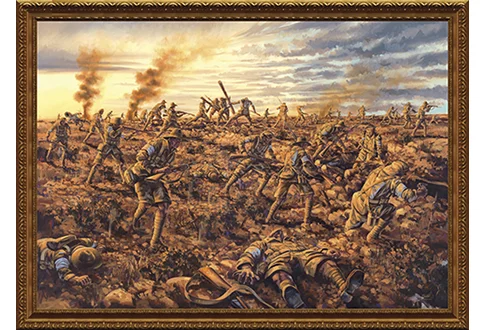
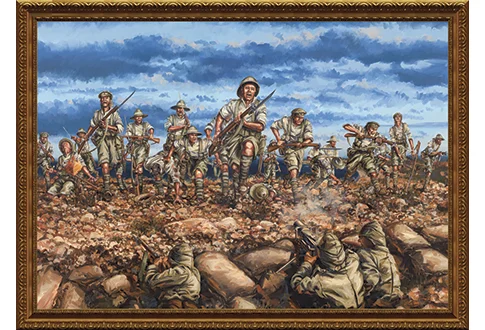
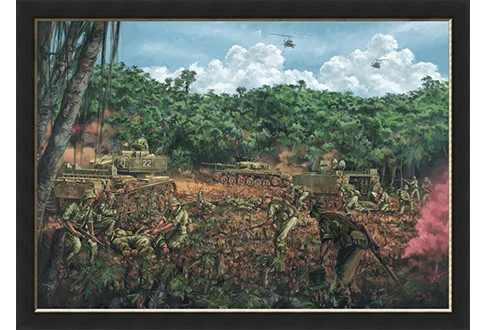
Operation Slipper – In Service Against Terrorism holds an important place in the BrandNet Archives. Unlike the Gallipoli and historic aviation commissions, it records an Australian campaign that was still within living memory when the artwork was created — a story of soldiers, equipment and service in the demanding landscape of Uruzgan.
Read more
Preserving the original painting alongside selected limited editions allows the Archive to hold both the commissioned work and the collection that grew from it. Together they form a material record of how Australian service in Afghanistan was interpreted and commemorated through art.