

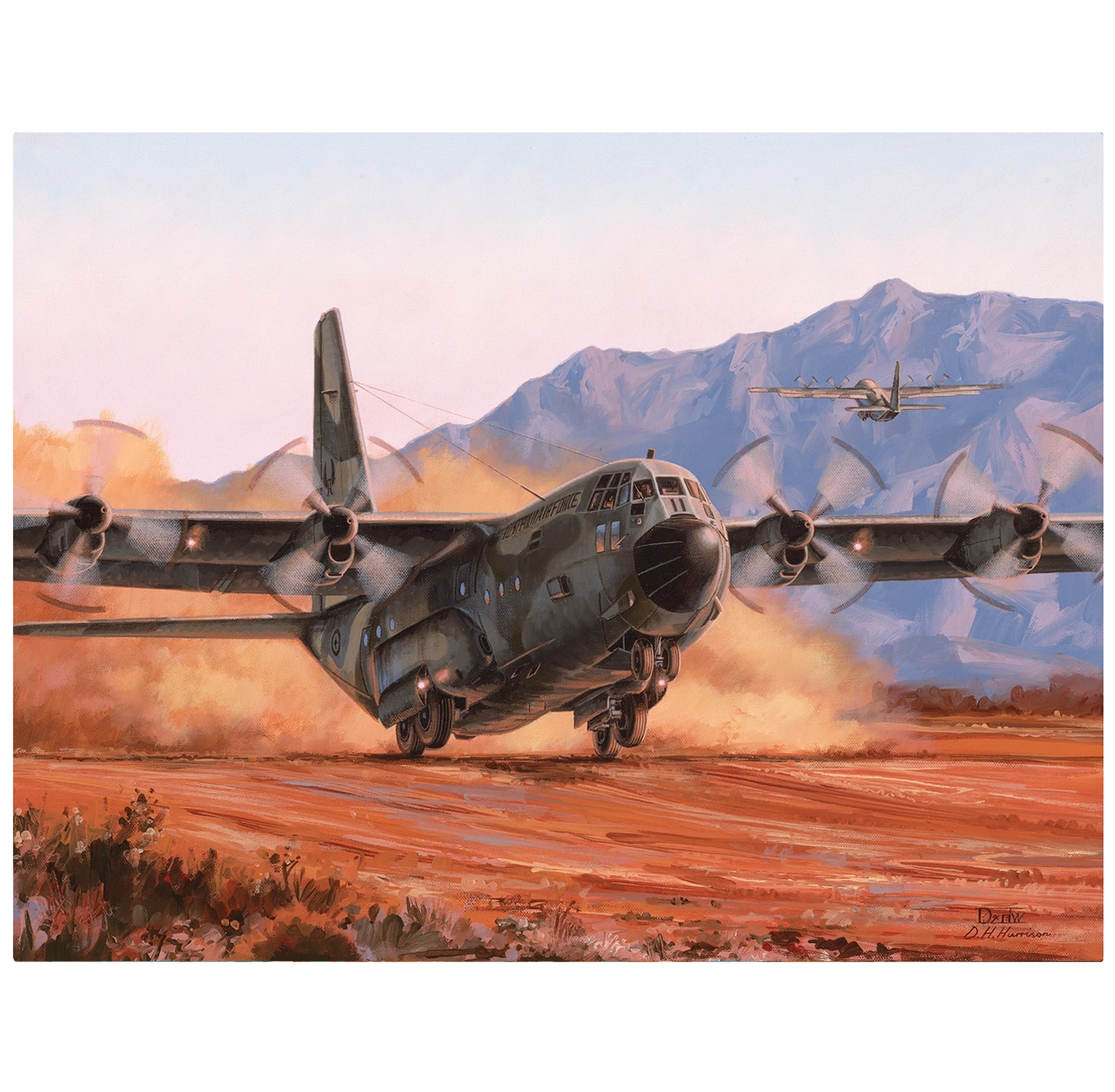
C-130 Hercules: First and Foremost
Discover the people, events and research behind each commissioned work.
View the original commissioned artwork and, where available, enquire about acquisition.
Discover and purchase rare #1–#10 Archive Editions and historically significant retained pieces.
Explore related Limited Edition lapel pins, medallions and art.
Lockheed C-130 Hercules
When the first C-130A Hercules arrived in Australia in December 1958, the Royal Australian Air Force became the first operator outside the United States to fly Lockheed’s new transport. It began one of the longest and most important aircraft relationships in RAAF history.
The Hercules transformed Australian air mobility. It could carry troops, vehicles, equipment and relief supplies over long distances, yet still operate from relatively short and austere airfields. Successive C-130A, E, H and J models kept that capability relevant as Australia’s commitments changed across more than six decades.
Read more
RAAF Hercules supported the Vietnam War, peacekeeping and evacuation missions, operations in East Timor and sustained deployments to the Middle East from 2003. In Iraq and Afghanistan, crews moved personnel and cargo into demanding operational environments. Closer to home, the same aircraft have repeatedly responded to bushfires, floods, cyclones and regional humanitarian crises.
No. 36 Squadron introduced the Hercules in 1958. No. 37 Squadron later became the sole Hercules operator and today flies the C-130J-30. The squadron motto Foremost, gives Drew Harrison’s painting its title. First and Foremost celebrates an aircraft whose importance lies not in one dramatic mission, but in being ready, dependable and useful wherever Australia has needed airlift.
The Hercules replaced the Dakota and immediately expanded the RAAF’s reach. Twelve C-130As arrived from 1958, followed by twelve C-130Es in 1966. The A-models were replaced by C-130Hs from 1978, and twelve C-130J-30s entered service from 1999. For many years Nos 36 and 37 Squadrons operated different Hercules fleets side by side before the C-130H retired in 2012 and all Hercules operations consolidated under No. 37 Squadron.
The aircraft’s record is unusually broad. During the Vietnam era Hercules flew regular transport and aeromedical evacuation tasks. Later missions included Cambodia, Somalia, Rwanda, Bougainville, East Timor and the evacuation of Australians from regional crises. From 2003, a Hercules detachment operated continuously in the Middle East for years, supporting Australian and coalition forces in Iraq and Afghanistan.
Humanitarian work is equally central to the story. Hercules aircraft have delivered emergency supplies after earthquakes, cyclones, tsunamis, fires and floods across Australia and the Indo-Pacific. That combination, military airlift in conflict and practical help in disaster, explains why the Hercules has become far more than a transport aircraft in Australian service. It is a capability generations of Australians have depended upon.
Campaign Facts
The Royal Australian Air Force (RAAF) began operating the C-130 Hercules in December 1958 with the C-130A, becoming the first country outside the United States to operate the aircraft. Over the years, the RAAF has operated several Hercules variants, including the C-130A, C-130E, C-130H and C-130J-30. The aircraft has played a vital role in tactical transport, troop movement, aeromedical evacuation, humanitarian assistance and disaster relief, supporting Australian operations during the Vietnam War and later missions in East Timor. From 2003, C-130 aircraft were also deployed to the Middle East Area of Operations, supporting Australian operations in Iraq and Afghanistan.
Read more
Today, No. 37 Squadron is the RAAF’s Hercules operator, and the title First and Foremost draws on the squadron’s motto, ‘Foremost’. Australia has also committed to replacing and expanding its current Hercules fleet with new C-130J aircraft. The Hercules has remained particularly well suited to Australia because its fundamental design meets the demands of a vast country with long distances, dispersed destinations and the need to transport substantial loads into airfields that may lack the infrastructure of major bases. Although newer variants have introduced improvements in engines, avionics, range and other systems, the aircraft’s essential airlift role has remained remarkably consistent.
C-130 Hercules: First and Foremost
Drew Harrison’s First and Foremost forms part of BrandNet’s Iconic Aviation Collection, commissioned to tell the stories of aircraft that became inseparable from Royal Australian Air Force history.
Read more
Unlike the speed and drama of the F-111, the Hercules story is about usefulness. Harrison presents the aircraft as a working military transport, large, rugged and close to the operational environment it supports. The composition emphasises movement and purpose rather than treating the Hercules as a static technical portrait.
The title works on two levels. The Hercules has often been among the first aircraft called upon when Australia needs to move people or supplies quickly, while ‘Foremost’ is the motto of No. 37 Squadron. That connection makes the painting as much a tribute to the squadron’s people and mission as to the aircraft itself.
Historical Accuracy
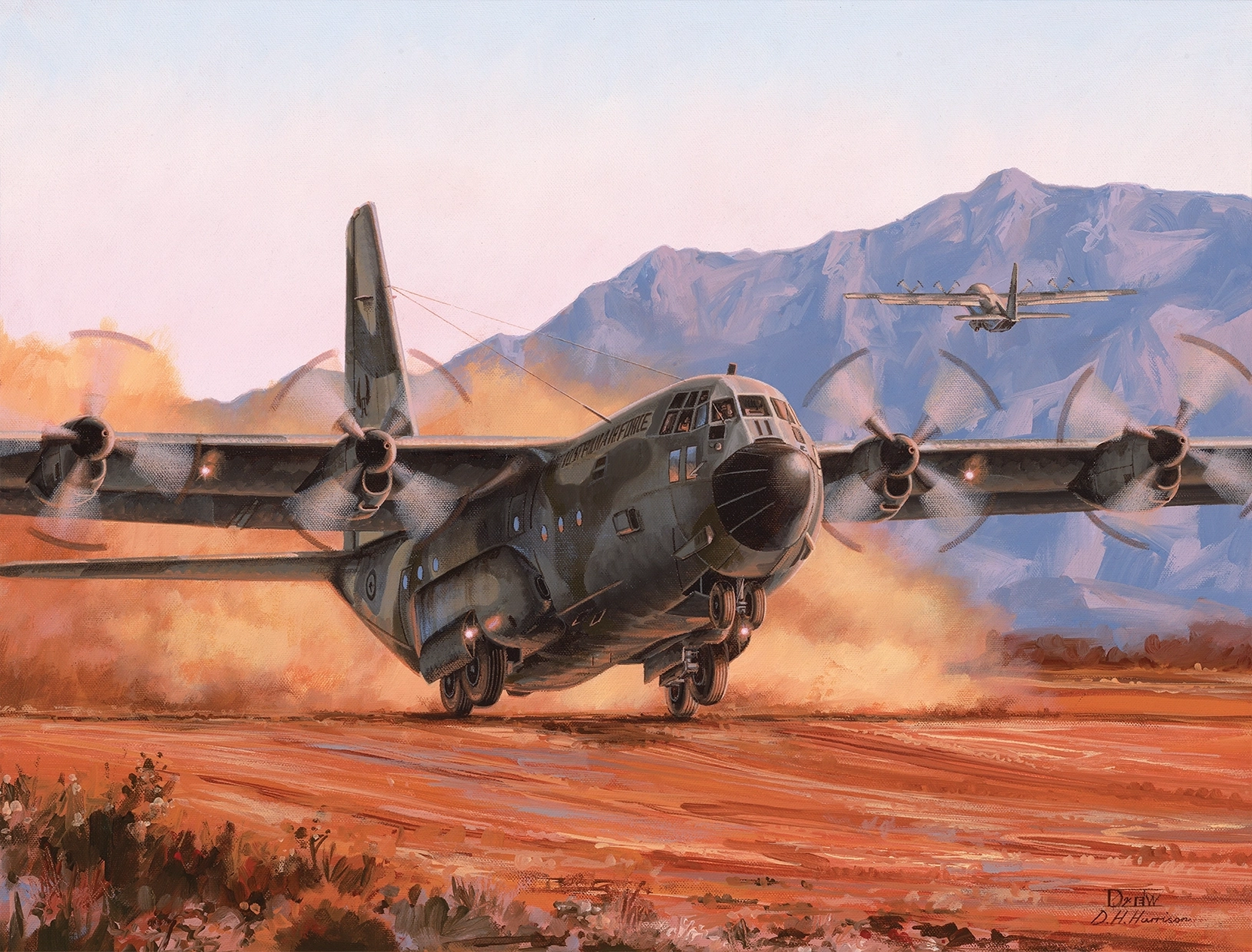
First and Foremost is a researched aviation composition rather than a reconstruction of one photograph or sortie. It places the Hercules in an operational setting that represents the tactical airlift work performed by No. 37 Squadron and the wider RAAF Hercules community.
Read more
The aircraft, squadron context and military setting are grounded in the type’s service history. The scene should therefore be read as representative of operations in which Hercules crews delivered personnel, equipment and supplies close to where they were needed, rather than as a claim that the painting records one named mission.
That approach is particularly appropriate to the Hercules. Its historical importance comes from thousands of missions rather than one defining battle: routine airlift, urgent resupply, aeromedical evacuation, humanitarian response and sustained operational support. Harrison uses a single dramatic scene to represent that much larger record.
The Hercules at work
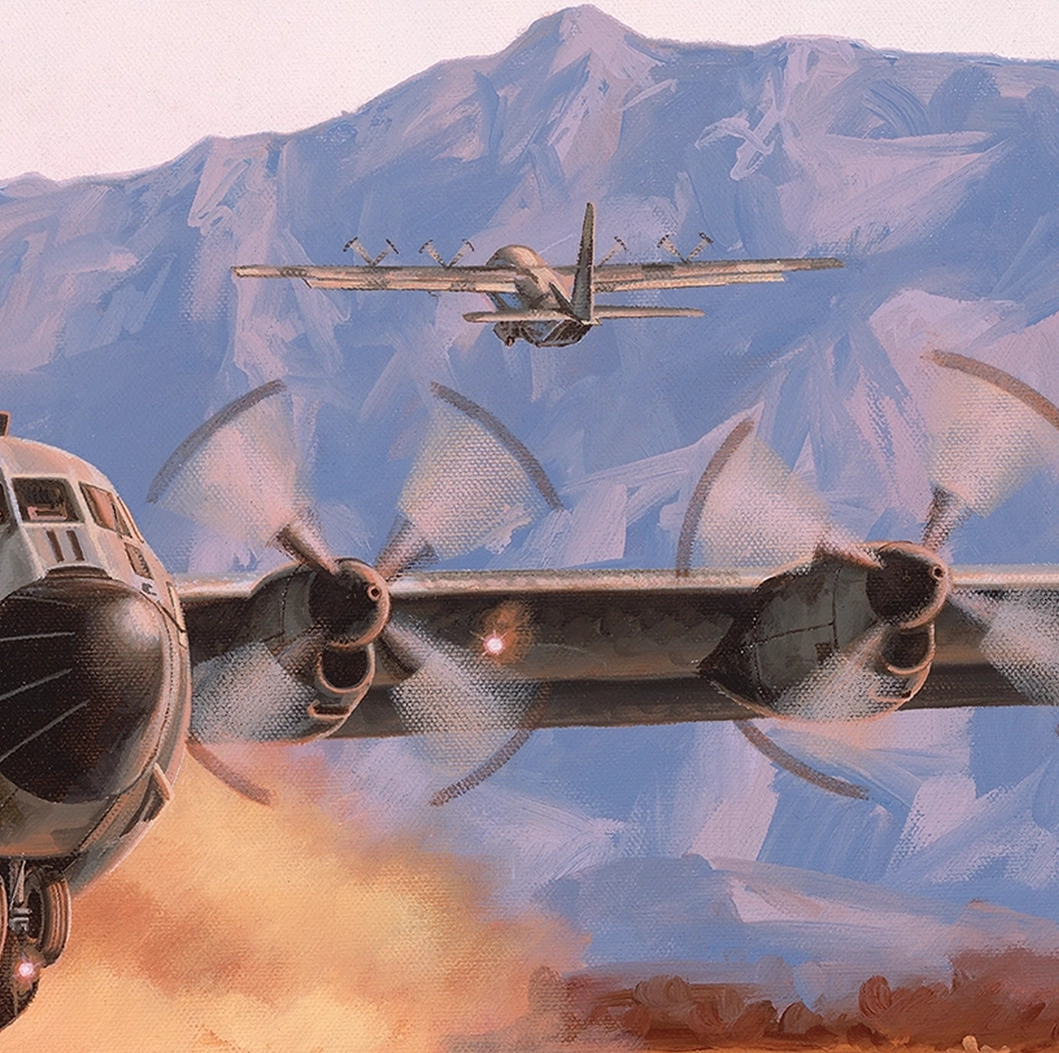
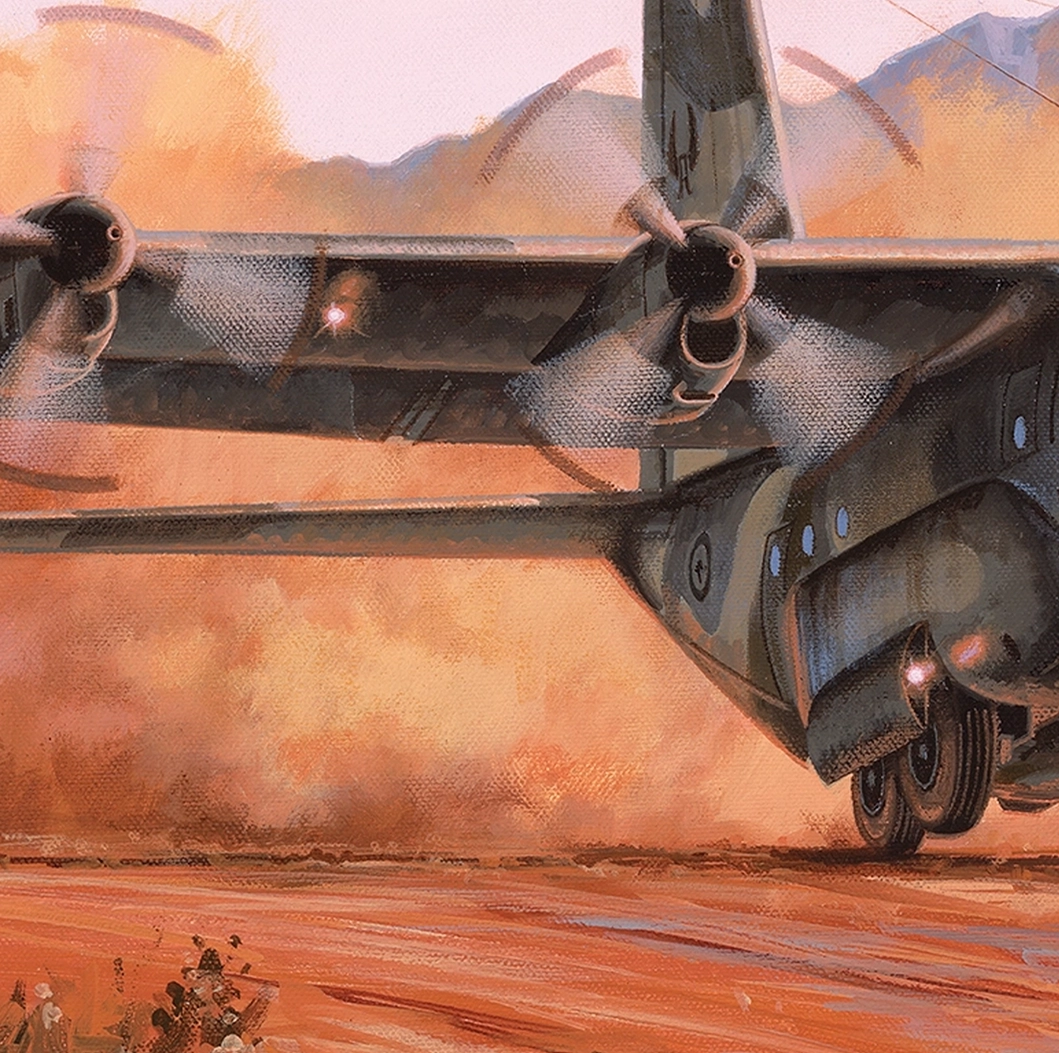
The aircraft is shown in its natural context, moving people and equipment rather than posed as an isolated aviation icon. That distinction matters. The Hercules earned its reputation through repeated practical service: landing, loading, unloading and departing again. Harrison’s operational setting makes that work the centre of the story.
‘Foremost’
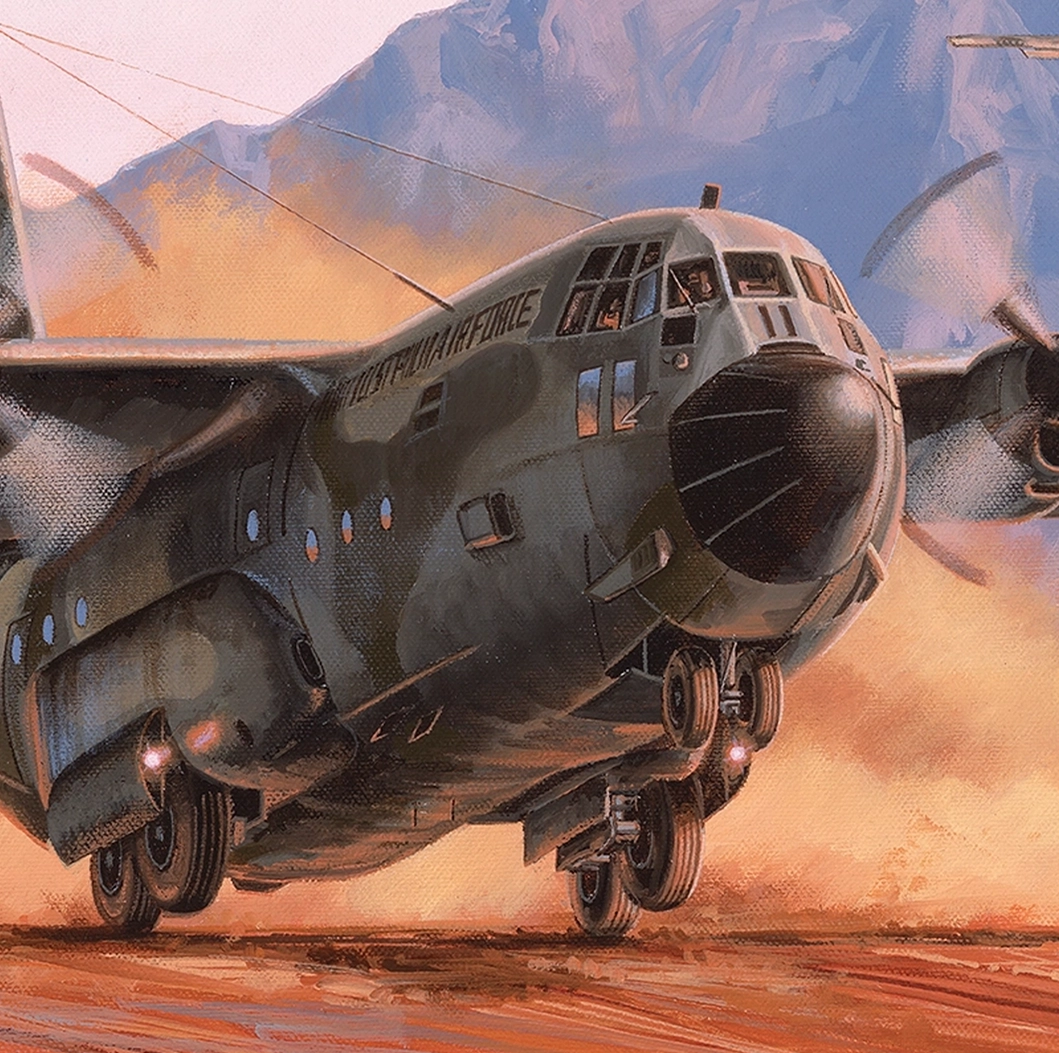
The title connects the aircraft directly with the squadron that has become synonymous with Australian Hercules operations. No. 37 Squadron has operated Hercules variants for decades and is now the RAAF’s sole C-130J-30 unit. Its motto, ‘Foremost’, gives Harrison a title that captures both squadron identity and the aircraft’s place at the front of Australian air mobility.
Close to the action
The composition emphasises the Hercules’ ability to operate where a large strategic transport cannot always go. The C-130 was designed to move useful loads into relatively short or austere airfields. That ability has made it valuable in war, peacekeeping and disaster relief alike, situations where the final destination may be far from a major airport.
Drew Harrison
Drew Harrison is an Australian aviation and military artist known for combining detailed research with a cinematic approach to composition. For the Iconic Aviation Collection, Harrison was commissioned to create six new works celebrating aircraft that have shaped Royal Australian Air Force history.
Read more
First and Foremost required a different visual language from a fighter or strike-aircraft painting. The Hercules is not defined by sleekness or individual combat. Its character comes from scale, endurance and the ability to deliver. Harrison therefore builds the image around operational purpose.
Across the Iconic Aviation Collection, Harrison uses aircraft markings, configuration and historical setting as factual anchors, then employs viewpoint, light and atmosphere to communicate why the aircraft mattered. In the Hercules work, the drama comes from the mission rather than from air combat.
Artist’s Notes
The Hercules is one of those aircraft whose silhouette is immediately familiar but whose real story is found in what happens around it people boarding, cargo moving, engines running and another mission beginning. The painting’s operational emphasis reflects that character. Rather than romanticise the aircraft through an empty sky, the composition connects it to the practical work that made the Hercules indispensable across generations of RAAF service.
Detailed Artwork Description
The Hercules dominates the composition through size rather than aggression. Its four-engine form, high wing and substantial fuselage give the scene visual weight and immediately identify the aircraft as a machine built to carry.
The surrounding operational environment provides the narrative. The aircraft is presented as part of a larger task moving personnel, equipment and support rather than as an end in itself. That approach mirrors the history of the type. A Hercules mission may be remembered because it brought soldiers home, delivered urgently needed supplies, evacuated casualties or reached a community cut off by disaster. Harrison’s composition allows one scene to stand for that broader record of service.
The original First and Foremost
The original Drew Harrison artwork from the Iconic Aviation Collection is preserved within the BrandNet Archives. It is the unique source work from which the C-130 Hercules limited-edition collector artworks were developed.
Read More
This is one of the six smaller original aviation paintings commissioned for the Iconic Aviation Collection. Together, the series records very different chapters of RAAF history, strike, transport, bomber operations, fighter escort, maritime operations and jet combat through Harrison’s contemporary aviation art.
Own a part of the story
First and Foremost was translated from Harrison’s original into limited-edition collector formats. The live page should display only editions that remain currently available and use their current normal retail price.
 Click to enlarge
C-130 Hercules Limited Edition Canvas Artwork
A numbered canvas reproduction of Drew Harrison’s complete First and Foremost artwork. The canvas format gives the Hercules and its operational setting a strong gallery presence while preserving the complete commissioned composition.
View the Artwork → Click to enlarge
C-130 Hercules Limited Edition Fine-Art Print
A numbered fine-art paper reproduction of the complete First and Foremost artwork. The paper edition is suited to a traditional framed presentation and preserves Harrison’s detailed treatment of the aircraft and operational environment.
View the Artwork → Click to enlarge
C-130 Hercules Limited Edition Aluminium Artwork
The complete First and Foremost artwork presented on solid aluminium as part of the Iconic Aviation collector series. The aluminium format gives the Hercules a clean contemporary presentation and complements the technical, working character of the aircraft.
View the Artwork → Click to enlarge
Air Force 100 Iconic Aviation Limited Edition Medallion Set of 6
The complete set brings together all six aircraft from Drew Harrison’s Iconic Aviation Collection: F-111C, C-130 Hercules, Avro Lancaster, P-51D Mustang, Catalina and CAC Sabre. Minted from brass alloy with a highly polished silver finish, the medallions use full-colour details from Harrison’s artworks together with raised aircraft schematics.
View the Set →History, artwork and collecting
Explore the history behind the C-130 Hercules Artwork, the choices and decisions made by the artist, and the Archive and Limited Edition pieces created from the commission.
The Aircraft
When did Australia begin operating the C-130 Hercules?
The first RAAF C-130As arrived in December 1958. Australia became the first country outside the United States to operate the Hercules. The aircraft replaced the Dakota in No. 36 Squadron and immediately gave the RAAF a major increase in payload, speed, range and tactical-airlift capability.
Which Hercules variants has the RAAF operated?
The RAAF has operated the C-130A, C-130E, C-130H and C-130J-30. Successive generations allowed the basic Hercules mission to continue while engines, avionics and performance improved. The current C-130J-30 is the stretched modern variant operated by No. 37 Squadron.
Why has the Hercules lasted so long?
Because the basic design combines useful payload, range and the ability to operate from relatively austere airfields. Those qualities remain valuable regardless of whether the mission is combat support, peacekeeping, evacuation or disaster relief. The Hercules occupies the space between smaller tactical aircraft and much larger strategic transports.
Did RAAF Hercules serve in Vietnam?
Yes. Hercules aircraft supported Australian operations during the Vietnam War. They transported personnel and cargo and conducted aeromedical evacuation. The Vietnam period established a pattern repeated many times since: Hercules crews connecting Australia with deployed forces over long distances.
What did the Hercules do in Iraq and Afghanistan?
RAAF Hercules moved personnel and cargo in support of Australian and coalition operations. A Hercules detachment began operating in the Middle East in 2003. Crews flew demanding tactical-airlift missions across the region, including support to Iraq and Afghanistan, sustaining deployed forces over many years.
Why is humanitarian work so important to the Hercules story?
Because the same qualities that make it a military transport make it exceptionally useful after disasters. The aircraft can carry substantial relief supplies and operate into destinations with limited infrastructure. Across decades, RAAF Hercules have responded to earthquakes, cyclones, floods, fires and other emergencies throughout Australia and the region.
The Commission
Why is the artwork called First and Foremost?
The title connects the Hercules’ role with No. 37 Squadron’s motto, ‘Foremost’. It also suits an aircraft repeatedly called upon early in military and humanitarian responses. The title therefore links squadron identity with the practical reputation the Hercules has earned in Australian service.
Does the painting show one specific mission?
No. It is a representative operational composition. The scene brings together historically grounded details to communicate the tactical-airlift role. That is more faithful to the Hercules story than tying the aircraft to one event, because its significance comes from thousands of missions across war, peace and disaster relief.
Why show the Hercules in an operational setting?
Because the aircraft’s importance is best understood through the work it performs. A static portrait can show the shape of a C-130. An operational composition can show why it matters: people, cargo, access and movement. Harrison’s treatment makes utility itself the subject.
How does this differ from the F-111 artwork?
The F-111 work is built around speed, strike and deterrence; the Hercules is built around lift, access and service. The contrast is deliberate within the Iconic Aviation Collection. Each painting uses a different operational narrative to explain the character of its aircraft rather than forcing six very different types into one visual formula.
The Collection
What collector formats were created from the original?
The Iconic Aviation Collection includes limited-edition canvas, paper and aluminium artwork formats, with selected releases also extending into commemorative collectables. Each format can have its own edition size, dimensions, certificate and availability. Those details should be taken from the live product record or physical certificate rather than assumed from another aircraft in the series.
Why are sold-out pieces not shown in the active product section?
Because the Archive page should give visitors a genuine path to purchase. Sold-out items remain part of the collection’s history and can be discussed where useful, but they should not occupy live product cards that imply the item can still be acquired.
Archive Editions
What makes a low-number Hercules edition interesting?
It identifies a piece from the beginning of a finite numbered release. Where the exact number is verified and accompanied by its certificate and BrandNet provenance, an early edition documents its position within the original Iconic Aviation release.
What should be recorded with an Archive Edition?
The exact number, format, edition size, certificate, dimensions and condition. Those details distinguish one edition from another and preserve provenance. They are particularly important where the same artwork was released in canvas, paper and aluminium formats.
Why preserve the original with the numbered editions?
The original records Harrison’s commission; the numbered editions record how that artwork reached collectors. Together they preserve the complete BrandNet history of the work from research and commissioning through to the limited releases created from the finished painting.
First and Foremost: Six decades of service
The Hercules story is not defined by a single battle or spectacular moment. Its legacy is the accumulation of missions: people moved, supplies delivered, casualties evacuated, communities reached and Australian operations sustained across the world.
Drew Harrison’s First and Foremost preserves that story within the Iconic Aviation Collection. The original and its early-numbered editions record an aircraft that has connected generations of RAAF personnel with operations and humanitarian missions for more than six decades and whose Australian story continues.
Explore the BrandNet Archives →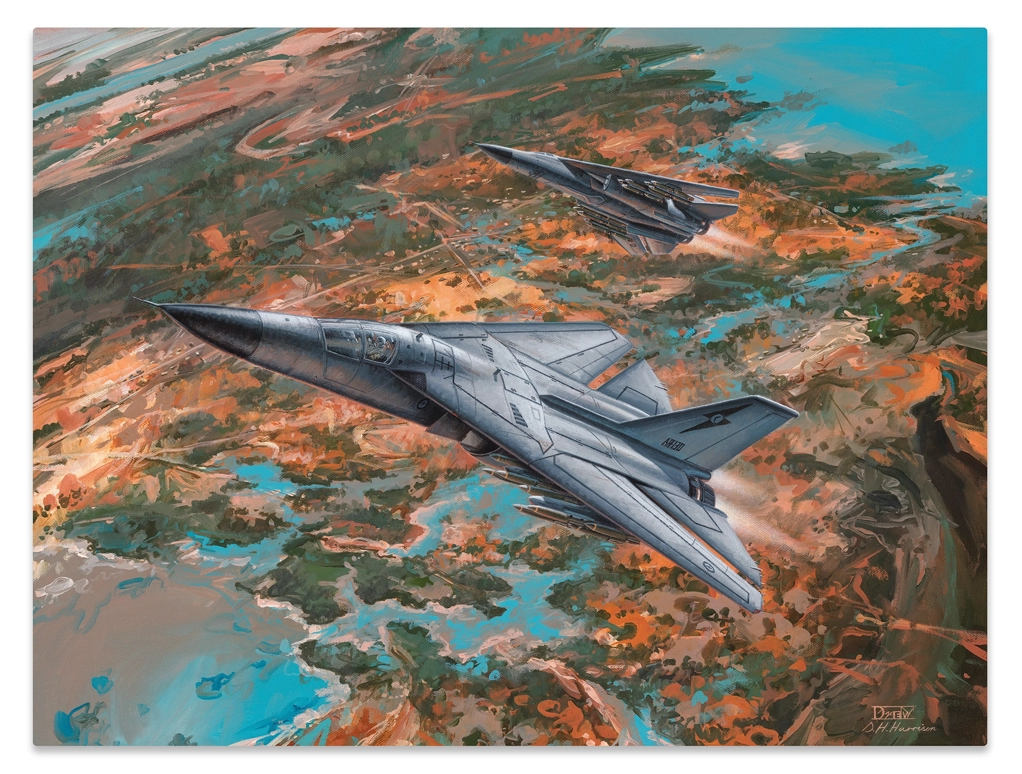
Explore more Australian military stories, art and collectables
The Battle of The Nek is one story within a much larger archive of commissioned military artworks, historically significant pieces, low-number Archive Editions and Limited Edition collections.
Explore The BrandNet Archives