Our Blog

How to Build a Themed Military Figurine Display Case
Table of Contents
- Step 1: Choose a theme that tells one story
- Step 2: Group pieces by size and scale
- Step 3: Choose a figurine display case or cabinet
- Step 4: Use stands, bases and labels to build the story
- Step 5: Get the light right
- Step 6: Pick a safe place in the room
- Step 7: Keep the case and figurines clean
- Start your themed display
- Sources
- FAQs
A themed display starts with one idea, such as a campaign, a service or an act of remembrance, and builds every choice around it. Pick the theme, group pieces by size, then choose a figurine display case or shelf that keeps out dust, direct sun and heat. Add stands and labels last.
This guide walks through each step, from choosing a theme to caring for your figurine display case. The display ideas are our suggestions. The advice on light, dust and case materials comes from conservation sources, including the Canadian Conservation Institute (CCI), the Western Australian Museum and the Australian reCollections guide.
Step 1: Choose a theme that tells one story
A theme gives a display a reason to exist. Without one, a shelf of figurines can look like stock waiting to be sorted. A clear theme also makes it easier to decide what to add next, and what to leave out. Three approaches work well.
- One campaign or era. Our Australian Light Horse figurines could fill a whole shelf on their own.
- One service. A Navy display might centre on the Naval Gunnery Rating World War II Limited Edition Figurine, which the listing describes as "a gunnery sailor serving a 4-inch gun during World War II" (Limited Edition: 1,000).
- One idea. A remembrance display could feature the Resting on Reversed Arms Digger Figurine, described in its listing as a lone digger "standing in the traditional position of respect for the fallen".
If the display honours a person, build it around their service, unit and era. Our article on shared Defence values across Army, Navy and Air Force may help if you want a display that brings all three services together.
Step 2: Group pieces by size and scale

Figurines vary a lot in size, so check the dimensions on each listing before you plan a shelf. The product dimensions for the Resting on Reversed Arms Digger Figurine give a height of 305mm. The Vietnam Digger Miniature Figurine is listed at 200mm high, and The Walers Mate Light Horse Miniature Figurine at 120mm high.
Our suggestion is to keep full-size pieces together and miniatures together, or to place miniatures in front of larger pieces on a stepped shelf. Mixing scales at random can make a strong piece look out of place. Measure width and depth as well as height, and check them against the shelf space inside your figurine display case: the Walers Mate miniature is wider than it is tall.
Step 3: Choose a figurine display case or cabinet
A closed figurine display case does most of the protective work for you. The Western Australian Museum advises that "Items on display should be placed into a showcase", or, if that is not possible, dusted regularly. In our view, a glass-fronted display cabinet for figurines, such as a curio cabinet, does the same job at home. If a closed case will not fit, an open figurine display shelf can work, but plan to dust it more often.
Materials inside an enclosed case matter. The reCollections guide warns that "Objects that are placed within a sealed, secure environment are at risk" if the enclosure contains active chemicals. Its table of materials for storage and display lists glass, ceramic and enamelled metal as good choices. It lists chipboard, unsealed woods (especially hardwoods), PVA glue and PVC as bad choices.
If you are buying a figurine display case, ask what the shelves and back panel are made of. Where the answer is chipboard, a glass shelf liner is a simple barrier, in our view.
Step 4: Use stands, bases and labels to build the story
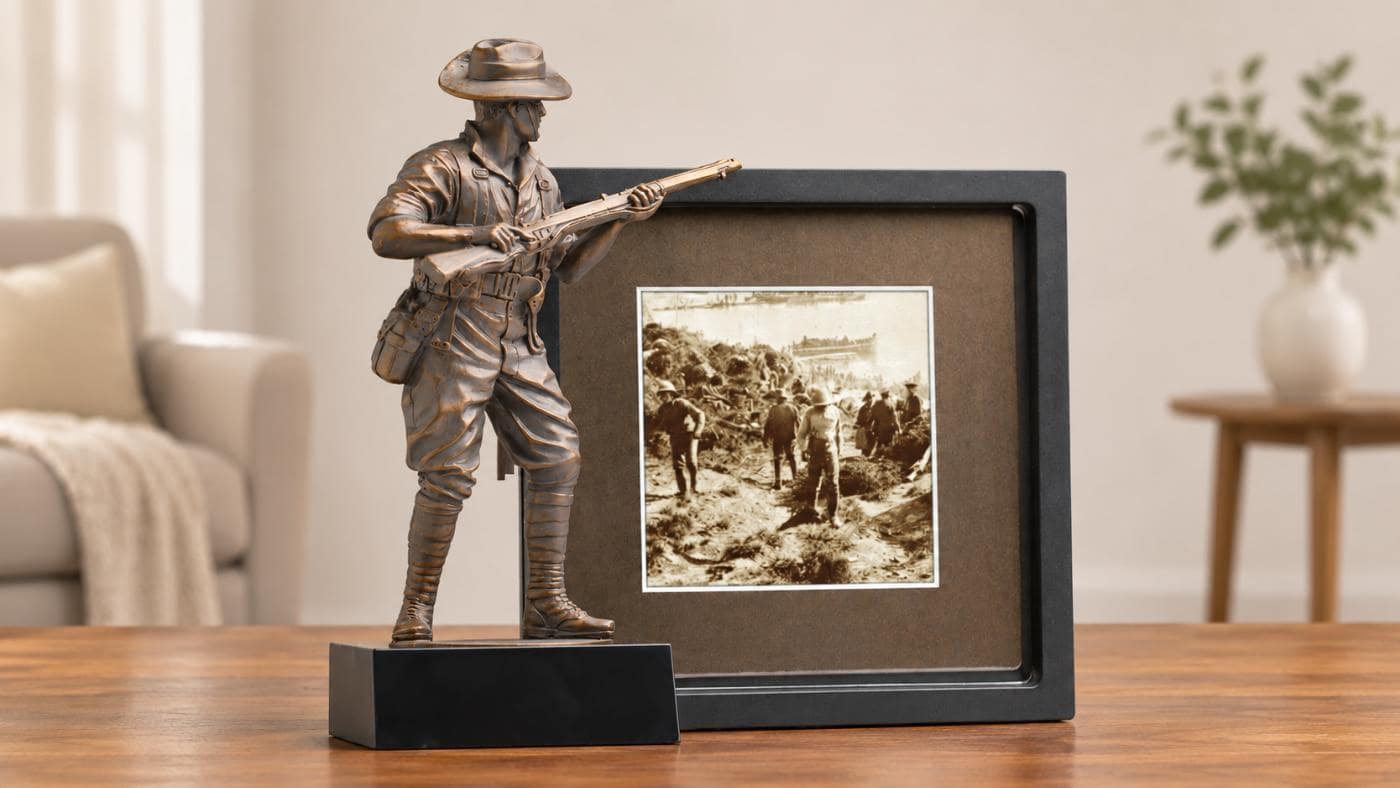
Height changes and labels turn a row of pieces into a display. Our timber Figurine Stand can accommodate a standard 15mm x 60mm inscription plate, according to the listing, though the plate is not included. A short inscription naming the campaign or the person being remembered helps visitors read the theme.
For miniatures, the Miniature Figurine Stand and 3D Frame combines a stand with a frame for photographs, souvenirs or mementos. The listing says items in the frame appear to be "'levitating' between two flexible silicone membranes". A photograph or letter beside a figurine is often what makes a display personal.
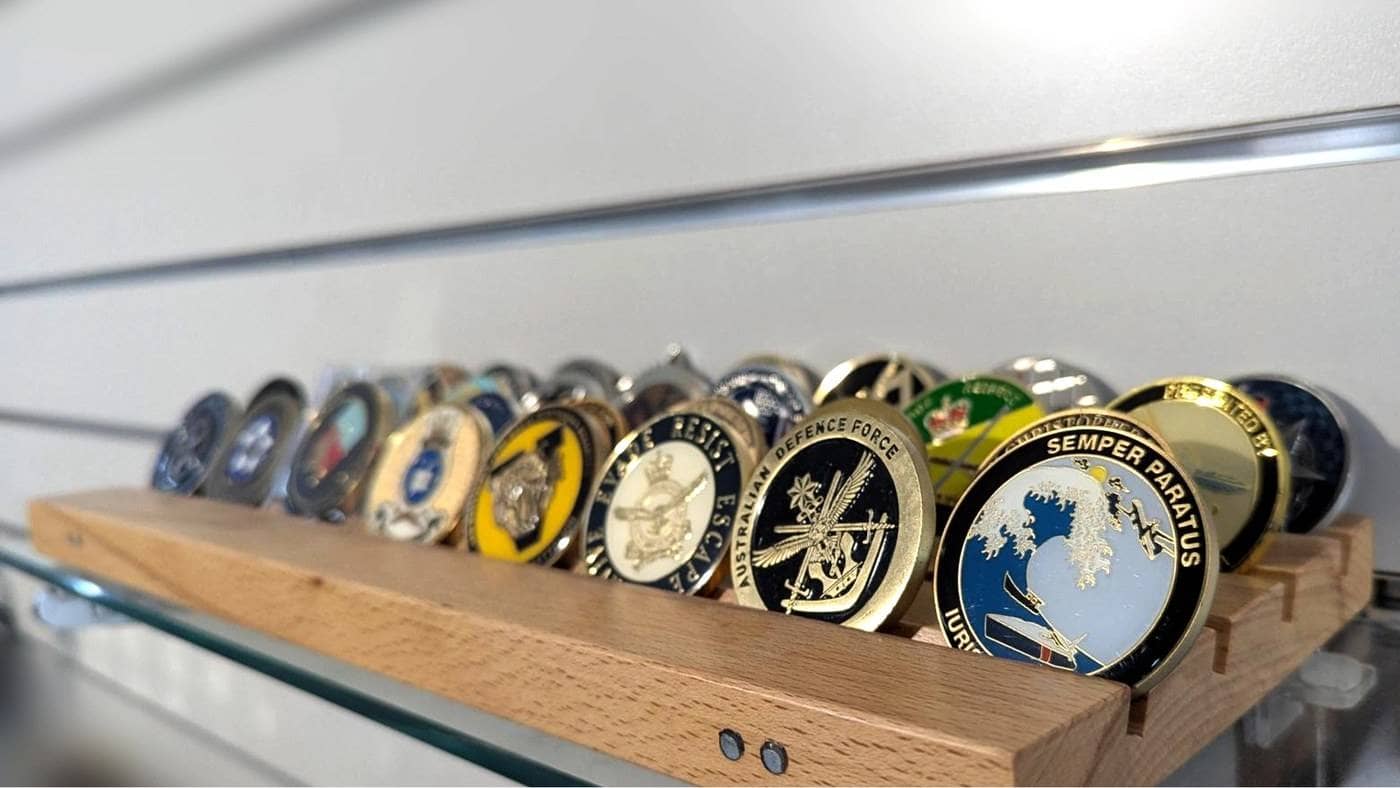
Some bases add their own personal touch. The Naked Army UN Peacekeeper Rwanda 1995 Bronze Figurine has space on its base for a 45mm challenge coin, according to the listing. A unit or association coin set into the base ties the figurine directly to the theme, and to the person or group the display remembers.
Step 5: Get the light right
Light is the factor most people forget. CCI lists "Cracking of most plastics, resins, varnishes, rubber" among the effects of ultraviolet light, and notes that sunlight or intense incandescent lighting can warm surfaces 40°C above ambient, or more. The figurine listings we checked describe their material as resin with a cold-cast bronze finish, so this advice is relevant to them.
CCI's practical advice is to avoid direct sunlight, use blinds or screens on windows and "Switch off electric lights whenever no viewer is present." The reCollections guide advises to "avoid placing tungsten incandescent bulbs inside display cases" because of the heat they produce. If you want a lit figurine display case, CCI notes that UV filters are not necessary for white LEDs.
Step 6: Pick a safe place in the room
Where the figurine display case sits matters as much as what is inside it. CCI's note on plastics advises against "proximity to any heat source" and says relative humidity values over 65% should be avoided. That rules out spots above heaters, beside fireplaces and in steamy bathrooms or laundries.
Our advice is to choose a sturdy, level piece of furniture away from doorways and busy walkways, where it is less likely to be knocked. Keep heavier pieces on lower shelves. Place each figurine well back from the shelf edge.
Step 7: Keep the case and figurines clean
Clean your figurine display case to suit its material. For glass, CCI's note on display cases suggests applying a product such as Windex "sparingly to the centre of the glass", wiping outwards to the edges "with a soft, lint-free cloth", then buffing with a dry cloth. For acrylic, it warns that "Many household cleaners contain abrasives that may scratch acrylic sheet". It also notes that "acrylics tend to generate static electricity during cleaning and use", and that plastics manufacturers sell cleaners for their own products that minimise this.
Our advice is to remove the figurines before cleaning inside any display case for figurines. For the pieces themselves, the Western Australian Museum recommends natural bristled paintbrushes and says to "only use the bristles of the brush". The reCollections guide adds: "Inspect and clean the storage and display areas regularly."
Start your themed display
Begin with one anchor piece that says what the display is about, then add to your figurine display case over time. If you need ideas for that first piece, see our top 12 figurines to own right now. Browse our full range of military figurines for your theme, and our figurine display stands for raising and labelling each piece. A small, well-chosen display often says more than a crowded one.
Sources
1 Canadian Conservation Institute | Agent of Deterioration: Light, Ultraviolet and Infrared | modified 17 May 2018 | https://www.canada.ca/en/conservation-institute/services/agents-deterioration/light.html
2 Canadian Conservation Institute | Care of Objects Made from Rubber and Plastic: CCI Notes 15/1 | modified 3 May 2019 | https://www.canada.ca/en/conservation-institute/services/conservation-preservation-publications/canadian-conservation-institute-notes/care-rubber-plastic.html
3 Western Australian Museum | Dust and Brush Vacuuming (Conservation and Care of Collections) | date not shown | https://manual.museum.wa.gov.au/dust-and-brush-vacuuming
4 Heritage Collections Council (hosted by AICCM) | reCollections: Caring for Collections Across Australia, Handling, Transportation, Storage and Display | 1998 | https://aiccm.org.au/yolo__trashed/handling_storage_transport_display
5 Military Shop | BrandNet Archive Edition: Naval Gunnery Rating World War II Limited Edition Figurine | SKU BN14454BAE | https://militaryshop.com.au/products/brandnet-archive-edition-naval-gunnery-rating-world-war-ii-limited-edition-figurine.html
6 Military Shop | Resting on Reversed Arms Digger Figurine | SKU BN38750 | https://militaryshop.com.au/products/resting-on-reversed-arms-digger-figurine.html
7 Military Shop | Miniature Figurine Stand and 3D Frame | SKU BN50721 | https://militaryshop.com.au/products/miniature-figurine-stand-3d-frame.html
8 Military Shop | Vietnam Digger Miniature Figurine | SKU BN50718 | https://militaryshop.com.au/products/vietnam-digger-miniature-figurine.html
9 Military Shop | The Walers Mate Light Horse Miniature Figurine | SKU BN6801 | https://militaryshop.com.au/products/the-walers-mate-light-horse-miniature-figurine.html
10 Military Shop | Figurine Stand | SKU BN27396 | https://militaryshop.com.au/products/figurine-stand.html
11 Canadian Conservation Institute | Cleaning Glass and Acrylic Display Cases: CCI Notes 1/2 | modified 22 February 2019 | https://www.canada.ca/en/conservation-institute/services/conservation-preservation-publications/canadian-conservation-institute-notes/cleaning-glass-acrylic-display-cases.html
12 Military Shop | Naked Army UN Peacekeeper Rwanda 1995 Bronze Figurine | SKU BN13912 | https://militaryshop.com.au/products/naked-army-un-peacekeeper-rwanda-1995-bronze-figurine.html