Our Blog
Challenge Coin Display and Storage: How to Look After Your Collection
Table of Contents
- Step 1: Handle challenge coins by the edges
- Step 2: Think twice before cleaning a coin
- Step 3: Choose coin holders and capsules free from PVC
- Step 4: Store coins somewhere cool, dry and stable
- Step 5: Pick a challenge coin display that suits the collection
- Step 6: Protect valuable coins inside a challenge coin display
- Step 7: Record and label your collection
- Building your challenge coin display with Military Shop
- Sources
- FAQs
A good challenge coin display keeps coins dust-free, out of direct sun and away from hands, while storage keeps them cool, dry and in holders free from PVC. Handle each coin by its edges, avoid cleaning wherever possible and use materials made for coins. That is the core of guidance from the Royal Australian Mint, the United States Mint, the Royal Canadian Mint and the Canadian Conservation Institute.
Mint guidance is written for coins, but the same principles suit challenge coins and commemorative medallions made from metal. This guide covers handling, cleaning, storage materials and challenge coin display options, drawing on mint and conservation guidance. Always follow any care instructions that come with a particular coin or set.
Step 1: Handle challenge coins by the edges
Most damage starts with fingers. The Royal Australian Mint advises holding coins by the rims and using cotton gloves for extensive handling, and says oils, dirt and moisture can tarnish the surface. The United States Mint suggests holding a coin by its edges between thumb and forefinger over a soft towel or surface.
The Royal Canadian Mint goes further: "Never hold a coin by touching the obverse or reverse surface." Holding a coin over a towel means a slip lands softly rather than on a hard bench.
Gloves are worth a note. The mints recommend cotton gloves, and the Royal Canadian Mint warns against latex or plastic gloves, as their powder or lubricants can damage coins. For metal objects generally, the Canadian Conservation Institute (CCI) recommends clean, suitable plastic gloves such as nitrile gloves, and notes that chloride salts have been found to penetrate cotton gloves after just a single use. Whichever you choose, keep gloves clean and handle coins as little as you can.
Step 2: Think twice before cleaning a coin
People often ask how to clean challenge coins. The short answer from the mints is: usually, don't. The Royal Australian Mint says cleaning coins is generally not recommended.
If a coin must be cleaned of dirt or grime, the Royal Australian Mint suggests only a soft cloth or cotton ball with lukewarm water. It warns never to use harsh chemicals, abrasive materials or polish, as they can damage the coin's surface and affect its value. The Royal Canadian Mint advises cleaning only by experienced specialists and cautions that "Even wiping coins with a soft cloth may damage their finish and drastically reduce their value."
For uncirculated or high-value coins, the Royal Australian Mint suggests leaving them as they are or consulting a professional. If a military challenge coin has enamel, plating or a domed finish, a gentle approach is the safer default.
Step 3: Choose coin holders and capsules free from PVC
Storage materials matter more than most collectors expect. The United States Mint recommends acid-free cardboard and plastic holders free from polyvinyl chloride (PVC), and warns that "PVC eventually coats a coin with sticky green slime." The Royal Canadian Mint suggests small, PVC-free plastic bags or slabs for valuable collector coins, and acid-free paper sleeves, envelopes, tubes, folders or albums for coins of lower value.
The Royal Australian Mint recommends protective holders such as capsules or albums designed specifically for coin storage. For valuable or rare coins, it suggests considering acid-free materials. The United States Mint adds that all modern coin sets and coins should be bought and sold in their original cases and capsules, and recommends hard plastic holders for high-value coins.
If coin holders or capsules do not say what they are made from, ask the seller before using them for long-term storage. That is our advice, based on the PVC warnings above.
Step 4: Store coins somewhere cool, dry and stable
The Royal Australian Mint advises storing coins in a dry, cool place away from direct sunlight and humidity, as excessive heat or moisture can cause coins to tarnish or degrade over time. The United States Mint notes that sharp changes in temperature and moisture cause discolouration that devalues coins.
CCI's guidance on metals points the same way. It says the priority is to avoid relative humidity above 65%, and that above this threshold all metal corrosion significantly speeds up. CCI also explains that dust settling on metal can contain salts and particles that attract moisture and cause local corrosion, so enclosures help.
In practice, an internal cupboard, shelf or wall in a living area usually suits coins and a challenge coin display better than a garage, shed or bathroom. That is our suggestion, not a rule.
Step 5: Pick a challenge coin display that suits the collection
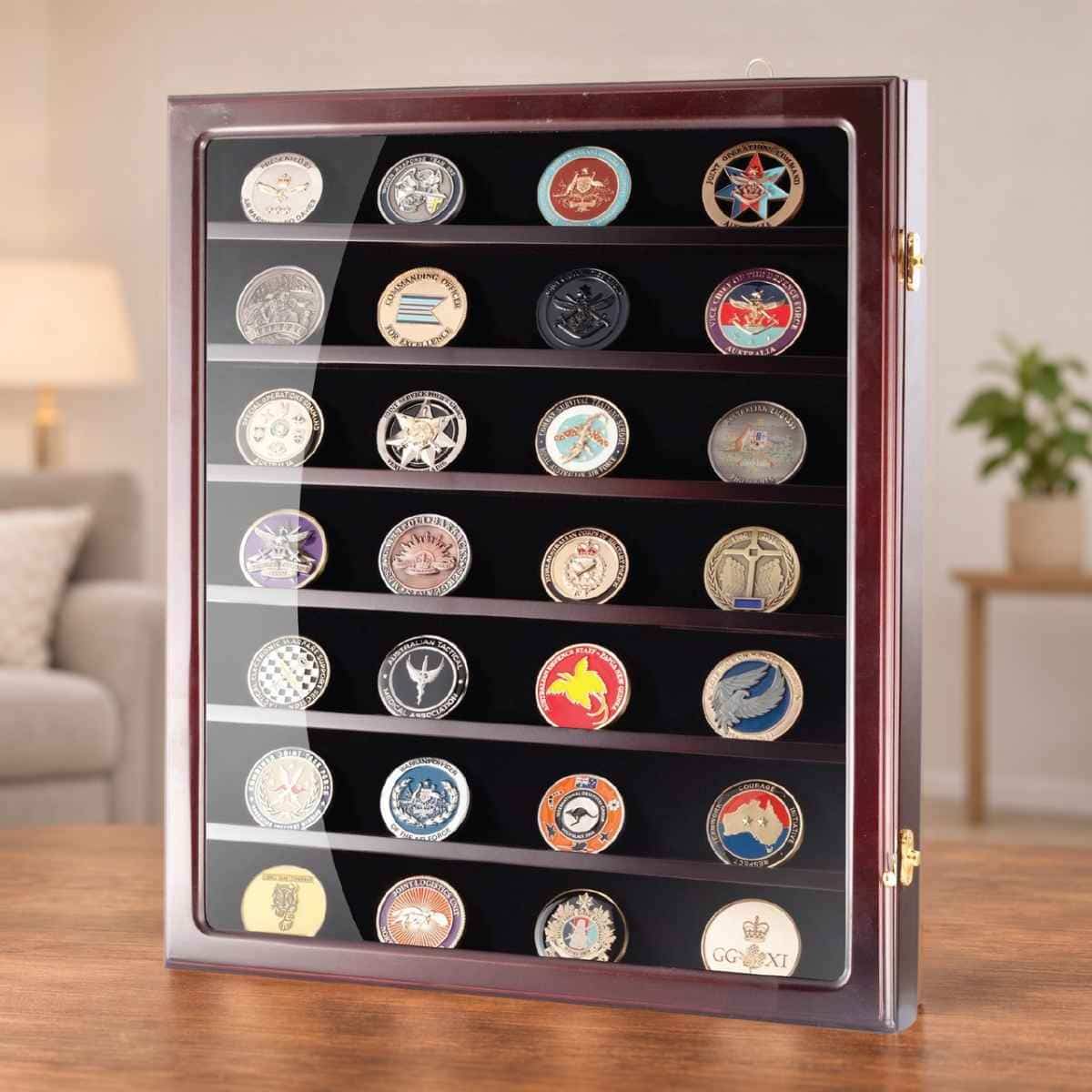
Once coins are handled and stored well, display becomes the enjoyable part. The right challenge coin display depends on how many coins you have and where you want to see them.
| Display type | Suits | Watch for |
|---|---|---|
| Wall-mounted coin display case | Larger collections on show | Dust, sun and wall placement |
| Tabletop slotted stands | Desks and shelves | Dust and handling |
| Single coin stand or presentation box | One special coin | Frequent handling |
For a wall, the Challenge High Gloss Timber 49 x Coin Wall Mountable Display Case is a coin display case with seven velvet-backed levels for up to 49 coins, according to the listing. The listing also describes a shatter-safe hinged Perspex window that keeps coins dust-free, and gold-plated fittings.
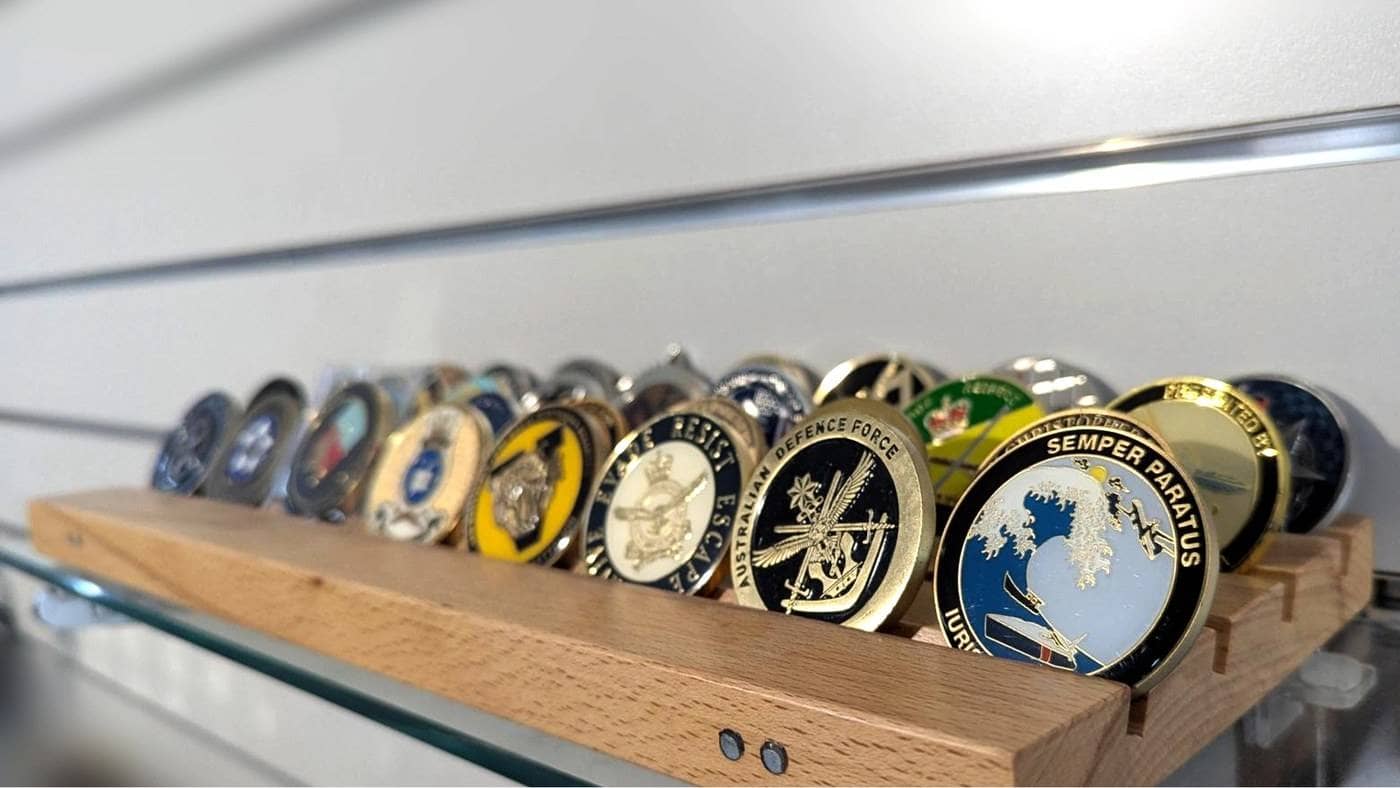
For a desk or shelf, the Solid Beech Challenge Coin Low-set Display Stand and the High-set Display Stand are slotted solid beech units. The listings say they have magnetic-lock tapered legs, and that combining the two creates an eight-slot graduated display for up to 64 coins.
For one special piece, the Medallion Stand In Gift Box is made from black acrylic and fits medallions up to 48 mm, according to the listing.
Step 6: Protect valuable coins inside a challenge coin display
A timber challenge coin display is traditional and looks good, but CCI notes that unsealed wood and wood-based products emit organic acids, and that paints and varnishes are generally not effective barriers. In discussing paints, varnishes and coatings, it says display cases and other enclosures need to air out for at least four weeks before metal objects are placed in them.
Our suggestion is simple. Keep everyday coins on open display, and keep rare or valuable coins in their coin capsules or holders, even when they are on show. Check coins now and then for tarnish or spots, and rotate them if one area gets more light.
Avoid touching displayed coins without washing your hands or wearing gloves. Fingerprints carry salts, oils and moisture that can lead to corrosion, especially on polished metal, according to CCI.
Step 7: Record and label your collection
A short record makes a collection easier to enjoy and pass on. Note each coin's unit, ship or occasion, where it came from and any number or certificate. Limited releases often come with paperwork worth keeping with the coin.
The Limited-Edition Lazy Anchor Button Challenge Coin and Boatswain's Call Collection is one example (Limited Edition: 1125). The listing says each coin is individually numbered, the set is presented in a leatherette display box, and each box set includes an individually numbered Certificate of Authenticity. Keep certificates dry and stored with or near the coin they belong to.
Building your challenge coin display with Military Shop
Challenge coins often mark a ship, unit or milestone, which is part of what makes them worth looking after. If your collection leans naval, our article on Navy roles: military, diplomatic and constabulary gives useful background. If you also look after service medals, read our guide on how to properly display and preserve war medals.
Browse our coin display and packaging range for cases, stands and presentation boxes. Start with how many coins you have and where you want to see them, and choose the challenge coin display that keeps them clean, dry and easy to enjoy.
Sources
1 Royal Australian Mint | Collection care | date not shown | https://www.ramint.gov.au/coin-care
2 United States Mint | Caring for Your Coin Collection | date not shown | https://www.usmint.gov/learn/collecting-basics/caring-for-your-coin-collection
3 Royal Canadian Mint | Coin Care | date not shown | https://www.mint.ca/en/get-started/coin-care
4 Canadian Conservation Institute (Government of Canada) | Caring for metal objects: Preventive conservation guidelines for collections | modified 11 February 2025 | https://www.canada.ca/en/conservation-institute/services/preventive-conservation/guidelines-collections/metal-objects.html
5 Military Shop | Challenge High Gloss Timber 49 x Coin Wall Mountable Display Case | SKU BN55252 | https://militaryshop.com.au/products/challenge-coin-display-case.html
6 Military Shop | Solid Beech Challenge Coin Low-set Display Stand | SKU BN55250 | https://militaryshop.com.au/products/solid-beech-challenge-coin-low-set-display-stand.html
7 Military Shop | Solid Beech Challenge Coin High-set Display Stand | SKU BN55251 | https://militaryshop.com.au/products/solid-beech-challenge-coin-high-set-display-stand.html
8 Military Shop | Medallion Stand In Gift Box | SKU BN8715 | https://militaryshop.com.au/products/medallion-stand-in-gift-box.html
9 Military Shop | Limited-Edition Lazy Anchor Button Challenge Coin and Boatswain's Call Collection | SKU BN34573 | https://militaryshop.com.au/products/limited-edition-lazy-anchor-button-challenge-coin-and-boatswain-s-call-collection.html