


Why Military Challenge Coins Hold Lifelong Meaning for Australian Veterans
Table of Contents
- What Are Military Challenge Coins?
- Why Do Veterans Keep Challenge Coins?
- Challenge Coins and Military Medals Are Not the Same
- The Tradition of the Coin Challenge
- Different Types of Military Coins
- Why Collect Military Challenge Coins?
- Military Coins in Australia and Veteran Communities
- Australian Collector Buying Guidance
- Keeping the Story Behind the Coin
- A Small Object With a Bigger Story
- FAQs
For many Australian veterans, military challenge coins are more than decorative pieces or souvenirs. A coin may represent a particular unit, deployment, commander, exercise, achievement or group of mates. Years after leaving the Australian Defence Force (ADF), veterans may still keep these coins in a drawer, display case, office or collection alongside medals, patches and other service memorabilia.
That personal connection is a major reason challenge coins continue to attract interest among veterans and military collectors. Their value isn't necessarily determined by the metal or the coin's financial worth. Instead, it often comes from the story attached to it.
What Are Military Challenge Coins?
Military challenge coins are small commemorative or recognition coins associated with military units, organisations, commands, events and individuals. Designs can feature unit insignia, service emblems, mottos, dates, operation references or other symbols connected to military service.
The modern challenge coin tradition is strongly associated with the US military, where the practice became widely established before spreading to other military and service communities, including Australia.
The way coins are issued and used can vary between organisations. Some are presented as informal recognition by a commander or senior officer, while others commemorate a deployment, exercise, anniversary or particular unit.
Unlike formal military medals, challenge coins generally do not form part of an official honours and awards system. Their significance is often more personal, reflecting an individual's connection to a unit, event or group of people.
Why Do Veterans Keep Challenge Coins?
They Represent Service and Belonging
Military service creates strong connections between people who train, work and deploy together. A challenge coin can provide a physical reminder of those relationships.
For a veteran, seeing a familiar unit insignia years after leaving service can immediately bring back memories of a particular posting or group of mates. The coin becomes a compact representation of an experience that may be difficult to explain to someone outside the defence community.
This is one reason military coins can hold considerable sentimental value even when they have little monetary value.
They Mark Important Moments
A coin may also commemorate a significant point in a military career.
It could be connected to a deployment, major exercise, posting, unit anniversary, or personal achievement. In some cases, someone presents a coin directly as informal recognition.
Unlike a formal award, the meaning may come from the circumstances in which you received the coin. Remembering who presented it, where it happened, and why it was significant can become part of the coin's story.
They Preserve Unit Identity
Military units develop their own traditions, insignia, and histories. Challenge coins can preserve part of that identity in a physical form.
A collection might include coins from different units, ships, squadrons, exercises or stages of a veteran's career. Each design can provide a small piece of information about where that person served and the organisations they were associated with.
For collectors, this historical connection can be just as interesting as the physical design.
Challenge Coins and Military Medals Are Not the Same
It is easy to group challenge coins and medals together because both can form part of a veteran's collection. However, they serve different purposes.
Military medals are formal honours awarded under established systems to recognise qualifying service, conduct, achievement, bravery or participation in particular campaigns and operations.
Challenge coins are generally informal tokens of recognition, association or commemoration.
That distinction does not make one more meaningful than the other. A medal may represent an officially recognised achievement, while a challenge coin may remind its owner of a particular commander, unit, deployment or group of colleagues.
For veterans, having both in a collection can provide a broader record of their military experience.
The Tradition of the Coin Challenge
One of the better-known traditions associated with challenge coins is the informal "coin challenge."
The exact rules vary between groups, but the basic idea involves one person producing their coin and challenging others to show theirs. In some versions of the tradition, anyone who cannot produce a coin may be expected to buy a round of drinks, while other groups treat the challenge simply as a social ritual.
The tradition is closely associated with military culture, particularly in the United States, and variations can exist between units and organisations.
The important point is less about the penalty and more about the sense of belonging behind the ritual. Carrying a coin can demonstrate a person's connection to a particular military community.
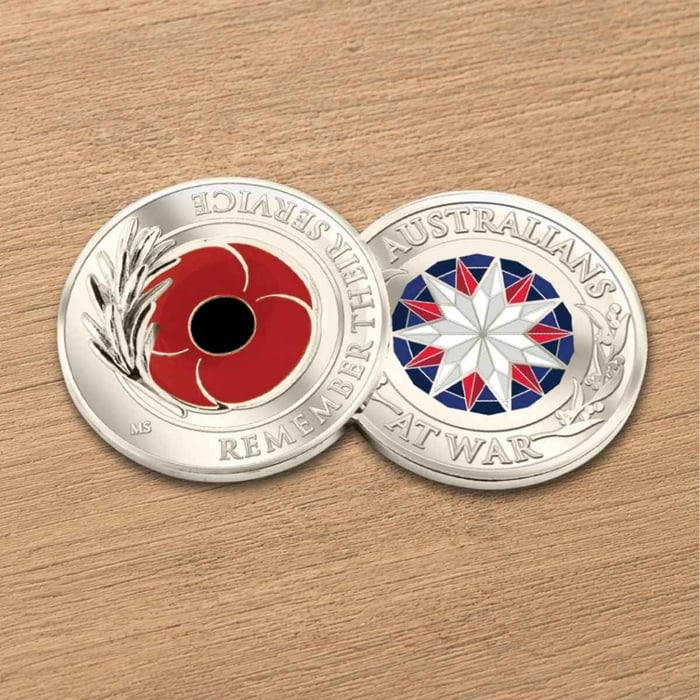
Different Types of Military Coins
Military coins can cover a wide range of designs and purposes. Common examples include:
- Unit and regimental coins: Associated with particular battalions, regiments, ships, squadrons or other military organisations.
- Commander's coins: Informal recognition presented by senior leaders to individuals for noteworthy contributions or achievements.
- Deployment coins: Created to commemorate deployments, operations, exercises or other periods of service.
- Commemorative coins: Produced to mark anniversaries, events, historical occasions or significant milestones.
- Service-themed coins: Featuring imagery, insignia or symbols associated with a particular branch or area of military service.
For Australian collectors, this variety creates plenty of opportunities to build collections around individual service histories, units or military themes.
Why Collect Military Challenge Coins?
Not every veteran who owns a challenge coin considers themselves a collector. For some, one particularly meaningful coin is enough. Others gradually accumulate coins over years of service and involvement with military communities.
A collection can provide a visual record of different stages of a career. Coins may represent units served with, deployments undertaken, exercises attended, or people who played an important role in a veteran's service.
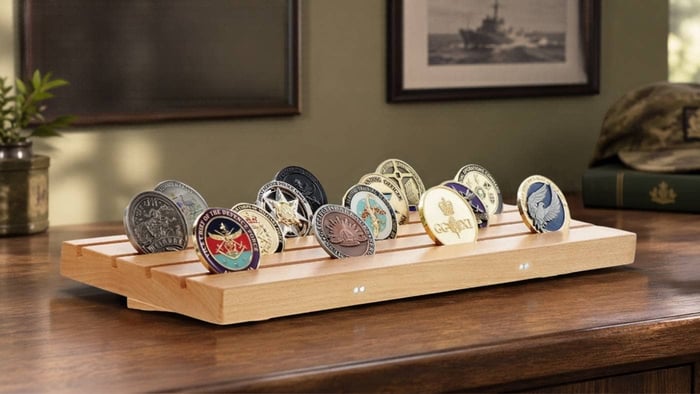
Collectors may also organise their coins by service, unit, period, operation or design. Display cases and dedicated storage can make it easier to protect and organise a larger collection.
The story behind each coin is often just as important as the object itself. Recording who presented a coin, when it was received and what it commemorates can help preserve that history for future generations.
Military Coins in Australia and Veteran Communities
Interest in military coins in Australia extends beyond current and former ADF personnel. Military history enthusiasts, families and collectors can also be drawn to coins because they provide an accessible way to explore military history.
A coin's insignia or wording can prompt questions about a particular regiment, ship, squadron, operation or period of service. In this way, a collection can become a starting point for researching the history behind the objects.
For families, challenge coins can also help preserve a veteran's personal story. A collection passed down to children or grandchildren can provide a tangible connection to a relative's service, particularly when the background of individual coins has been recorded.
Australian Collector Buying Guidance
For Australian collectors, buying military challenge coins is often about finding pieces with genuine relevance rather than simply accumulating as many coins as possible. Before purchasing, consider what the coin represents and whether it fits your collection's focus.
A few practical points are worth keeping in mind:
- Check the design and markings: Look for clear unit insignia, service references, dates, mottos or other details that identify what the coin represents.
- Understand the background: If a coin is described as relating to a particular unit, operation or event, learn what that connection is before buying. The story behind a coin can greatly increase its interest.
- Consider condition: Scratches, worn finishes, damaged edges or missing presentation cases may affect how a coin fits into a collection, particularly when long-term preservation matters.
- Ask about provenance: When buying an older or particularly specific military coin, any available information about its history, previous ownership or original issue can be useful.
- Be cautious with rarity claims: Words such as "rare", "limited edition" or "hard to find" do not automatically mean a coin is historically important or valuable. Look for specific information about its production and connection to the military organisation or event.
- Buy for relevance as well as appearance: A well-designed coin may look impressive, but a piece connected to a unit, service or period of history that interests the collector can make a collection more meaningful.
Australian collectors should also be aware that not every military-themed coin has a direct connection to an official military organisation. Commercially produced commemorative pieces can look similar to genuine unit or recognition coins. When authenticity or historical provenance matters, understanding exactly what you're buying is more important than relying solely on the design.
For many collectors, a clear theme can make a collection easier to research and organise. This might centre on Australian military units, particular conflicts, ADF history, deployments or specific types of military memorabilia.
Keeping the Story Behind the Coin
Because challenge coins are small and easy to store, they can remain in good condition for many years with sensible care.
Keeping coins in a dry environment and protecting them from unnecessary scratching or handling can help preserve their appearance. Display cases, holders, and other suitable storage options can also help when a collection includes numerous pieces.
More importantly, preserve the information attached to significant coins.
A note explaining who presented a coin, when it was received, what unit it represents or which event it commemorates can add valuable context. Without that information, future generations may inherit the object without knowing the story that made it important.
A Small Object With a Bigger Story
Military challenge coins occupy an interesting place in military memorabilia. They are small, practical, and relatively easy to collect, yet they can represent years of service, unit identity, important milestones, and friendships formed in uniform.
For Australian veterans, a coin's meaning often comes from the experience behind it, not the object itself. A particular insignia can recall a posting. A date can bring back a deployment. A commander's coin can remind someone of recognition received from a senior leader. A unit coin can reconnect former colleagues with the organisation they once served.
That mix of personal history and military tradition explains why challenge coins still find a place in collections long after the uniform has been put away. For veterans, families and collectors looking to preserve those connections, browse Military Shop's range of military memorabilia and related products.
FAQs
What do you do with military challenge coins?
In the Australian Defence Force, military challenge coins can be kept as mementos of service, recognition, unit membership, deployments, exercises or important events. Australian Defence has documented challenge coins being presented by commanders to personnel as recognition, including at multinational exercises.
Veterans may carry a particularly meaningful coin, display their collection at home, or keep coins alongside medals, patches and other military memorabilia. Coins can also be exchanged between serving personnel and used to maintain connections between colleagues and units.
What are the rules of a military challenge coin?
There is no single set of official Australian Army rules governing challenge coins. Their use is generally informal and can vary between units, commanders and organisations.
The Australian Army's own professional discussion platform, The Cove, has described a company commander creating a numbered challenge coin and presenting it alongside certificates of appreciation to recognise high-performing personnel. The article specifically notes that the coin was not an official Defence or Army award.
Some groups also use the traditional coin challenge, where personnel are asked to produce their coin. Customs around this practice can differ, so no universal Australian rule requires a particular response or penalty.
What do Army challenge coins symbolise?
Australian Army challenge coins can symbolise recognition, unit identity, achievement, service and connection between personnel.
The meaning depends on the coin and the circumstances of its presentation. For example, the Australian War Memorial held an Australian Army challenge coin presented by the Chief of Army to Corporal Garth O'Connell during NAIDOC Week in 2012. The coin featured the Aboriginal Flag, Torres Strait Islander flag and the Australian Army's Rising Sun emblem.
More recently, Defence has described a challenge coin designed for the Chief of Joint Capabilities as a “symbol of pride and connection” across the organisation.
Should you carry a challenge coin?
Australian Army personnel and veterans are not required to carry a challenge coin. Whether someone carries one is generally a personal choice.
Some serving personnel carry a particular coin because it represents their unit, a significant achievement or an important period of service. Australian Defence has also documented personnel who actively collect and carry different coins. In one example, a Royal Australian Navy sailor described carrying a different “Coin of the Day” while maintaining a large personal collection.
For veterans, a coin can serve as a personal reminder of service or be kept safely at home as part of a larger collection.
What is the rarest military challenge coin?
There is no officially recognised single rarest Australian military challenge coin. Rarity can depend on how many coins were produced, who issued them, when they were made, who received them, and how many examples are known to exist.
Some Australian Army coins are particularly limited or closely associated with senior commanders. For example, the Australian War Memorial holds a 2012 Australian Army Aboriginal and Torres Strait Islander challenge coin that was described as a limited edition produced specifically for the Chief of Army.
However, limited production does not automatically make a coin the most valuable or historically significant. For Australian collectors, the coin's provenance, issuing unit, date, recipient, and connection to a particular event or period of service can all be important when assessing its significance.