Our Blog
Maritime Security and Naval Warfare: Where the Ideas Overlap and Differ
Table of Contents
- What is maritime security?
- Maritime Border Command and maritime security in Australia
- What naval warfare means
- Where maritime security and naval warfare overlap
- Maritime security vs naval warfare: the key differences
- A middle ground: maritime interdiction
- How to read a story about security at sea
- Honour the people who serve at sea
- Sources
- FAQs
Maritime security and naval warfare share ships, people and some goals, but they answer different problems. Maritime security is about protecting a country's maritime interests, including ports, coastal waters and shipping, often against non-military threats such as smuggling or marine pollution. Naval warfare is combat at sea against an armed adversary, with authorisation to use force. The overlap is real; the threat, the legal authority and the lead agency are what separate them.
This guide draws on Sea Power Centre publications, Home Affairs, the Australian Border Force, DFAT and Defence. It explains each idea in Australian terms, shows where they meet and gives a simple test for reading news about activity at sea.
What is maritime security?
The Sea Power Centre, Australia glossary defines maritime security as "The protection of a country's maritime interests, including its ports, coastal waters, and shipping." That is a broad definition. It covers more than defence against another navy.
In Australia, the civilian side has its own strategy. On 6 April 2022 the Australian Government released the Australian Government Civil Maritime Security Strategy. Home Affairs says robust civil maritime security is needed to advance and protect Australia's interests "while actively managing non-military risks to Australia". The Strategy sets out a whole-of-government approach, and the Department of Home Affairs is the lead agency for its implementation.
Its strategic objectives include upholding "Australia's sovereignty, freedom of navigation and maritime trade", protecting maritime infrastructure and natural resources, protecting users of the maritime domain and strengthening relationships within the region.
Maritime Border Command and maritime security in Australia
Much of the operational work sits with Maritime Border Command (MBC). The Australian Border Force says MBC "is comprised of both Australian Border Force and Australian Defence Force personnel and assets". Its role is to "coordinate and execute civil maritime security operations in order to deter, detect and respond to illegal activities".
ABF lists eight threats MBC addresses: unauthorised maritime arrivals; prohibited imports and exports; illegal exploitation of natural resources; illegal activity in protected areas; compromises to biosecurity; maritime terrorism; piracy, robbery or violence at sea; and marine pollution. The scale is large. ABF notes that "Australia's coastline is 37,000km long" and that its Exclusive Economic Zone is larger in size than mainland Australia.
Most of those threats come from criminals, polluters or unlawful activity, not from an enemy fleet. For a closer look at the policing side, see our guide to how naval diplomacy differs from maritime law enforcement.
What naval warfare means
Australian Maritime Doctrine (RAN Doctrine 1, second edition, 2010) sets out a spectrum of operations. Warlike operations "all involve the existence of an armed adversary and the authorisation to apply force". That is the starting point for combat at sea.
The doctrine explains sea control as the freedom to use an area of sea "for its own purposes for a period of time" and, if required, to deny its use to an opponent. It also describes sea denial in several forms, ranging "from the maintenance of a blockade of enemy forces", "through the operation of exclusion zones", "to campaigns against an adversary's trade or logistic systems".
Current planning still reflects warfighting priorities. The 16 April 2026 ministerial release on the 2026 National Defence Strategy says the 2026 Integrated Investment Program prioritises investment to "deliver an enhanced undersea warfare capability" and to "accelerate the delivery of more lethal maritime capabilities". These are plans and investment priorities, not a description of the fleet in service today.
Doctrine is only one way to describe what a navy does. Our article on the military, diplomatic and constabulary roles of a navy sets out the wider picture.
Where maritime security and naval warfare overlap
Shipping and trade
The Sea Power Centre glossary definition names shipping. Doctrine lists campaigns against an adversary's trade among forms of sea denial. The 2026 National Defence Strategy factsheet says the Government has directed the ADF to maintain the capacity to "Protect Australia's economic connection to our region and the world". Trade sits inside both ideas. Our article on the Merchant Navy and Australian defence explores why shipping matters to security.
Freedom of navigation
DFAT says the United Nations Convention on the Law of the Sea (UNCLOS) "provides all countries with a clear framework for the lawful uses of our oceans" and that it "includes well-established rights to freedom of navigation and overflight." Freedom of navigation appears in the civil strategy's objectives. Defence's Regional Presence Deployments page also says Australian vessels and aircraft "will continue to uphold International Law" and "exercise freedom of navigation".
The same people and platforms
MBC draws on ADF personnel and assets as well as ABF ones. A naval vessel on a civil security task is still a naval vessel. What it is authorised to do depends on the task.
Maritime security vs naval warfare: the key differences
| Question | Maritime security (civil) | Naval warfare |
|---|---|---|
| Main threat | Non-military risks and illegal activity | An armed adversary |
| Use of force | In peacetime, only within domestic law or the international order | Authorisation to apply force |
| Lead in Australia | Home Affairs strategy; MBC operations | Defence, under Government direction |
| Typical tasks | Deter, detect and respond to illegal activities | Sea control and sea denial |
On use of force, doctrine says that in peacetime operations "Force or threats of force are only employed within the context of the domestic legal system or the international order." It describes operations other than war as activities "short of warlike, where the application of force is limited to self-defence."
The "Lead in Australia" entry for naval warfare is our summary, not a quote. Treat the table as a reading aid, not a legal classification.
A middle ground: maritime interdiction
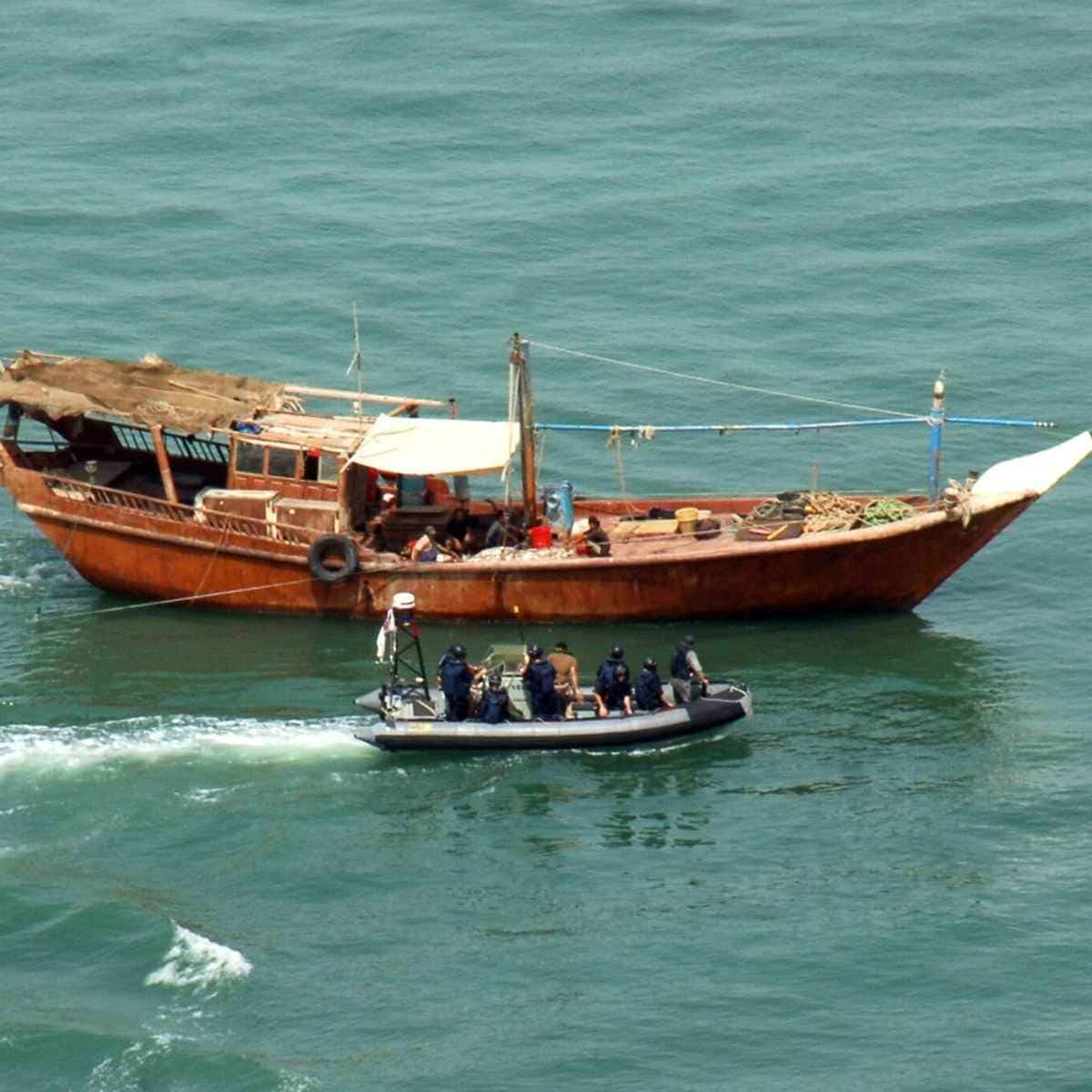
Some tasks sit between the two ideas. The Sea Power Centre glossary defines maritime interdiction as "The use of force or coercion to interrupt or stop maritime activity, such as smuggling or piracy."
That definition shows why the line can blur. Interdiction can involve force without being naval warfare. In our view, the clearest test remains the one in doctrine: is there an armed adversary, and has force been authorised against it?
How to read a story about security at sea
When a news story mentions a warship, a patrol boat or an aircraft at sea, ask four questions. What threat is described? Which agency is named as leading? What authority does the source say was used? Is the activity a patrol, an interception or a combat operation?
For example, a patrol that intercepts a vessel suspected of carrying prohibited imports is maritime security work, even if a Navy ship takes part. A plan to strengthen undersea warfare is about naval warfare, even if no conflict is under way. Keep the date and publisher with your notes, and separate plans from capabilities already in service.
The Navy's work spans both ideas, which is part of what makes naval service distinctive.
Honour the people who serve at sea
Whether a sailor's service was spent on border patrols, regional deployments or warfighting training, it deserves accurate recognition. Our Royal Australian Navy gear and gifts range brings together Navy collectables and commemorative items.
The Navy pewter tankard is described in its listing as a traditional pewter tankard with an engraved navy crest. For everyday wear, the Navy veteran badge is listed as an enamel over metal veterans' badge reflecting the colours and traditions of the Royal Australian Navy. Pair either with a short, accurate note about the person's service.
Sources
1 Sea Power Centre, Australia | Glossary: M | date not shown | https://seapower.navy.gov.au/glossary/m
2 Department of Home Affairs | Civil maritime security (web page on the Australian Government Civil Maritime Security Strategy) | Strategy released 6 April 2022 | https://www.homeaffairs.gov.au/about-us/our-portfolios/national-security/civil-maritime-security
3 Australian Border Force | Maritime Border Command | last updated 12 October 2026 | https://www.abf.gov.au/about-us/what-we-do/border-protection/maritime
4 Sea Power Centre, Australia | Australian Maritime Doctrine: RAN Doctrine 1 (Second Edition) | 2010 | https://seapower.navy.gov.au/sites/default/files/documents/Amd2010.pdf
5 Deputy Prime Minister and Minister for Defence | 2026 National Defence Strategy and Integrated Investment Program (media release) | 16 April 2026 | https://www.minister.defence.gov.au/media-releases/2026-04-16/2026-national-defence-strategy-integrated-investment-program
6 Department of Defence | 2026 National Defence Strategy: overview factsheet | 2026 | https://www.defence.gov.au/sites/default/files/2026-04/2026%20NDS%20Overview_factsheet_WEB.pdf
7 Department of Foreign Affairs and Trade | Australia supports peaceful dispute resolution in the South China Sea (media release) | date not shown | https://www.dfat.gov.au/news/news/Pages/australia-supports-peaceful-dispute-resolution-in-the-south-china-sea
8 Department of Defence | Regional Presence Deployments | date not shown | https://defence.gov.au/defence-activities/operations/indo-pacific-operations/regional-presence-deployments
9 Military Shop | Navy Pewter Tankard | SKU BN2271 | https://militaryshop.com.au/products/navy-pewter-tankard.html
10 Military Shop | Navy Veteran Badge | SKU BN41987 | https://militaryshop.com.au/products/navy-veteran-badge.html