Our Blog
What Does the Navy Do? Naval Presence and Naval Combat at Sea
Table of Contents
- What does the Navy do? Its mission covers competition and conflict
- What does the Navy do short of war? Naval presence
- Regional Presence Deployments show presence in practice
- What does the Navy do in combat? Naval warfare and sea control
- Presence and combat compared
- Presence depends on combat credibility
- How to read a naval story: presence or combat?
- Recognise the ship behind the story
- Sources
- FAQs
What does the Navy do when it is not fighting? A large part of the answer is presence: ships deployed where they can be seen, work with partners and show national intent. Combat has a different purpose. Australian maritime doctrine describes warlike operations as involving an armed adversary and the authorisation to apply force. [1] The same ship can be prepared for both, but the purpose of a task decides which one it is.
This guide uses Royal Australian Navy doctrine, Defence statements and Sea Power Centre analysis to separate the two ideas. It asks two questions: what does the Navy do short of war, and what does the Navy do in combat? It keeps published concepts, documented past activities and future plans apart. It does not describe any current operation beyond what Defence has published.
What does the Navy do? Its mission covers competition and conflict
Navy's published mission is "to prepare naval power in order to enable the integrated force in competition and conflict." [2] That sentence names two settings, not one. Navy also says it contributes to the Defence mission by providing "safe seaworthy, airworthy and battle worthy ships, submarines, aircraft, and specialist teams", and that these assets contribute "to maintaining sovereignty and security in Australia's region." [2]
In our reading, presence does much of its work in competition, while combat belongs to conflict. The ships, crews and training are the same in both. What changes is the task they are given and the authority they hold. So the answer to "What does the Navy do?" depends on the setting.
What does the Navy do short of war? Naval presence
Australian Maritime Doctrine (RAN Doctrine 1, second edition, 2010) is published by the Sea Power Centre, Australia. It describes maritime forces, "through their ability to demonstrate sustained presence without violating another nation's sovereignty", as "a highly appropriate mechanism for demonstrating national intent." [1]
The same publication says the RAN "has on countless occasions acted to support, reassure, deter, or coerce as a particular need arose." [1] It links the effect of naval diplomacy to "the normally unstated, but self-evident threat inherent in a warship." [1]
That is the core of naval presence. A ship can reassure a partner or signal resolve without firing a shot. Its message depends on what it could do, not only on what it does that day. Our article on how naval diplomacy differs from maritime law enforcement looks more closely at the relationship side of that work.
Regional Presence Deployments show presence in practice
Defence describes Regional Presence Deployments as demonstrating "Australia's commitment and ability to maintain a near continuous presence" to support "regional security and stability." [3] Its page lists purposes that include protecting Australia's interests, preserving an international rules-based order, enhancing cooperation and relationships with regional partners and allies, and developing capability and interoperability. [3]
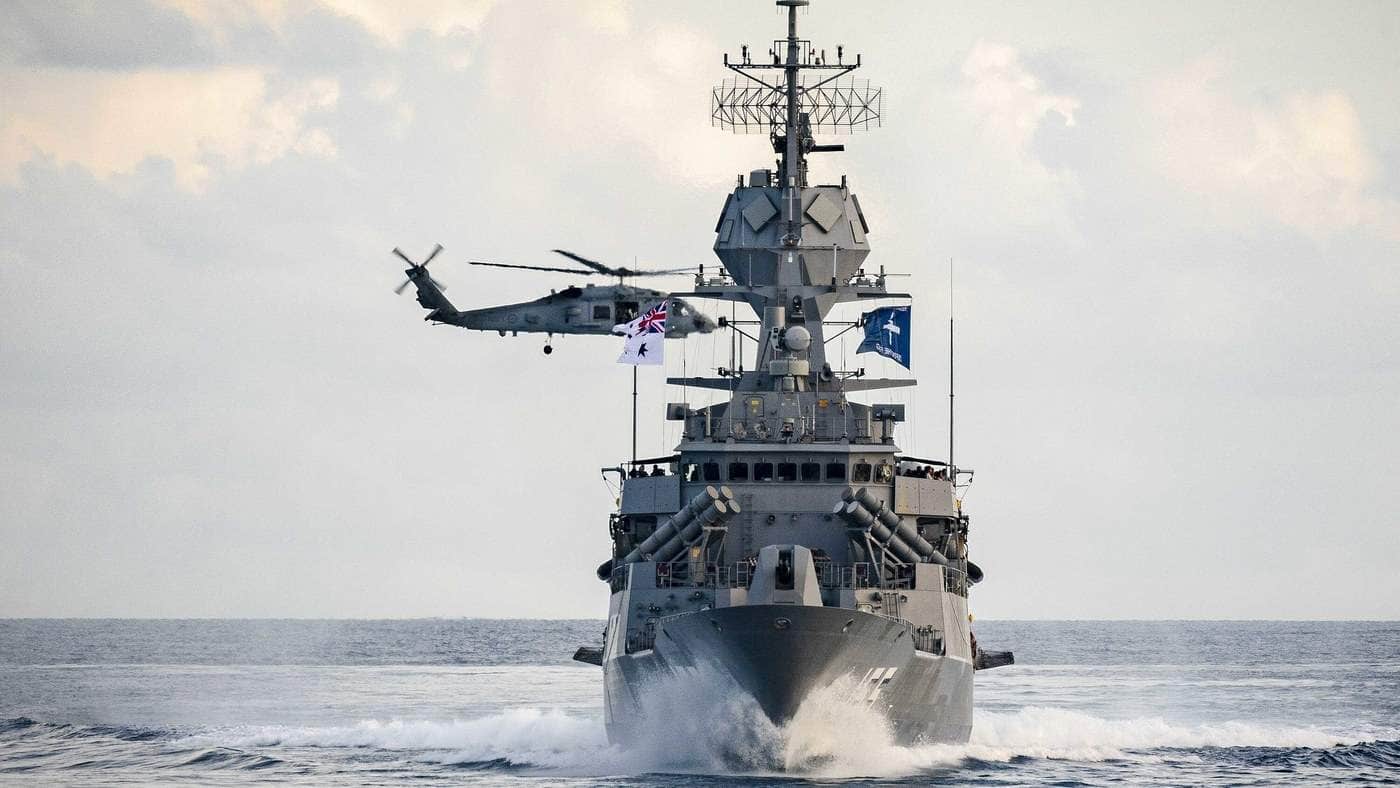
A documented example comes from late 2025. On 13 November 2025, Defence reported that "HMAS Ballarat has conducted a series of transits and patrols through the South China Sea" as part of her regional presence deployment. [4] It described the deployment as three months long and "Australia's fourth for 2025". [4] The same item says Defence undertakes maritime activities in the region "in accordance with international law". [4]
Keep the date with that example. It describes a 2025 deployment, not a ship's present location. It also describes transits and patrols, not combat action. For an earlier chapter in the same ship's story, see our 2016 article on the HMAS Ballarat missile defence upgrade.
What does the Navy do in combat? Naval warfare and sea control
Doctrine places operations on a spectrum: peacetime operations, operations other than war, and warlike operations. [1] Operations other than war are "short of warlike, where the application of force is limited to self-defence." [1] Warlike operations "all involve the existence of an armed adversary and the authorisation to apply force". [1]
At sea, much of that combat effort centres on sea control. Doctrine says achieving sea control "allows a force the freedom of action to use an area of sea for its own purposes for a period of time" and, if required, to deny the sea's use to an opponent. [1] It adds that control "is limited in place and in time" and describes sea control as "simply a means to an end and not an end in itself." [1]
Sea control is one strand of naval warfare. Doctrine also describes a related concept, sea denial, which is about preventing an opponent's use of the sea. [1] For this article, the key point is simple: naval combat has an adversary, an authorisation to use force and a defined military objective.
Presence and combat compared
The table below sets the two answers to "What does the Navy do?" side by side.
| Question | Naval presence | Naval combat |
|---|---|---|
| Main purpose | Demonstrate national intent, reassure partners, support stability [1] [3] | Achieve military objectives against an armed adversary [1] |
| Use of force | Not the aim; doctrine limits force short of warlike operations to self-defence [1] | Authorised to apply force [1] |
| Typical official wording | Deployment, transit, engagement, cooperation [3] [4] | Sea control, sea denial, warlike operations [1] |
This table is a reading aid drawn from the cited sources, not a legal classification of every naval activity.
Presence depends on combat credibility
The two purposes are distinct, but they are not independent. A Sea Power Centre article by Lieutenant Robert Rushby on deterrence through denial cites Michael Mazarr's description of denial as deterring "an action by making it infeasible or unlikely to succeed." [5] It also cites a warning against assuming that "all it takes to deter is to put enough force on display". [5]
The article notes an argument that denial "demands the availability of nearby force that can be employed quickly and lethally". [5] In other words, presence carries weight because observers believe the ships behind it could fight if required.
Current strategy reflects that link. The ministers' 16 April 2026 release on the new strategy says the 2024 strategy "adopted the Strategy of Denial as the cornerstone of Defence planning" and that the 2026 National Defence Strategy builds on "these foundations". [6] A Defence News article on the 2026 strategy describes plans for "a larger, more lethal Navy with more surface ships" and investment of "up to $77 billion in frigates and destroyers to support localised sea control". [7] These are stated plans and investments, not a description of the fleet in service today.
How to read a naval story: presence or combat?
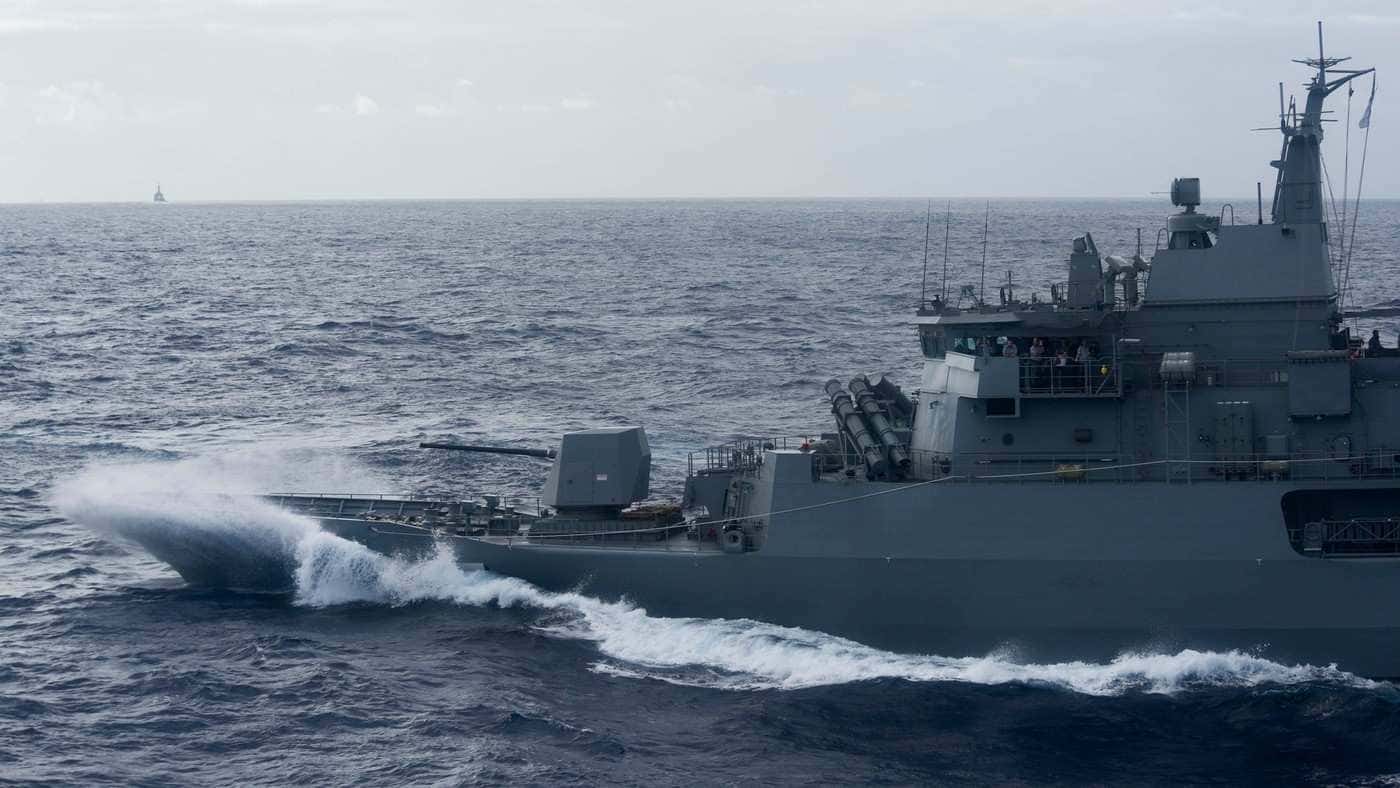
When you see a warship in the news, ask what the source says the ship was doing. Look for the stated purpose, the setting and whether any use of force was authorised. A transit, a port visit or an exercise is not combat, even when the ship is heavily armed. Asking "What does the Navy do in this story?" sorts most reports into presence or combat.
Then check the date and the publisher. A Defence release on a past deployment is good evidence for that deployment, not for the ship's current tasking. Strategy documents describe intent and investment, not finished capability.
Presence and combat sit alongside other tasks too. Our guide to three ways a navy serves a nation: military, diplomatic and constabulary explains the wider framework, including policing work at sea. Asking "What does the Navy do?" across all of these tasks gives a fairer picture of naval service than combat alone.
Recognise the ship behind the story
If someone you know has served in a ship that carried out presence deployments, a ship-specific keepsake can mark that service. Our Royal Australian Navy ships collectables are grouped by ship name, including an HMAS Ballarat gifts and collectables range.
The HMAS Ballarat 48mm medallion is described in its listing as full colour enamel, with the ship's crest on the front and the ship's profile on the reverse. [8] For something smaller, the HMAS Ballarat lapel pin is listed as a 20mm pin made from gold-plated zinc alloy with enamel fill. [9] Whichever you choose, pair it with a few accurate words about where and when the person served.
Sources
1 Sea Power Centre, Australia | Australian Maritime Doctrine: RAN Doctrine 1 (Second Edition) | 2010 | https://seapower.navy.gov.au/sites/default/files/documents/Amd2010.pdf
2 Royal Australian Navy | Mission and values | date not shown | https://www.navy.gov.au/about-navy/mission-values
3 Department of Defence | Regional Presence Deployments | date not shown | https://defence.gov.au/defence-activities/operations/indo-pacific-operations/regional-presence-deployments
4 Department of Defence | Ballarat upholds Indo-Pacific freedom (news; no headline shown on fetch, title taken from URL) | 13 November 2025 | https://defence.gov.au/news-events/news/2025-11-13/ballarat-upholds-indo-pacific-freedom
5 Sea Power Centre, Australia | Deterrence through denial (Lieutenant Robert Rushby) | date not shown | https://seapower.navy.gov.au/deterrence-denial
6 Minister for Defence | 2026 National Defence Strategy and Integrated Investment Program (media release) | 16 April 2026 | https://www.minister.defence.gov.au/media-releases/2026-04-16/2026-national-defence-strategy-integrated-investment-program
7 Defence News | Focus on maritime strength | date not shown on page (URL dated 17 April 2026) | https://news.defence.gov.au/navy/workplace/2026-04-17/focus-maritime-strength
8 Military Shop | HMAS Ballarat Medallion 48mm Full Colour Enamel | SKU BN3910 | https://militaryshop.com.au/products/hmas-ballarat-medallion.html
9 Military Shop | HMAS Ballarat Lapel Pin | SKU BN3842 | https://militaryshop.com.au/products/hmas-ballarat-lapel-pin.html