

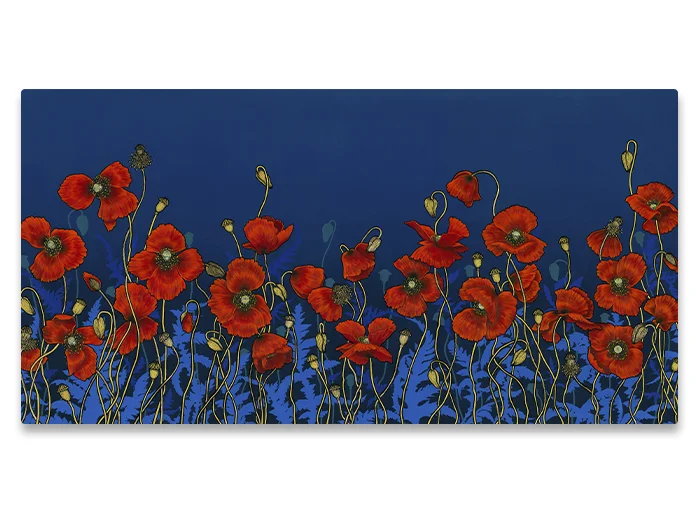
Where The Poppies Grow
Discover the poppy, its connection with remembrance and the symbolism behind the artwork.
Explore Adriana Seserko’s original painting, her family story and the poem written to accompany it.
Discover significant retained editions and collectables where verified.
See how Where The Poppies Grow moved from an original painting into fashion, accessories, homewares, prints and collectables.
The Poppy
From Battlefield to Remembrance
A sea of red poppies fills the landscape. Beautiful at first glance, the scene carries a deeper meaning: the same ground that once witnessed violence and loss can, with time, become a place of peace, remembrance and renewal.
Where The Poppies Grow, by Canberra artist Adriana Seserko, uses the poppy not simply as a decorative flower but as a metaphor for the human cost of war and the responsibility of later generations to remember.
Read More
The work is also deeply personal. Adriana connected its themes to the story of her own great-grandfather, who died during the Second World War, and to the effect his loss had on the generations of her family that followed.
The red poppy became one of the most recognised symbols of remembrance after the First World War. Poppies grew in the disturbed soil of parts of the Western Front, and John McCrae’s 1915 poem In Flanders Fields helped fix the flower in public memory as a symbol of those who had died in war. Where The Poppies Grow is not intended as a depiction of one particular battlefield. Instead, Adriana Seserko uses the image of a field of poppies to move between two moments in time: the violence that once scarred such landscapes and the peace that later returned.
Where The Poppies Grow
Where The Poppies Grow presents the poppy en masse, not as a single remembrance flower, but as a landscape.
Adriana described the poppy as fragile in appearance yet robust in nature. Its translucent petals, long stems, green leaves and distinctive seed pods gave her a subject of natural beauty, but she deliberately wanted the painting to carry more than decorative appeal. Her intention was to use the poppy as a metaphor for the human condition and to place beauty beside the darker memory of war.
The artwork asks the viewer to consider what lies beneath a peaceful landscape. The red field can be read simultaneously as natural beauty, the colour of blood and sacrifice, and the enduring symbol of remembrance. Peace has returned, but memory remains.

From One Generation to the Next
For Adriana, the subject was not only historical.
Her great-grandfather was 19 when his life was cut short during the Second World War. He was captured and taken to a prisoner-of-war camp in Germany, where he died. Adriana’s great-grandmother was pregnant and waiting for her husband to return; her grandmother consequently grew up without her father. That loss became part of the family story passed from one generation to the next.
Adriana has also written of a moment when her grandmother, thinking about her father, found a small remembrance coin decorated with a red poppy. Her grandmother regarded the discovery as a deeply personal connection with the father she had never known.
Adriana’s great-grandfather had himself been an artist. Although she never knew him, stories of his creativity and gentle nature survived within the family. Where The Poppies Grow therefore carries another thread: an artist remembering an artist, and creativity continuing through generations despite a life cut short by war.
Adriana Seserko
Adriana Seserko is a self-taught Australian artist based in Canberra. Her work is characterised by close attention to detail, strong colour and an interest in the natural world.
Her paintings often use animals and botanical subjects to explore wider environmental and social ideas. For Adriana, art is not simply decorative; it is a means of giving form to ideas and encouraging reflection and conversation. In Where The Poppies Grow, that approach is especially personal. The natural beauty of the poppy becomes the means through which she explores war, family loss, remembrance and the inheritance of peace.
The Words Behind The work
Adriana wrote an original poem to accompany the painting. The poem begins with the apparent tranquillity of a field of poppies before turning to the violence and suffering that such ground once witnessed. It then returns to the present, where peace has replaced warfare and the poppies remain as a living guard of remembrance. The poem is important to understanding the painting because the two works were conceived around the same idea: beauty in the present does not erase suffering in the past.
Where The Poppies Grow. Original Painting by Adriana Seserko
The unique original painting from which the Where The Poppies Grow collection was created. There is only one original Where The Poppies Grow. Its significance extends beyond the canvas: Adriana’s painting became the source for limited-edition fine-art prints, aluminium artwork, collectable medallions and a much broader Poppy Mpressions lifestyle collection. The original also carries Adriana’s personal family story and the poem written to accompany the work.
Specialist delivery, insurance and installation requirements can be arranged directly with the purchaser.
Acquire the Original Enquire About the ArtworkFrom the original painting to Limited Editions
Where The Poppies Grow developed from a single original painting into a series of numbered artworks and collectables. The limited editions allow the complete composition to be experienced in traditional fine-art paper, canvas and contemporary aluminium formats, while the medallions translate the artwork into a smaller collectable form.
Where The Poppies Grow Beyond the Canvas
The imagery of Where The Poppies Grow went considerably further than its numbered art editions. The artwork was adapted across a broad Poppy Mpressions lifestyle collection, including umbrellas, scarves, bags, stationery, drinkware, headwear and other accessories and gifts.
This is an important part of the provenance of the original painting. It was not simply reproduced as wall art; it became a design language that could be carried, worn, displayed and used in everyday life. Thousands of Poppy Mpressions products have been sold across the broader collection. For the owner of the original painting, that history creates a direct connection to the source artwork from which those products developed.
 Click to enlarge
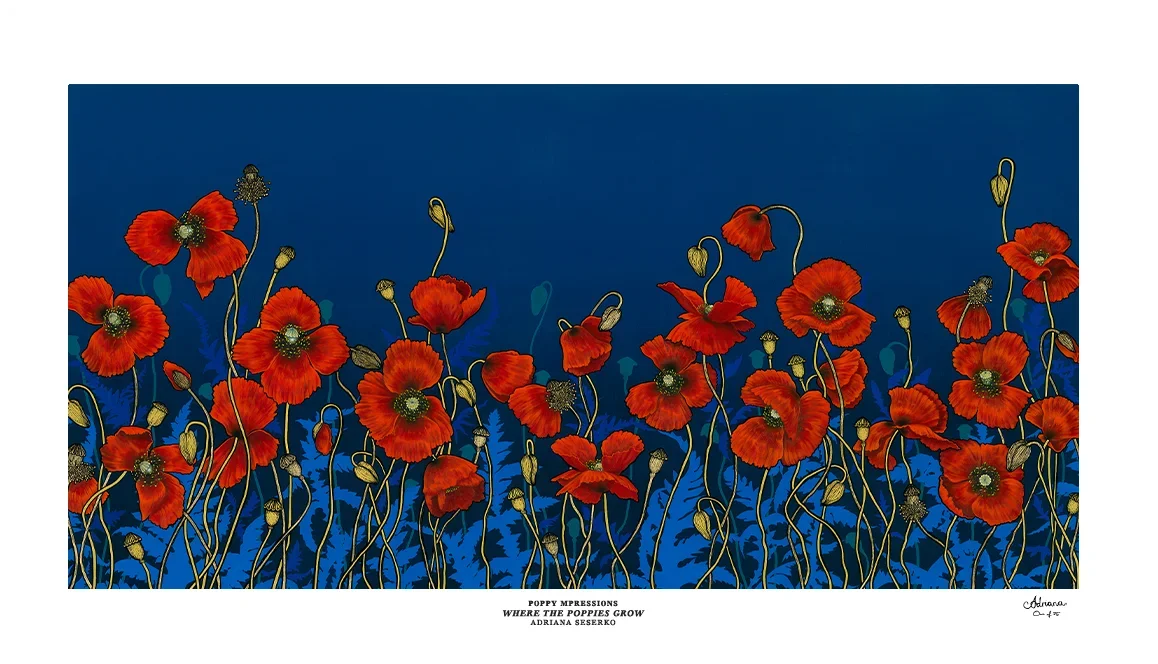
Where The Poppies Grow Limited Edition Fine Art Print
Printed on Hahnemühle German Etching paper, this fine-art edition gives Where The Poppies Grow a traditional textured presentation. Three sizes were created, with the largest 1200 × 600 mm artwork restricted to an edition of just 25.
View the 600 x 300mm Artwork → View the 900 × 450 mm Artwork → View the 1200 × 600 mm Artwork →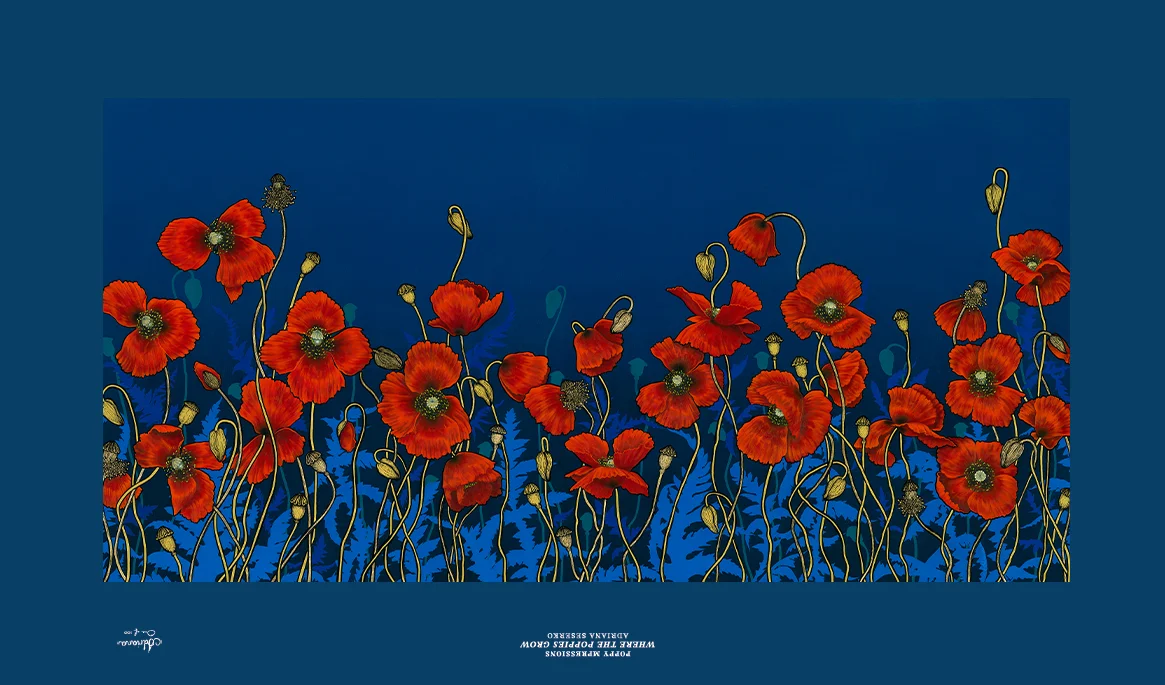 Click to enlarge
Where The Poppies Grow Limited Edition Canvas Artwork
A premium Hahnemühle Daguerre canvas reproduction that gives the field of red poppies scale and visual impact while retaining the detail of Adriana’s original composition. The largest 1200 × 600 mm format is limited to just 25.
View the 600 x 300mm Artwork → View the 900 × 450 mm Artwork → View the 1200 × 600 mm Artwork → Click to enlarge
Where The Poppies Grow Limited Edition Aluminium Artwork
The aluminium format gives the red poppy field a crisp, contemporary presentation, emphasising the colour and contrast of Adriana’s original artwork while preserving the complete composition.
View the Artwork → Click to enlarge
Where The Poppies Grow Limited Edition Medallion
The medallion translates the imagery and remembrance theme of the painting into a numbered collectable, extending the story of Where The Poppies Grow beyond the original canvas.
View the Collection → Click to enlarge
Poppy Mpressions Limited Edition Medallion Set of 3
Three limited-edition medallions representing Brothers In Arms, Fields of Poppies and Where The Poppies Grow, presented together in a 3D frame. Bringing all three Poppy Mpressions artworks together, the framed medallion set connects the individual paintings as one collection and preserves the visual identity of the series in a single collectable.
View the Collection →History, artwork and collecting
Why is the red poppy a symbol of remembrance?
The red poppy became strongly associated with remembrance after the First World War. Poppies grew in disturbed ground on parts of the Western Front, and the image was given lasting cultural significance by John McCrae’s 1915 poem In Flanders Fields.
Does Where The Poppies Grow depict a specific battlefield?
No. The artwork is symbolic rather than a literal representation of one battlefield. Adriana uses the peaceful image of poppies growing where conflict once occurred to explore loss, memory, renewal and the contrast between war and peace.
What is the personal story behind the artwork?
Adriana connected the work to the loss of her great-grandfather during the Second World War. He was 19 when he died after being captured and taken to a prisoner-of-war camp in Germany. His death left Adriana’s grandmother to grow up without her father, and the story remained part of the family’s memory.
Why did Adriana write a poem for the artwork?
The poem expands the same ideas explored visually in the painting. It contrasts the tranquillity of a present-day field of poppies with the violence, fear and loss once experienced on wartime ground, before returning to remembrance and peace.
Were limited-edition versions of Where The Poppies Grow produced?
Yes. Numbered editions were produced on Hahnemühle German Etching paper, Hahnemühle Daguerre canvas and aluminium. The paper and canvas editions were offered in three sizes, with the largest 1200 × 600 mm editions limited to 25.
Were collectables produced from the artwork?
Yes. Where The Poppies Grow was represented as an individual limited-edition medallion and also forms part of the framed set of three Poppy Mpressions limited-edition medallions.
Did the artwork become a wider product collection?
Yes. The imagery was adapted across fashion, accessories, homewares, stationery, drinkware and gifts, including umbrellas, scarves, bags, pens, notebooks, travel mugs and headwear.
Is the original Where The Poppies Grow painting available?
Yes. The original painting by Adriana Seserko is being offered through the BrandNet Archives for $3,900.
What makes the original different from the limited editions?
The numbered editions reproduce or interpret the artwork, but there is only one original painting. It is the source work behind the limited editions, collectables and broader Where The Poppies Grow collection.
Poppy Mpressions Collection
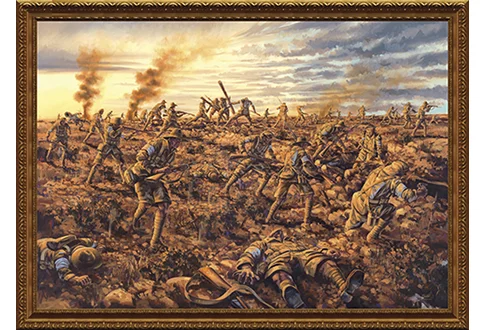
Preserving the Story Behind the Collection
For more than two decades, BrandNet has commissioned and developed artworks, limited editions and collectables connected with Australian and New Zealand history, service and remembrance. Some remained individual works. Others, including Where The Poppies Grow, became the creative foundation for much broader collections.
The BrandNet Archives brings these original artworks and surviving limited editions together with the stories behind their creation — preserving not only the objects, but the people, ideas and histories that gave them meaning.
Explore The BrandNet ArchivesWhere The Poppies Grow
There is a tale often told, of a place where the poppies do grow; where boys and men fought courageously to defend, country and home. Here the fields blaze and glow, underneath the suns ever watchful eye, and what a sight it is to behold, a scarlet sea of poppies that ripple and sway, like ocean waves in the gentle breeze.
Peaceful is the place where the poppies grow, though once it was not so. Long ago, soldiers cried, rallied, as their fallen brothers moaned. The veiled silence palpable, a grim testimony of the dead, A dirge whispered on the breath and sigh of the wind, yet scarcely caught to the deafening roar of warfare.
You may hardly believe it so now, with the birdsong chirped so sweet, yet how awful was the bellow of gunfire, the explosions that boomed like thunder and lightning on a stormy summer eve. It may be difficult to imagine the horror, for those who have only known peace, to live daily in uncertainty and in fear of ones life, to be bruised body and soul by atrocities witnessed and experienced.
Yet Spirit was not abandoned, when it could have easily been crushed, determination and great bravery prevailed in men, peace and freedom their lasting gift to all of us. Too many lives were sacrificed, lost to the place where the poppies grow, fathers and sons, brothers and uncles, lovers and dear friends, their crimson life blood staining the battle ravaged earth in shades of red.
Destruction, loss, and despair time nursed, as only time could do, till all suffering waned, and peace again governed in a world remade anew. At this place an army still stands, though only the perceptive can truly see it, for not a regiment of men can be found there but only a legion of proud poppies. Forevermore the poppies keep vigil, igniting the flames of remembrance, and guard the place where now they grow in point of the lost and fallen. Together, we will remember them, now and evermore.
Adriana Seserko - 2022