

Brothers In Arms
Discover the poppy, the ANZAC connection and the symbolism behind the artwork.
Explore Adriana Seserko’s original painting and the poem written to accompany it.
Discover significant retained editions and collectables where verified.
See how Brothers In Arms moved from an original painting into fashion, accessories, homewares, prints and collectables.
Why the Poppy?
Few flowers carry as much meaning as the red poppy.
Its association with remembrance grew from the battlefields of the First World War, where poppies flourished in disturbed ground across parts of the Western Front. The flower was immortalised in John McCrae's 1915 poem In Flanders Fields and became an enduring international symbol of remembrance.
In Brothers In Arms, however, the poppy is joined by two distinctly Antipodean symbols. Australian eucalyptus and New Zealand silver fern grow together among the flowers, creating an image of two nations standing side by side.
Read More
The composition draws together three botanical symbols to tell a larger story: the poppy for remembrance, eucalyptus for Australia and silver fern for New Zealand. Rather than depicting a particular battle or individual serviceman, Adriana Seserko created a symbolic landscape representing the enduring connection between the two countries and those who served together.
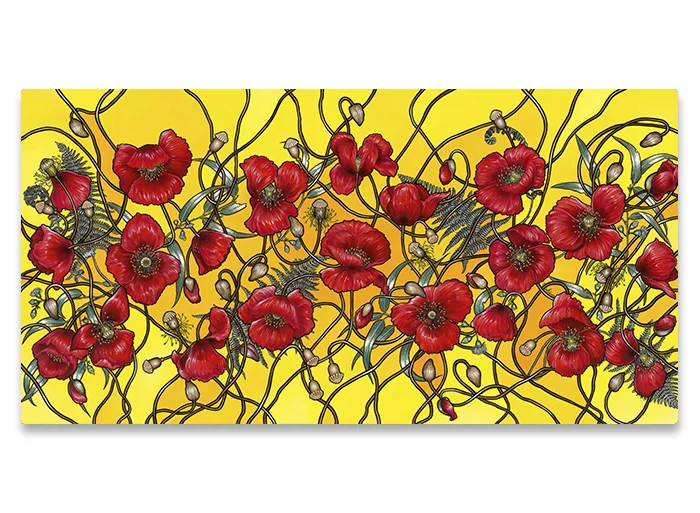
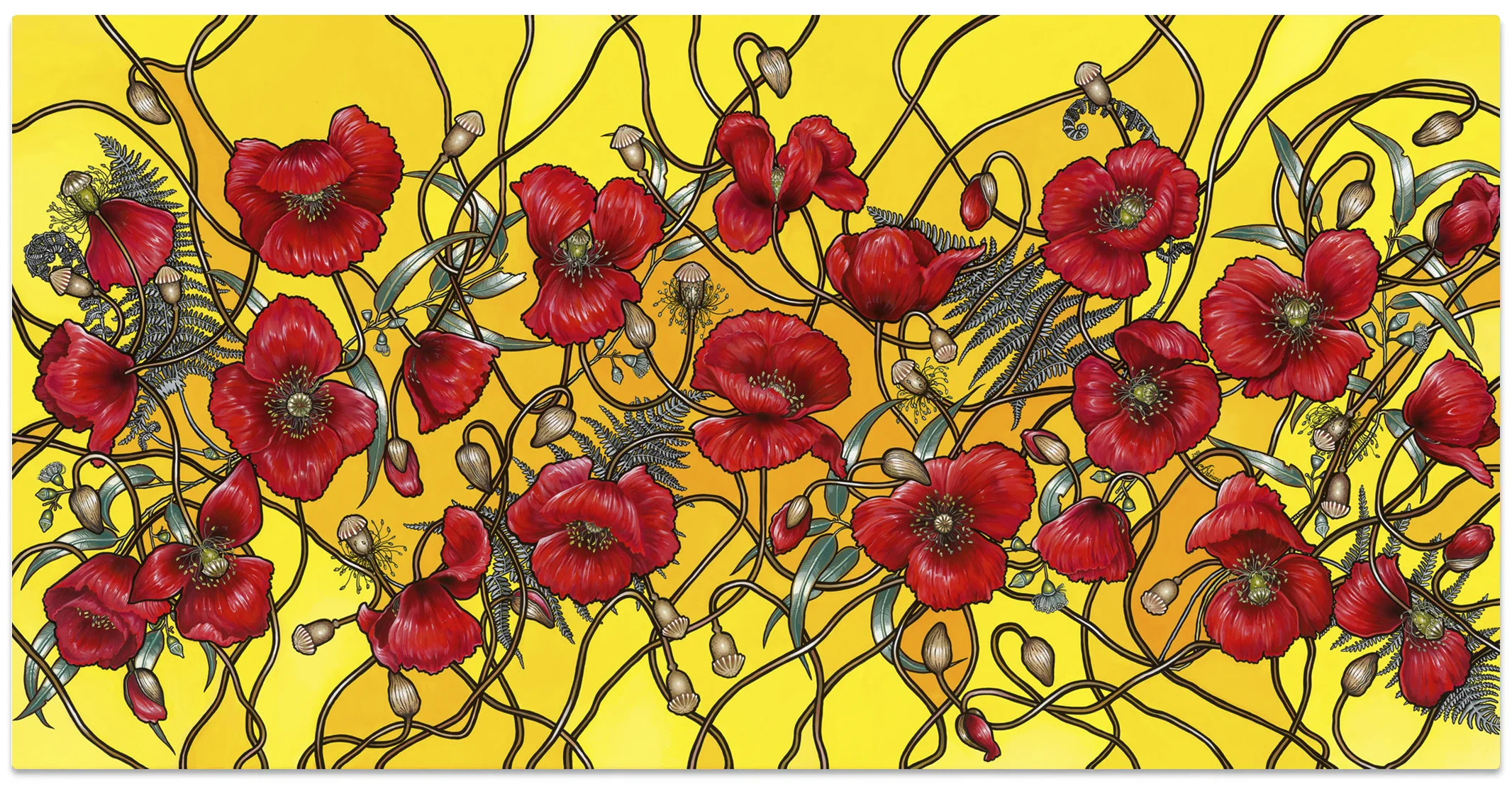
Against a brilliant field of yellow, red poppies rise among Australian eucalyptus and New Zealand silver fern. Brothers In Arms, by Australian artist Adriana Seserko, brings together symbols of Australia, New Zealand and remembrance in an artwork celebrating the bond forged between two nations through service, sacrifice and shared history.
The original painting became much more than a single work of art. Its imagery went on to inspire limited-edition artworks, collectable medallions, fashion, accessories and gifts — with thousands of Poppy Mpressions products finding their way into Australian and New Zealand homes.
Brothers In Arms
The strength of Brothers In Arms lies partly in its simplicity.
Brilliant red poppies dominate the composition, set against a striking yellow background. Among them are the leaves of Australian eucalyptus and the distinctive silver fern of New Zealand. The plants are intertwined rather than separated.
It is this detail that gives the artwork its meaning: two nations, different in identity but connected through a shared history. Adriana's approach uses familiar natural forms rather than literal military imagery. The result is an artwork that can be read at several levels — as a remembrance piece, a celebration of the Australia–New Zealand relationship, or simply as a vivid botanical composition.
Adriana Seserko
Adriana Seserko created Brothers In Arms as part of the Poppy Mpressions collection, using the poppy and native botanical imagery to explore remembrance, connection and shared identity.
Her distinctive use of strong colour gave the artwork an immediate visual identity that subsequently translated particularly well across fine-art reproductions, aluminium artworks, medallions, fashion and other collectables. The success of those products would ultimately make Brothers In Arms one of the foundation artworks behind the broader Poppy Mpressions collection.
The Words Behind The work
Adriana also wrote a poem to accompany Brothers In Arms. The poem provides another layer to the painting, expressing in words the ideas of standing together, courage, sacrifice and remembrance that Adriana represented visually through the intertwined poppies, eucalyptus and silver fern.
Brothers In Arms. Original Painting by Adriana Seserko
The unique original painting from which the Brothers In Arms collection was created. Unlike a reproduction or numbered edition, there is only one original Brothers In Arms. Its provenance extends beyond the painting itself. The artwork became the creative source for a commercial collection that reached thousands of customers through art, fashion, collectables, accessories and gifts.
For its future owner, that provides an unusual connection between an original Australian artwork and the collection it went on to inspire.
Specialist delivery, insurance and installation requirements can be arranged directly with the purchaser.
Acquire the Original Enquire About the ArtworkFrom the original painting to Limited Editions
The original Brothers In Arms painting became the foundation for a series of limited-edition artworks and collectables. Collectors could choose traditional fine-art paper, canvas or contemporary aluminium reproductions, while details from the artwork were also translated into individually numbered medallions.
 Click to enlarge
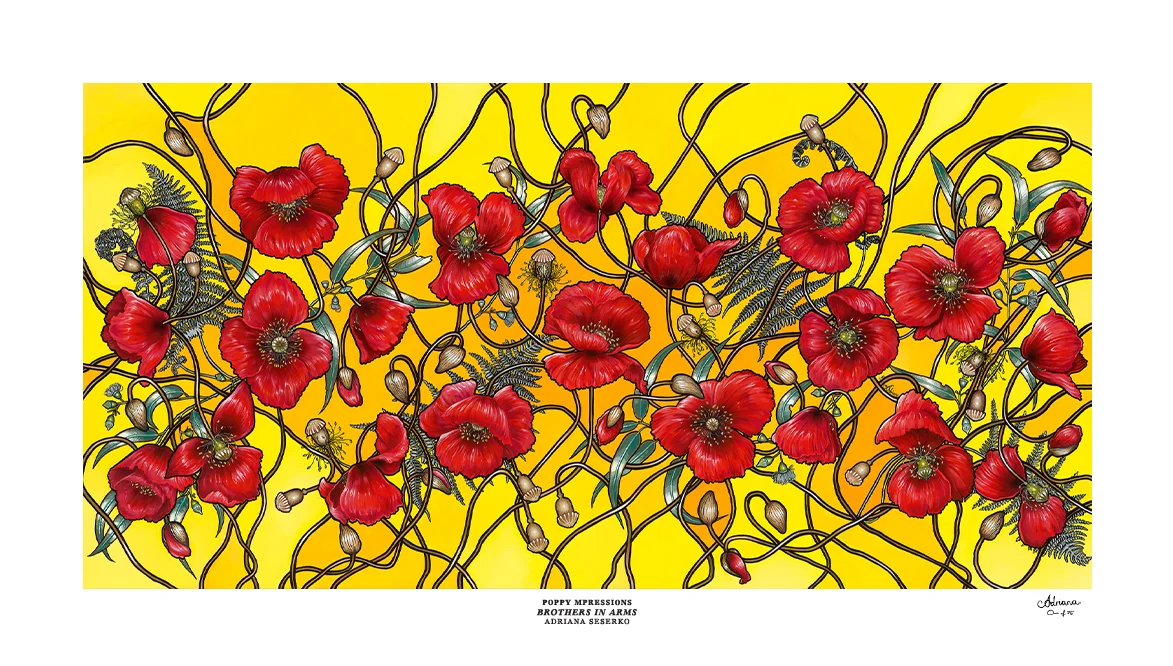
Brothers In Arms Limited Edition Fine Art Print
Printed on Hahnemühle German Etching paper, this fine-art edition gives Brothers In Arms a traditional textured presentation. Three sizes were created, with the largest 1200 × 600 mm artwork restricted to an edition of just 25.
View the 600 x 300mm Artwork → View the 900 × 450 mm Artwork → View the 1200 × 600 mm Artwork →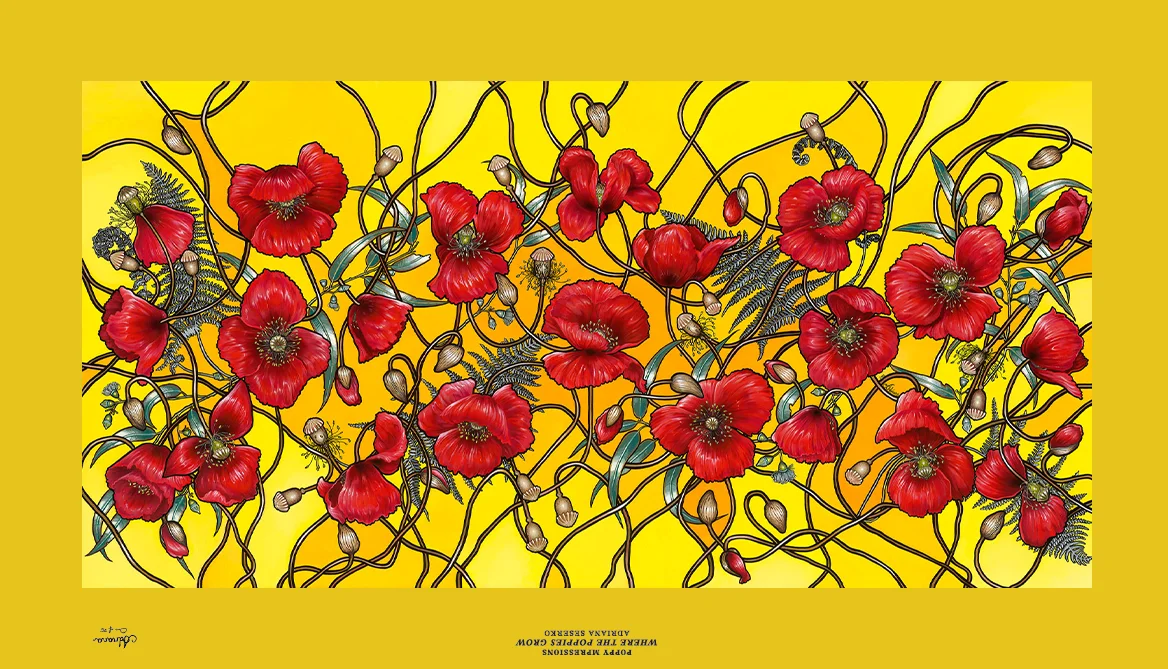 Click to enlarge
Brothers In Arms Limited Edition Canvas Artwork
A premium Hahnemühle Daguerre canvas reproduction of Adriana Seserko's Brothers In Arms, capturing the vivid colour and botanical detail of the original painting. Three sizes were created, with the largest 1200 × 600 mm artwork restricted to an edition of just 25.
View the 600 x 300mm Artwork → View the 900 × 450 mm Artwork → View the 1200 × 600 mm Artwork → Click to enlarge
Brothers In Arms Limited Edition Aluminium Artwork
The aluminium format gives the brilliant reds, greens and distinctive yellow background of Brothers In Arms a crisp, contemporary presentation while retaining the complete composition of Adriana's original painting.
View the Artwork → Click to enlarge
Brothers In Arms Limited Edition Medallion
Translating elements of the original painting into a finely detailed collectable, the medallion extends the Brothers In Arms story beyond the canvas while retaining the distinctive imagery of the Poppy Mpressions collection.
View the Collection → Click to enlarge
Poppy Mpressions Limited Edition Medallion Set of 3
Bringing the three Poppy Mpressions artworks together, the medallion set connects the individual paintings as one collection and provides a lasting representation of the art series they inspired.
View the Collection →An Artwork That Went Beyond the Canvas
The influence of Brothers In Arms extended considerably further than its limited-edition artworks.
Its distinctive imagery and colour palette were adapted across fashion, accessories, homewares, gifts and collectables. Elements of the artwork appeared on products that allowed people to wear, display and share the Poppy Mpressions story in everyday life. Thousands of products inspired by the Poppy Mpressions artworks have been sold.
This commercial history adds an interesting dimension to the provenance of the original painting. Brothers In Arms was not simply reproduced as a limited-edition artwork. It became a source artwork from which an entire family of products was developed. The original therefore represents the beginning of a much larger creative story.
History, artwork and collecting
Why are poppies associated with remembrance?
Poppies became closely associated with remembrance following the First World War, particularly through John McCrae's 1915 poem In Flanders Fields. They subsequently became an internationally recognised symbol for remembering those who served and died in war.
What do the eucalyptus and silver fern represent?
The eucalyptus represents Australia and the silver fern represents New Zealand. Their placement together among the poppies reflects the close historical relationship between the two countries and their shared tradition of service.
Is Brothers In Arms based on a particular battle?
No. The artwork is symbolic rather than a depiction of a specific battle. Its imagery represents the broader relationship between Australia and New Zealand, remembrance and shared sacrifice.
Were limited-edition versions of Brothers In Arms produced?
Yes. The artwork was reproduced in limited editions on Hahnemühle Daguerre canvas, Hahnemühle German Etching paper and aluminium. The canvas and paper editions were produced in three sizes, with the largest 1200 × 600 mm versions restricted to just 25 examples.
Were collectables also produced from the artwork?
Yes. Numbered editions were produced on Hahnemühle German Etching paper, Hahnemühle Daguerre canvas and aluminium. The paper and canvas editions were offered in three sizes, with the largest 1200 × 600 mm editions limited to 25.
Were collectables produced from the artwork?
Yes. Brothers In Arms inspired an individually limited-edition medallion and also forms part of the three-medallion Poppy Mpressions collection.
Were other products inspired by the painting?
Yes. The Poppy Mpressions artwork was adapted across a much broader range of fashion, accessories, gifts, homewares and collectables, with thousands of products sold.
Is the original Brothers In Arms painting available?
Yes. The original Brothers In Arms painting by Adriana Seserko is being offered through the BrandNet Archives for $3,900.
Why is the original different from the limited editions?
Every limited-edition artwork ultimately derives from the original painting. While numbered editions may themselves be scarce, there is only one original Brothers In Arms — the artwork from which the subsequent collection developed.
Poppy Mpressions Collection
Preserving the Story Behind the Collection
For more than two decades, BrandNet has commissioned and developed artworks, limited editions and collectables connected with Australian and New Zealand history, service and remembrance.
Some became individual collectables. Others, like Brothers In Arms, became the creative foundation for much larger collections. The BrandNet Archives brings these original artworks and surviving limited editions together with the stories behind their creation — preserving not only the objects, but the history of how they came to be.
Explore The BrandNet ArchivesBrothers In Arms
Side by side, erect and proud, my brothers stand—a living shield. Our courage unwavering, though the insurmountable nightmare before us sends the Reaper’s shadow creeping at our heels. We are children born beneath the shining stars of the Southern Cross, who traversed unforgiving seas and found our feet upon the sands of foreign shores, where despair reigned supreme. Shoulder to shoulder, we confront our foe, our thoughts turning to home and kin, those cherished reveries softening the blow. United, we trudge onward into the gathering darkness.
Providence be damned. We shall prevail. Though Death, unconquerable in his sable cowl, strides among our weary ranks, tallying the fallen within his ancient tome, we march on. Crimson life pours in rivulets from broken bodies, sinking into the ever-thirsty earth. To bear witness to such horror—to comprehend its terrible futility—is to understand the measure of our sacrifice.
But what is war to he who sits safely afar, strategising, manipulating pieces across an alabaster and ebony board? Is concern etched upon his brow? Does fear pierce his soul? Do his eyes glisten with unshed tears for the remembered peace of yesterday? Does his heart bleed for the loss of kin—for the sons he has forfeited? Yet, brothers, we must march on.
For those who would shackle our freedom and conquer our peaceful lands must be shown the measure of our resolve. And if our deaths must become the sword that severs the enemy’s grasp, then gladly we offer our lives for the cause. In death, as in life, we shall remain brothers— forever bound, forever remembered, forever the guardians of peace.
Adriana Seserko - 2022