

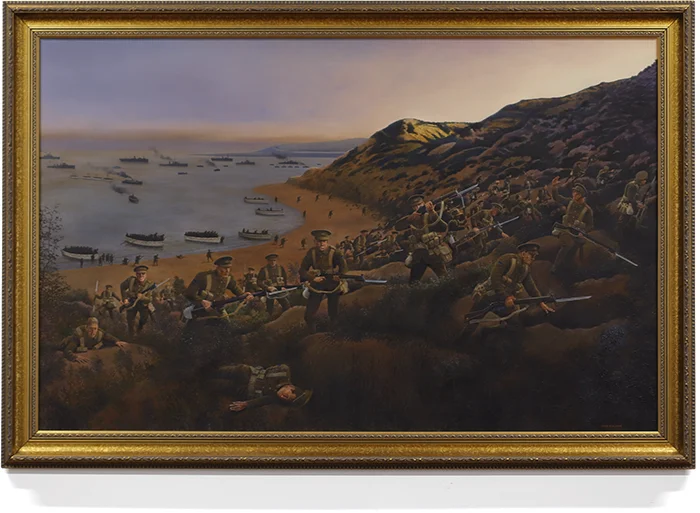
The Spirit – Gallipoli Landing 1915
Discover the people, events and research behind each commissioned work.
View the original commissioned artwork and, where available, enquire about acquisition.
Discover and purchase rare #1–#10 Archive Editions and historically significant retained pieces.
Explore related Limited Edition lapel pins, medallions, figurines, bears and art.
The landing that became part of Australia's national story
The Nek was a narrow bridge of land at the northern end of the Anzac position, connecting Russell's Top with Baby 700 across the head of Monash Valley. Ottoman trenches on and beyond Baby 700 dominated the approaches. The ground between the opposing positions was desperately short — roughly 27 metres in the plan preserved in BrandNet's historical notes — but it was exposed to rifles and machine guns.
From Lemnos to the Gallipoli Peninsula
After training in Egypt, the Australian and New Zealand Army Corps prepared for an Allied landing on the Gallipoli Peninsula. In the darkness before dawn on 25 April, men climbed from Royal Navy warships into small boats. Steam pinnaces towed strings of rowing boats toward the coast in silence. The first Australian covering force came from the 3rd Australian Infantry Brigade — men of the 9th, 10th, 11th and 12th Battalions.
The first wave reached the shore around Ari Burnu at approximately 4.30 am. The landing was north of the intended area near Gaba Tepe, confronting the Australians not with open ground but with steep ridges, gullies and broken country rising immediately from the coast. The geography would shape everything that followed.
What happened in the first thirty minutes?
The initial troops landed in darkness on a frontage of roughly 370 metres around Ari Burnu. They moved quickly off the beach and up the steep ground. The historical reconstruction used for the painting records that the Ottoman defenders immediately facing the landing were a relatively small force — about 80 riflemen of Second Lieutenant Muharrem's platoon — against almost 4,000 men of the Australian 3rd Brigade arriving in the opening phase.
Royal Navy steam pinnaces offshore carried machine guns and fired toward Turkish rifle flashes on the heights. The beach itself offered areas of dead ground from defenders above. The heights overlooking Anzac Cove were taken quickly, but the Australians then entered a confusing landscape of ridges and gullies where units became mixed and the advance lost cohesion.
Why did the Australians land at what became Anzac Cove?
The Allied plan sought to force the Dardanelles and ultimately pressure the Ottoman Empire out of the war. The ANZAC landing was intended farther south around Gaba Tepe, where the ground was considered more favourable. The covering force instead came ashore north of the intended point around Ari Burnu. Debate continues over the causes, but the consequence was immediate: the troops faced steep, dissected terrain rather than the more open country envisaged in planning.
What happened as daylight arrived?
As dawn strengthened, additional waves came ashore from destroyers and transports. The second and third waves spread across a much wider frontage around the cove. By noon, about 10,000 men were ashore. Ottoman artillery began engaging the landing area later in the morning, and the fighting moved increasingly onto the ridgelines above the beach. By the end of 25 April the ANZAC force held a precarious perimeter rather than the objectives originally envisaged.
Why is 25 April remembered as Anzac Day?
The Gallipoli campaign was costly and ultimately unsuccessful in its strategic aims, but the conduct of Australian and New Zealand troops became central to the developing Anzac tradition. The anniversary of the landing became a national day of commemoration, expanding beyond Gallipoli to remember Australians and New Zealanders who served and died in wars, conflicts and peacekeeping operations.
A painting built from evidence, not mythology
Military Shop commissioned the work with historical accuracy as a central requirement. Brigadier Chris Roberts AM, CSC (Rtd), a published Gallipoli historian, worked with the Australian Army History Unit to assist David Rowlands with the historical content. The research extended well beyond uniforms: it covered the topography, light, ships, battalion movements, headdress, equipment and even the level of opposition around the cove in the opening phase.
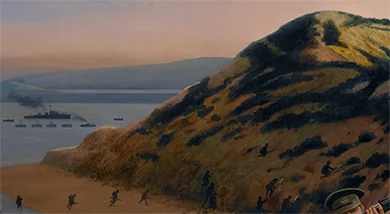
The terrain
The view is anchored to real ground: MacLagan's Ridge, Plugge's Plateau, Hell Spit and Ari Burnu. The painting looks northwest, with Suvla Bay faintly visible in the distance.
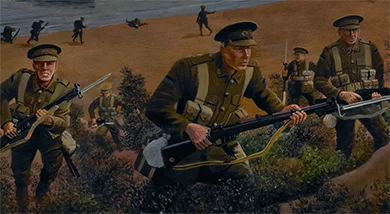
The men
The soldiers wear field service caps rather than predominantly slouch hats. Landing orders specified the cap, and contemporary photographs support its use by the brigades coming ashore.
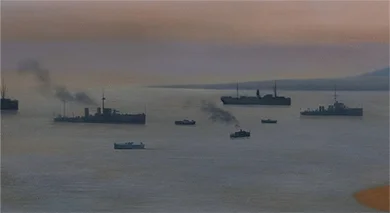
The ships
The destroyers and transports were not generic background vessels. Rowlands identified the ships carrying particular companies and units and positioned them according to the reconstructed scene.
Roberts said the work captures the action about thirty minutes after the initial landing and strips away mythology surrounding the event. He specifically praised the meticulous research into uniforms, headdress, equipment, terrain, shipping offshore and the comparatively light Australian casualties around the cove at the beginning of the action.
The Spirit – Gallipoli Landing 1915
Rowlands chose not to paint an anonymous rush onto a generic beach. His composition places the viewer inside a reconstructed landscape at dawn, with the second wave of the 10th Battalion climbing from the cove while the naval operation remains visible offshore.

The second wave
The foreground represents men of the 10th Battalion scaling the heights at around 5.00 am. The first wave is already above them on Plugge's Plateau.
Ari Burnu at first light
The first light of dawn catches the northern headland of the cove. The painting uses the changing light to distinguish the first landing in darkness from the waves arriving minutes later
The naval operation offshore
Destroyers, transports, steam pinnaces and the battleship HMS London make the landing visibly part of a much larger amphibious operation rather than an isolated scene on the beach.
David Rowlands
An internationally recognised military artist whose atmospheric oil paintings are known for combining dramatic storytelling with close attention to military detail.
Rowlands' work has attracted Royal patronage and commissions from military organisations internationally. For this commission, his task was unusually exacting: reconstruct a famous event that is surrounded by powerful national memory while allowing the historical evidence to determine what appears on the canvas.
Read the artist's account of the landing
In his notes, Rowlands describes troops leaving Royal Navy ships in complete darkness, being towed toward shore by steam pinnaces, and approaching in silence. Rifles were initially kept with empty magazines to reduce the risk of accidental discharge. Once ashore, the men fixed bayonets, crossed the shingle, removed packs, loaded their magazines and climbed into the steep gullies above the cove.
He identifies the destroyers visible offshore as HMS Ribble, Usk, Chelmer and Scourge, with Galeka, Novian and HMS London farther out. These details show how the painting was conceived not simply as an impression of Gallipoli but as a reconstruction of a particular place and time.
Acquire the original commissioned artwork
This is the source painting behind the 2012 Sands of Gallipoli collection and one of the major original works held within the BrandNet Archive.
Specialist delivery, insurance and installation requirements can be arranged directly with the purchaser.
Acquire the Original Enquire About the ArtworkThe first numbers, retained from release
BrandNet retained certificate numbers #1–#10 of the 2005 Sands of Gallipoli Battle of The Nek medallion. These are the original low-number pieces from the edition — not newly numbered products — and all ten are recorded in good condition with their certificates.
The Landing Set of Two — Archive Editions #1–#10
Two proof-quality 50 mm medallions featuring details from Rowlands' painting, presented with Gallipoli sand, a miniature artwork plate and numbered certificate of authenticity.
Standard-number 2012 sets remain available separately at $125 while stocks last.
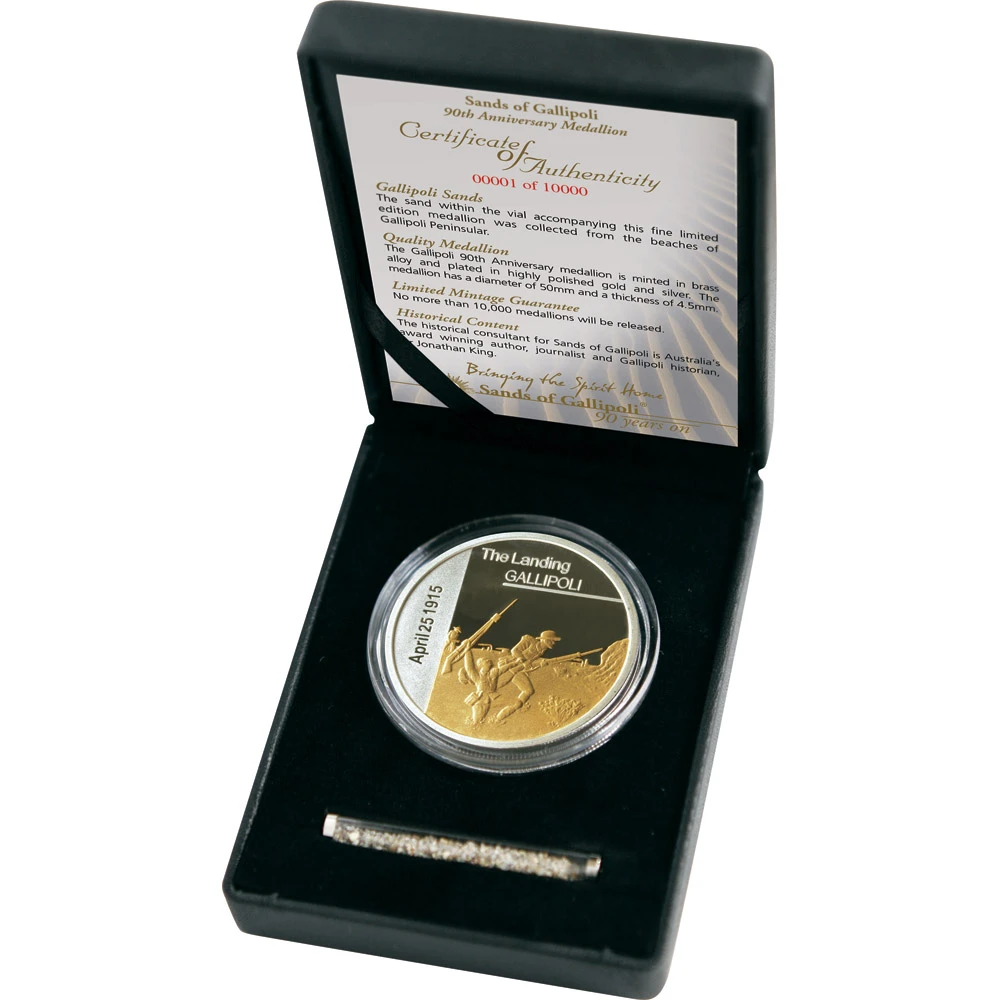
The Landing Single Medallion — Archive Editions #1–#10
One of the early Sands of Gallipoli releases. BrandNet's first ten numbered examples have remained together in the archive for more than two decades.
From the original painting to Limited Editions
The 2012 commission became the visual foundation for medallions, art editions, a figurine and later Battles of Gallipoli collectables. These pieces offer different ways to connect with the same history without diminishing the significance of the original artwork or the low-number Archive Editions above.
Click to enlarge
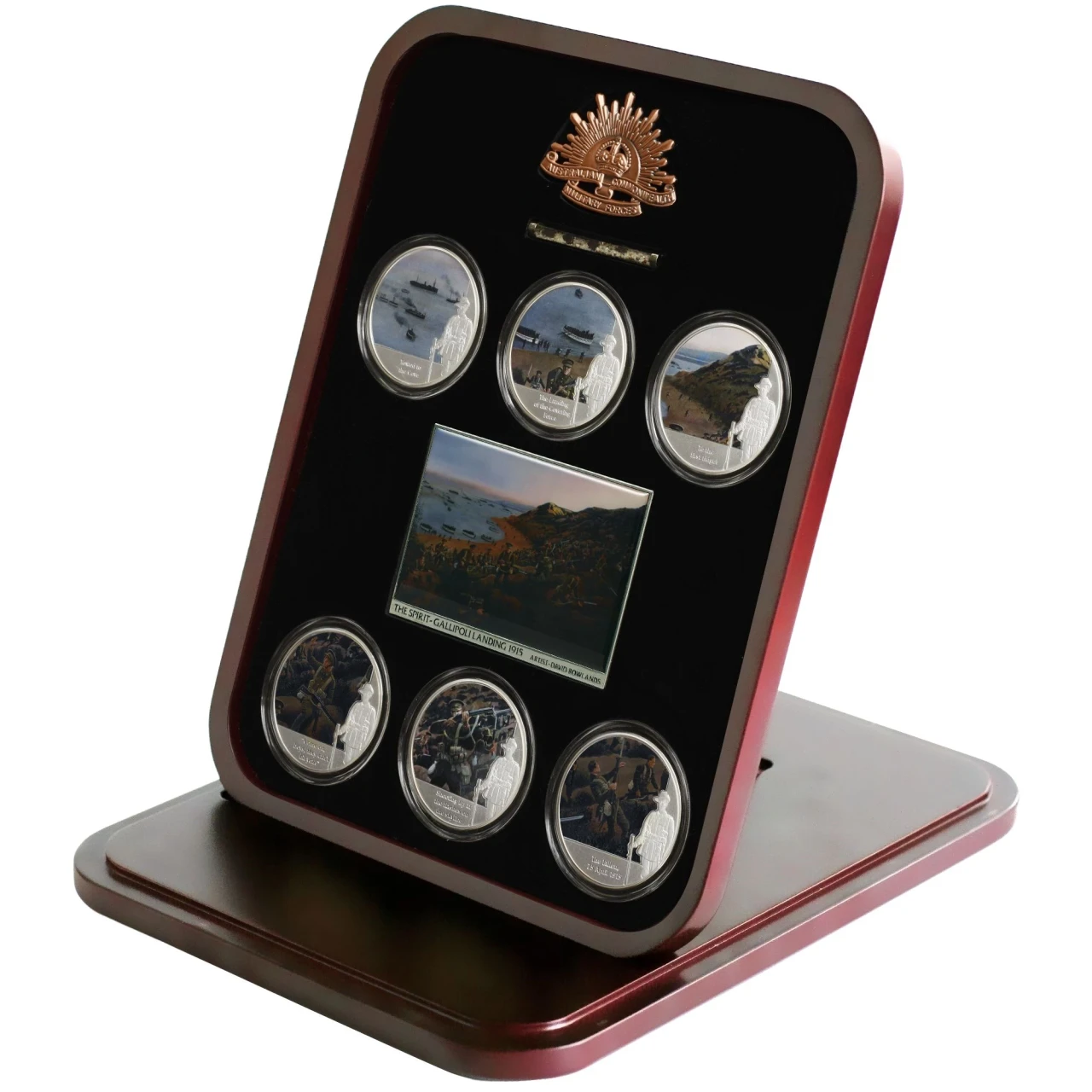
Landing Set of Six Medallions
The most complete medallion presentation in The Landing collection. Six proof-quality medallions feature details from David Rowlands’ painting, accompanied by authentic Gallipoli sand, a miniature artwork, a full-size replica 1904 Rising Sun badge and a numbered certificate of authenticity.
View the set →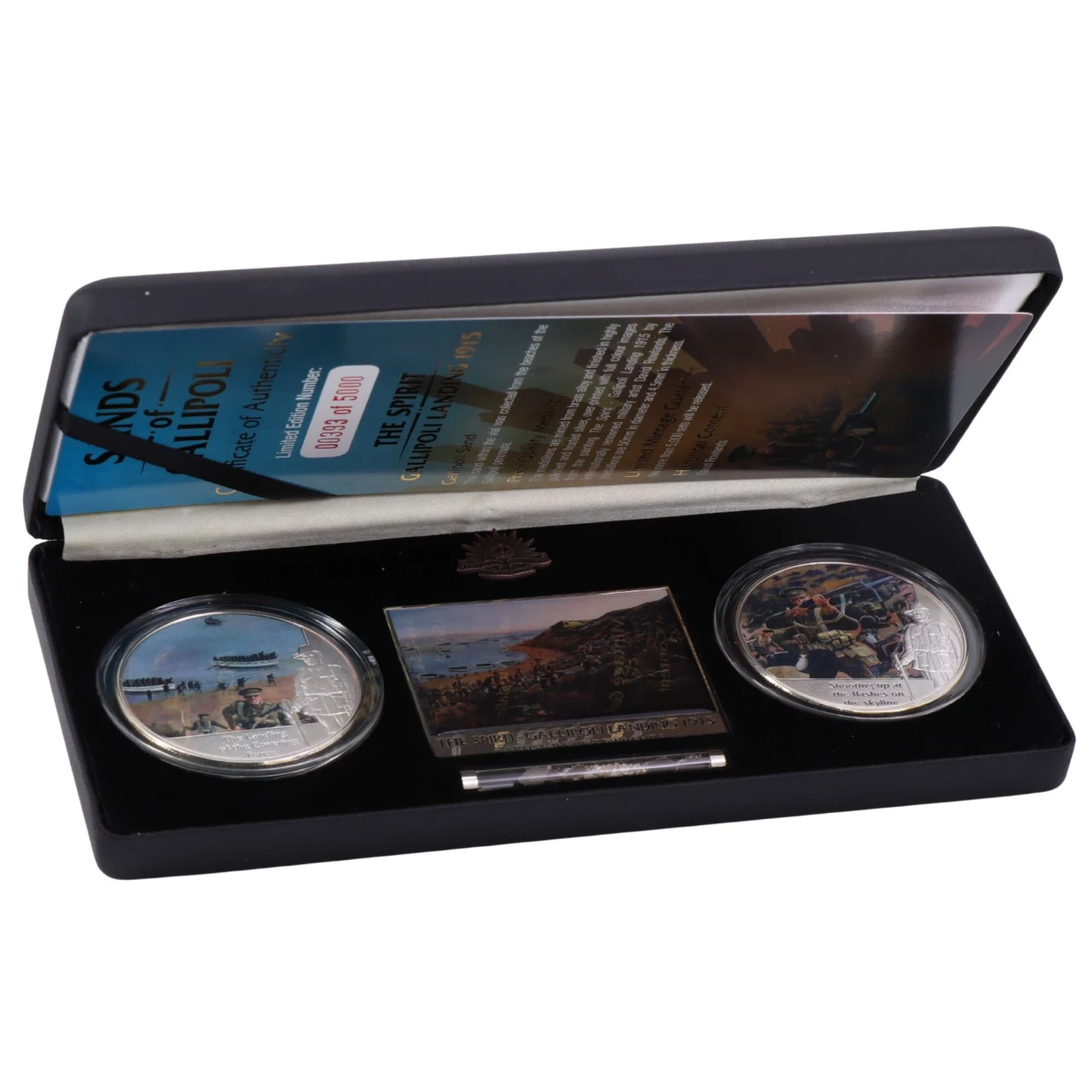 Click to enlarge
Landing Set of Two Medallions
A beautifully presented introduction to The Landing collection. Two proof-quality medallions feature details from Rowlands’ painting, accompanied by authentic Gallipoli sand, a miniature artwork and a numbered certificate of authenticity.
View the set →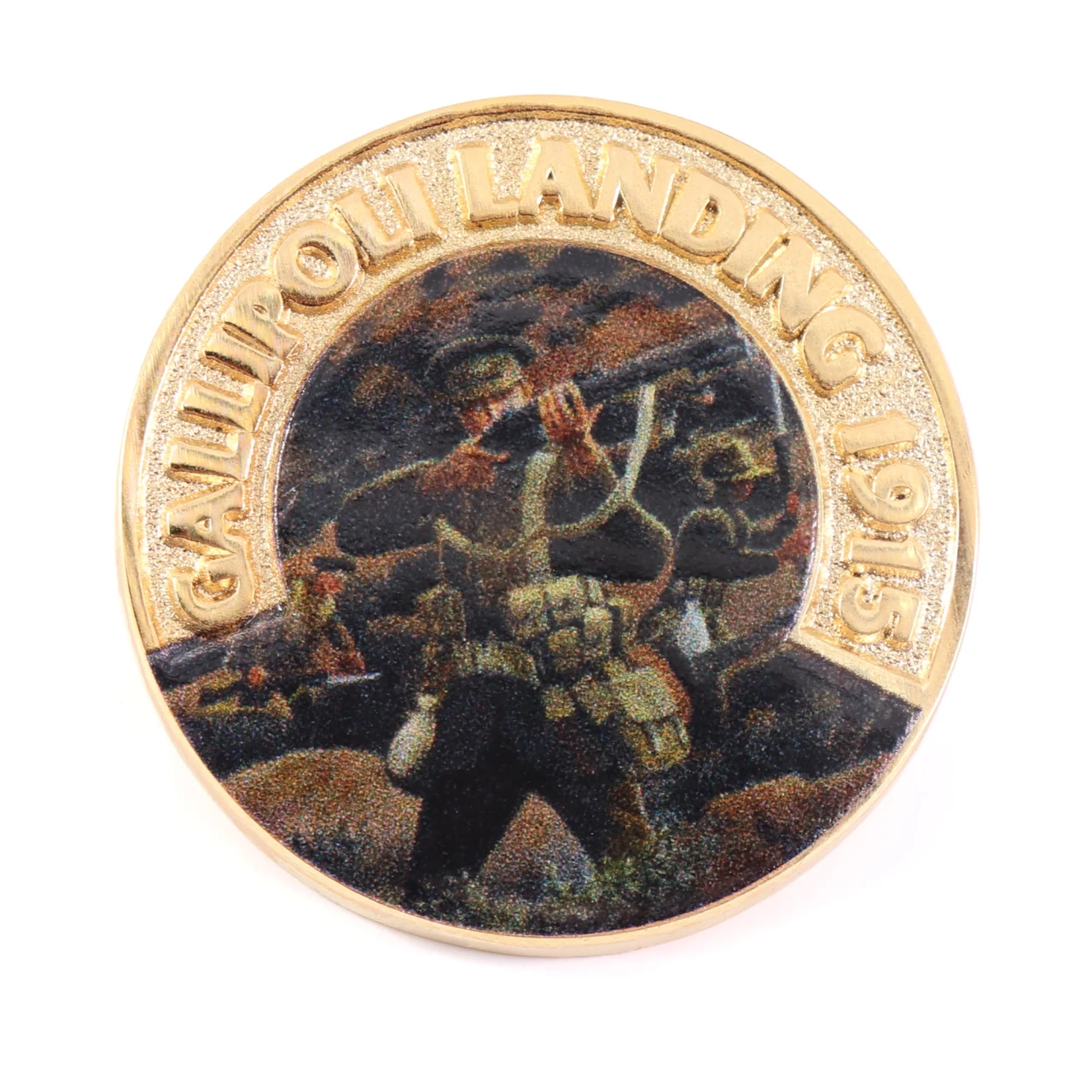 Click to enlarge
Gallipoli Landing Lapel Pin
A small, highly collectable connection to the Landing story. The pin captures a detail from Rowlands’ artwork and each piece is individually numbered, with its Limited Edition number laser engraved on the reverse.
View the pin →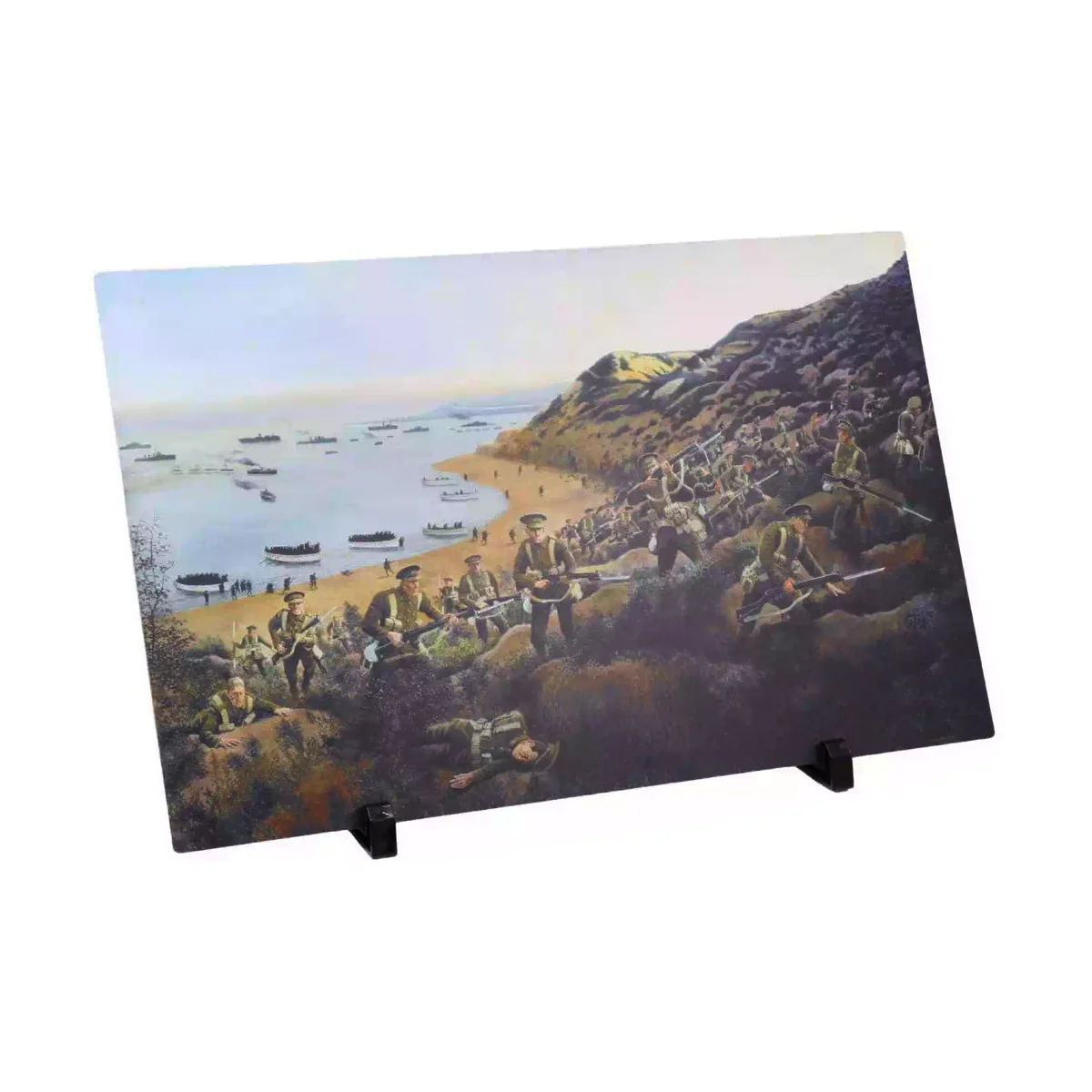 Click to enlarge
Aluminium Print
A contemporary presentation of David Rowlands’ Landing artwork on solid aluminium. The compact format preserves the complete composition and provides a modern way to display this historically researched work.
View the artwork →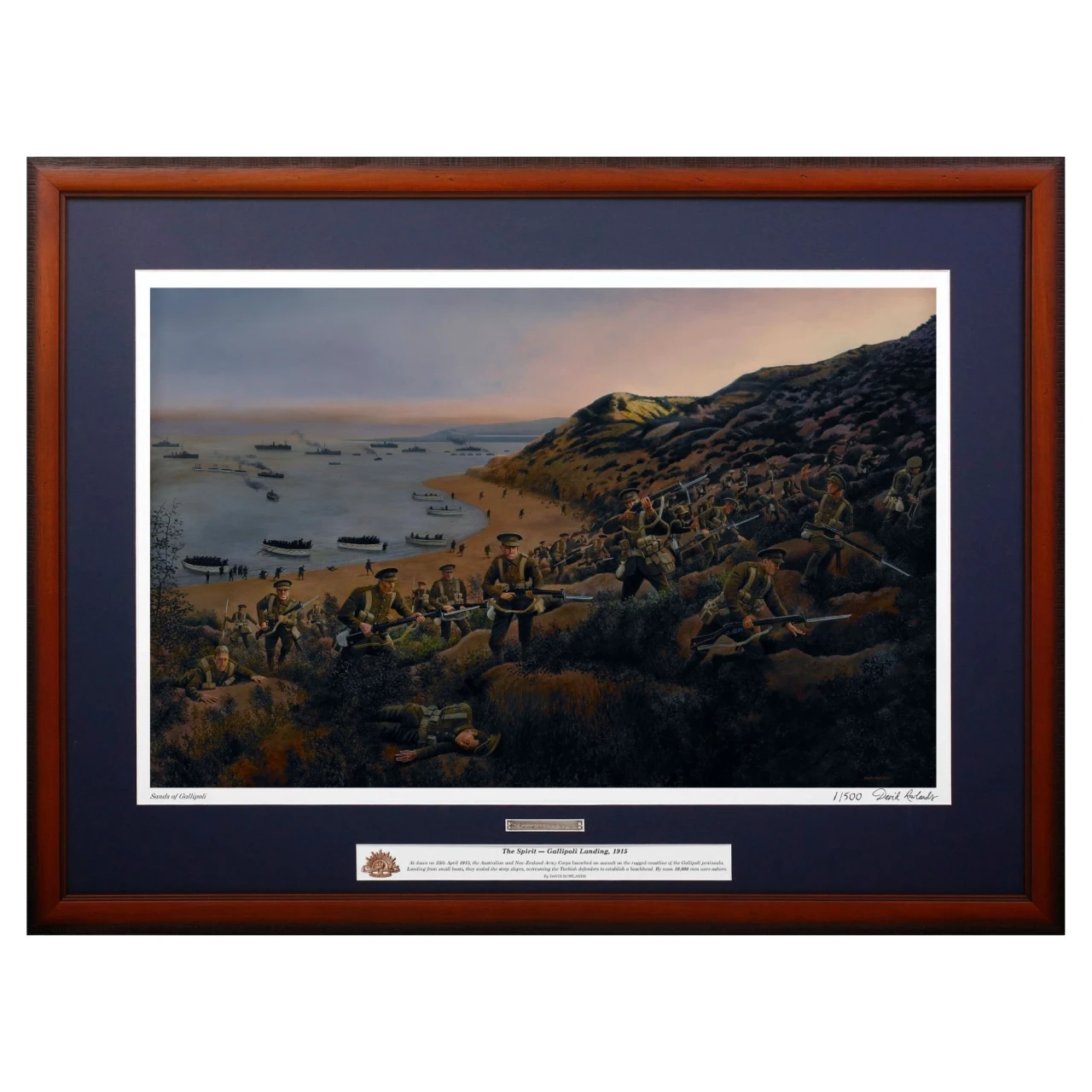 Click to enlarge
Framed Limited Edition Print
A signed and numbered fine-art edition of The Spirit – Gallipoli Landing 1915, created for collectors who want Rowlands’ complete composition in a traditional framed presentation.
View the print →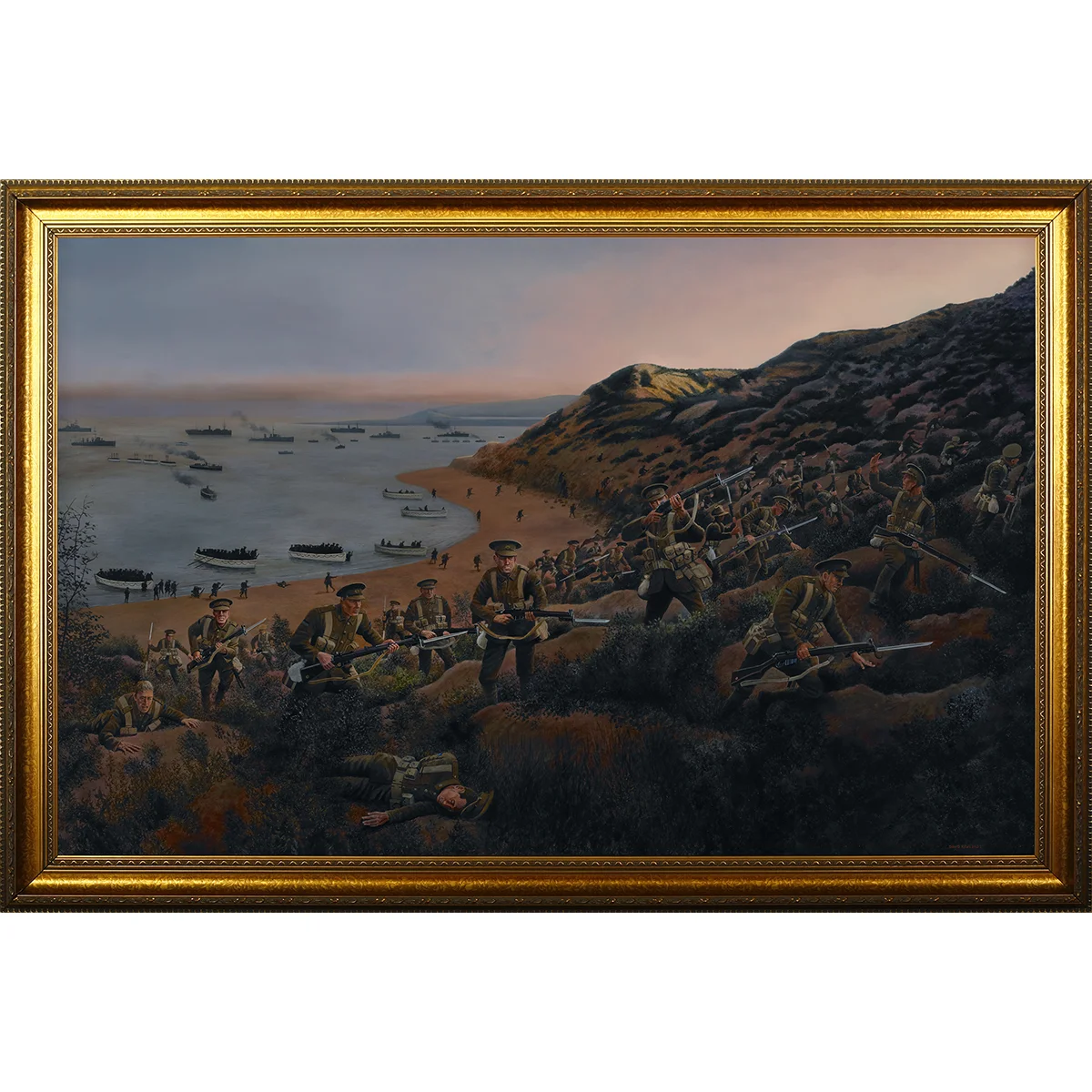 Click to enlarge
Full-Size Framed Canvas
The closest Limited Edition presentation to the scale and visual impact of the original commission. Restricted to just 100 examples, this full-size canvas reproduces the complete Landing composition at 1545 × 1130 mm.
View the canvas →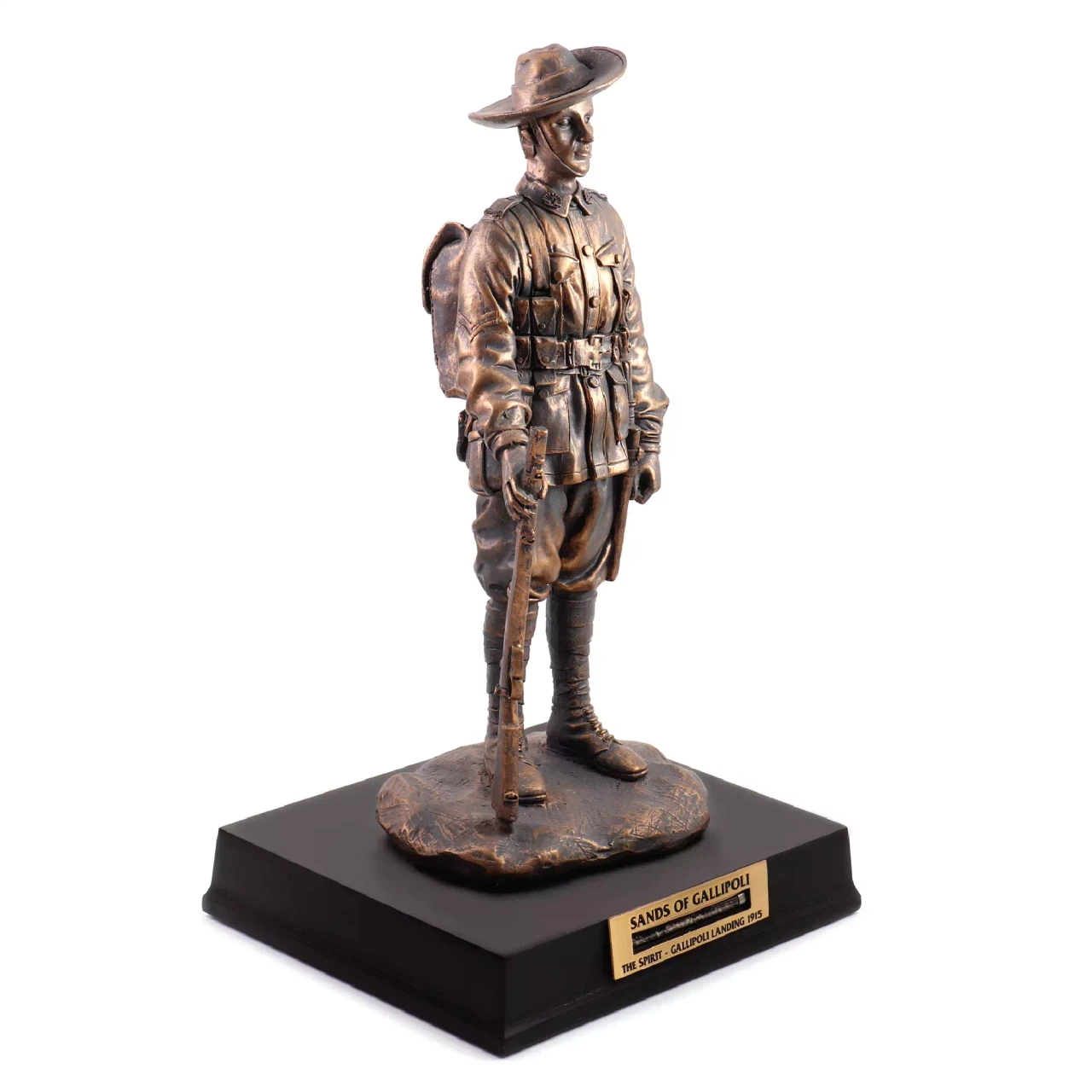 Click to enlarge
Sands of Gallipoli Digger Figurine
A sculptural interpretation of the Australian Digger associated with the 2012 Landing collection. Produced as a numbered Limited Edition, the presentation incorporates Gallipoli sand to create a tangible connection with the place being commemorated.
View the figurine →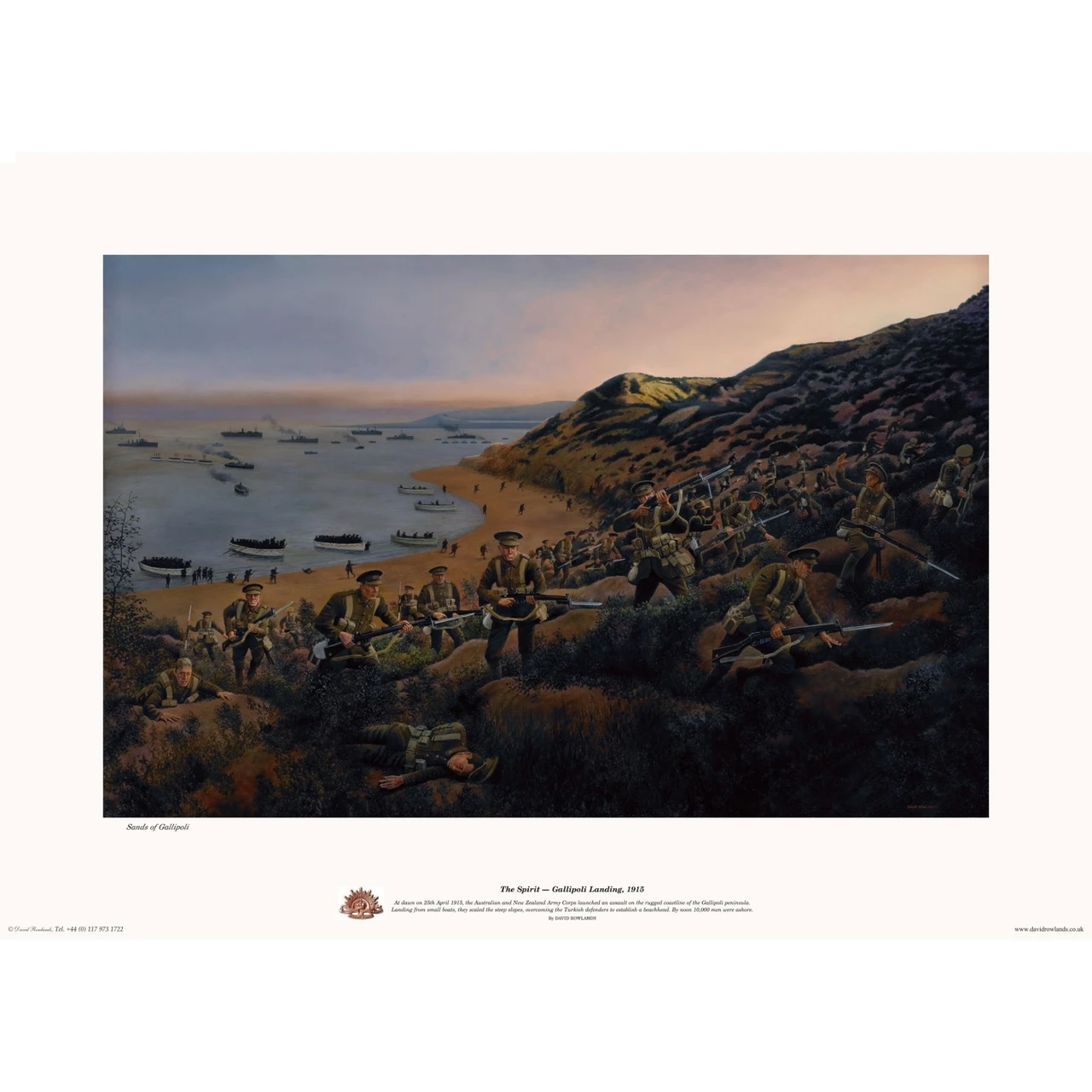 Click to enlarge
Unframed Limited Edition Print
A signed and numbered paper edition of Rowlands’ complete Landing composition, giving collectors the flexibility to frame and present the work to suit their own collection.
View the print →History, artwork and collecting
History • 25 April 1915
What happened at the Gallipoli landing on 25 April 1915?
Australian troops of the 3rd Brigade began landing around Ari Burnu at about 4.30 am in darkness. They moved off the beach and onto steep ridges above what became Anzac Cove. Further waves arrived from destroyers and transports as daylight strengthened. By noon about 10,000 men were ashore, but the force had not reached the objectives envisaged in the original plan.
Read more: The initial wave landed either side of Ari Burnu on a frontage of about 370 metres. The later waves spread across roughly 1,500 metres. The first wave contained half of the 9th, 10th and 11th Battalions; the painting foregrounds the second wave of the 10th Battalion and men of the 12th. By noon approximately 10,000 men were ashore. The immediate heights were taken quickly, but the steep, broken ridges and gullies disrupted formations and shaped the fighting that followed.
Did the Anzacs land at the wrong beach?
They came ashore north of the intended landing area near Gaba Tepe. The reasons have been debated, but the military consequence is clear: the Australians encountered steep and broken terrain around Ari Burnu rather than the more open ground expected farther south.
Read more: The force came ashore north of the intended area near Gaba Tepe. Whatever the cause of the deviation, the consequence was profound: instead of more open country, the Australians faced the steep spurs and gullies around Ari Burnu, Plugge's Plateau and MacLagan's Ridge. This terrain made navigation, command and unit cohesion difficult almost immediately.
Were Turkish machine guns firing on the beach?
The historical research used for this artwork challenges the familiar depiction of the beach as being swept by Ottoman machine-gun fire at the first landing. The immediate defenders were riflemen; machine guns on Royal Navy steam pinnaces offshore fired toward Turkish rifle flashes. Fighting intensified as the Australians moved inland and Ottoman reinforcements arrived.
Read more: The research used for the painting identifies about 80 riflemen of Second Lieutenant Muharrem's platoon as the immediate Ottoman opposition to almost 4,000 men of the Australian 3rd Brigade. No machine guns were deployed with that platoon. Royal Navy steam-pinnace machine guns offshore fired toward Ottoman rifle flashes. This is one of the most important ways the painting deliberately follows evidence rather than later popular imagery.
Which Australian units landed first?
The covering force was the 3rd Australian Infantry Brigade, comprising the 9th, 10th, 11th and 12th Battalions. The painting foregrounds the second wave of the 10th Battalion from South Australia.
Read more: The 3rd Australian Infantry Brigade comprised the 9th, 10th, 11th and 12th Battalions. Half of the 9th, 10th and 11th formed the initial wave. The remaining companies and elements of the 12th followed. Rowlands depicts the second wave of the South Australian 10th Battalion climbing from the cove at about 5.00 am.
How many Australians were ashore by noon?
Rowlands' artist notes state that by noon approximately 10,000 men had landed at Anzac Cove. The flow of troops continued as the beachhead and ridgelines became the base of the ANZAC position for the campaign.
Read more: Rowlands' historical notes put the number at about 10,000 by noon. The landing had by then expanded well beyond the narrow first-wave frontage, with men moving into an increasingly confused network of ridges and gullies above the cove.
Why are the soldiers wearing field service caps instead of slouch hats?
Short answer: Landing orders directed troops to wear field service caps to help distinguish them from Ottoman troops at a distance.
Read more: Contemporary photographs taken aboard the battleships on 24 April and ashore on 25 April support this detail. Rowlands and his advisers deliberately followed that evidence, even though the slouch hat is now the more familiar Australian symbol.
Which ships are shown offshore?
Short answer: The reconstruction identifies HMS Ribble, Usk, Chelmer and Scourge, with transports Galeka and Novian and battleship HMS London farther offshore.
Read more: The vessels are not generic scenery. Destroyers brought later waves inshore and steam pinnaces towed strings of rowing boats. Identifying and positioning the ships was part of the same historical reconstruction as the troops and terrain.
Artwork • The Commission
Who painted The Spirit – Gallipoli Landing 1915?
Internationally renowned military artist David Rowlands. Military Shop commissioned the painting, which was completed in late 2011 for the 2012 Sands of Gallipoli collection.
How was the painting researched?
Short answer: The research process worked backwards from the exact scene Rowlands wanted to reconstruct — about 5.00 am on 25 April 1915 — and tested the visible details against historical evidence.
Read more: Rather than repeating the broader accuracy story above, this is where the method matters. The advisers had to answer practical visual questions: where would the second wave have been at that minute; what could be seen from MacLagan's Ridge; which headlands and ridgelines belonged in the view; what light existed just after civil dawn; which battalions were moving through the scene; what headgear and equipment were actually being worn; and which naval vessels should appear offshore.
Those answers were then brought together in a single composition. The result is not a photograph of one instant, but a researched reconstruction in which terrain, timing, troops and shipping are intended to agree with one another. That is what distinguishes the commission from a generic dramatic interpretation of the Landing.
What exact moment does the painting show?
About 5.00 am on 25 April 1915 — approximately thirty minutes after the first landing. The second wave of the 10th Battalion is shown climbing from the cove while elements of the first wave are already on the heights.
Read more: Civil dawn was at about 4.55 am. The painting looks roughly northwest from MacLagan's Ridge: men of the second wave climb from the cove while the first wave is already on Plugge's Plateau. First light catches Ari Burnu and the distant outline toward Suvla Bay can be seen beyond.
Can the original painting be purchased?
Yes. The BrandNet-held original is being offered through The BrandNet Archives at $15,000, with an enquiry option for collectors who would like further provenance and acquisition information.
Products • The Collection
How many 2012 medallion sets were released?
The Set of Six was limited to 2,500 sets and the Set of Two to 5,000 sets. Each was issued with a numbered certificate of authenticity.
Do the Landing collections contain real Gallipoli sand?
Yes. The 2012 medallion sets include Gallipoli sand, and several Sands of Gallipoli artworks and figurines also incorporate or accompany genuine sand collected from Gallipoli.
How limited are the art editions?
The current aluminium print is limited to 250, the framed paper print to 500, and the full-size canvas to 100.
Was there a 2012 Landing figurine?
Yes. The Sands of Gallipoli Digger figurine was released as a limited edition of 5,000. It stands 240 mm high and includes a glass vial of Gallipoli sand in the base.
Collecting • Archive Editions
What is a BrandNet Archive Edition?
An Archive Edition is an original low-number or otherwise significant piece retained by BrandNet from the time of release. For The Landing, BrandNet physically holds certificate numbers #1–#10 of the 2012 Set of Two and #1–#10 of the 2005 single medallion.
Read more: These are not newly numbered pieces. They are low-number examples retained by BrandNet from the original release. The certificate establishes the exact number and the BrandNet provenance adds another layer of collecting significance. Each #1–#10 piece is therefore offered as an individual one-stock variant.
Why do editions #1–#10 cost more?
The product itself belongs to the same original limited release, but the unusually low certificate number and direct BrandNet provenance distinguish the archive-held piece from a standard-number example.
Can I choose the exact edition number?
Yes. The Archive presentation is designed so each available number can be selected individually. Once a particular number is acquired, that exact Archive Edition is no longer available.
Do Archive Editions include their certificates?
Yes. The certificate number is central to the provenance of these pieces and should remain with the corresponding product.
The Battles of Gallipoli
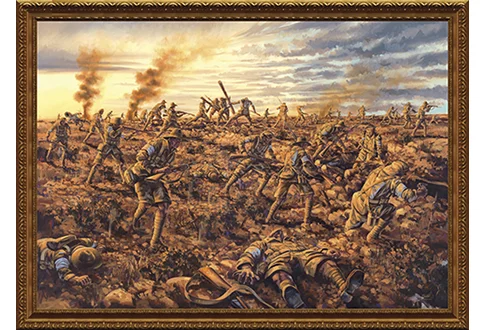
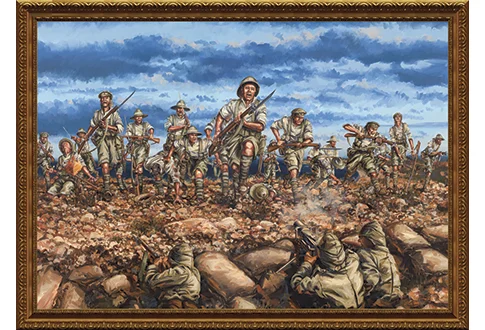
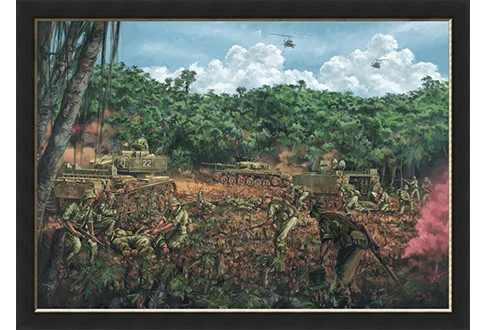
Explore more Australian military stories, art and collectables
The Battle of The Nek is one story within a much larger archive of commissioned military artworks, historically significant pieces, low-number Archive Editions and Limited Edition collections.
Explore The BrandNet ArchivesThe Spirit - Gallipoli Landing
In 1915, after weeks of intensive training, the soldiers of the Australian and New Zealand Army Corps (ANZAC) were carried in ships from the island of Lemnos to force a landing on the Gallipoli peninsula. Early on the morning of 25th April, in complete darkness, troops climbed down from battleships of the Royal Navy into small boats. Steam pinnaces then towed lines of rowing boats, packed with soldiers, toward the shore in strict silence. In order to prevent an accidental discharge from a rifle, their magazines were empty; the men were under orders that no shots were to be fired before daylight, and the attack was to be undertaken at bayonet point. The sea was as smooth as satin.
The Turkish defenders became aware of their approach and opened up with small arms fire, causing casualties. Nearing the shore, the steamboats cast off their tows and the sailors rowed the boats furiously towards the beach. The first element landed under cover of darkness around a little promontory topped by a hill called Ari Burnu. They advanced up the steep slopes and captured the Turkish machine gun position at the top.
Anzacs of the second element followed quickly, carried in River class destroyers which approached to within 500 yards of the shore. These men entered the rowing boats and were landed on a much wider shoreline (both north and south of Ari Burnu). My painting shows soldiers of the 3rd Infantry Brigade landing in the little bay which became known as Anzac Cove. Ari Burnu is the hill at the northern end of the beach. As dawn breaks, the destroyers can be seen offshore: from right to left, HMS Ribble, Usk, Chelmer and Scourge. (Other destroyers were to the left, out of view). They were obliged to wait for the return of the rowing boats before they could clear all their troops. Beyond the destroyers are the transport ships Galeka and Novian. Standing farther out to sea is the battleship HMS London, which had discharged soldiers of the first wave. In the far distance is Suvla Bay.
The men were ordered to fix bayonets the moment they landed from the boats; they then doubled across the shingle, quickly removed their packs and loaded their magazines with five or ten rounds before scaling the steep slopes. They climbed up the steep gullies in the sandstone rocks, engaging Turkish riflemen hidden in the scrubby vegetation. The Turkish artillery did not open fire on them until about an hour after the first Anzacs landed.
Further waves of troops were disembarked from ships, and by noon some 10,000 men were ashore at Anzac Cove.
David Rowlands - 2011The Spirit - Gallipoli Landing
The painting depicts in the foreground, the second wave of the 10th Battalion (South Australia) scaling the heights at about 0500 hours (civil dawn was at 0455), thirty minutes after the initial landing, which was in darkness. The first wave of the three leading Australian battalions, half of the 9th (Queensland), 10th and 11th (Western Australia), are already on Plugge's Plateau above the top right of the painting.
The view is looking roughly northwest from the slopes of MacLagan's Ridge, the spur running from Plugge's Plateau to Hell Spit enclosing Anzac Cove. The first lights of dawn strike Ari Burnu, the northern headland of the cove, while in the far distance is the faint outline of Nibrunesi Point, the southern headland of Suvla Bay. The initial wave landed either side of Ari Burnu on a frontage of about 370 metres at 0430 hours. The second and third waves were carried inshore by the destroyers shown in the painting. They landed astride the cove on a 1500 metre frontage, with the remaining half of the 10th Battalion and some of the 12th (Tasmania, South and Western Australia) landing along the cove itself, and it is these men shown in the painting. The 11th Battalion and part of the 12th landed north of Ari Burnu, while the second wave companies of the 9th and part of the 12th landed south of Hell Spit, behind the viewer.
Contrary to popular opinion the Turkish opposition at Anzac Cove was relatively light. About 80 riflemen of Second Lieutenant Muharrem's 2nd Platoon, of the 8th Company, 2nd Battalion, 27th Infantry Regiment confronted the almost 4000 men of the 3rd Australian Infantry Brigade. There were no machine guns deployed with this platoon. The first few boats had grounded, and Private Alex Wilson was helping Sergeant Fred Coe remove his pack when the first shot rang out in the pre-dawn darkness. Machine guns mounted on the Royal Navy steam pinnaces that had towed the boats of the first wave inshore, then opened fire on the Turkish rifle flashes on Plugge's Plateau. On the beach the Australians were in dead ground or defilade to the Turkish riflemen above them. The primary source evidence and the Australian Official History record the Turks quickly fell back and the heights overlooking Anzac Cove were captured about 20 minutes after the first wave landed. In Anzac to Amiens Charles Bean, the Australian Official Historian, wrote "Neither then nor at any time later was that beach the inferno of bursting shells, barbed wire, and falling men that has sometimes been described or painted." All the photos taken of the beach later in the morning show only one dead man lying on it, and he is accurately depicted in the painting at the water's edge.
The depiction of the troop's headdress is correct. The orders for the landing directed they were to wear the field service cap, rather than the slouch hat, to avoid confusion at a distance with the Turkish headdress; it was felt the sharp round rim of the field service cap would stand out. Photos of the 3rd Brigade on board the battleships heading for Gallipoli on the afternoon of the 24th April, of the 2nd and 1st Brigades disembarking from the transports and the troops ashore on the morning of the 25th April show them wearing the cap. Very few wore the slouch hat.
Out to sea steam pinnaces can be seen transferring the last elements of the 12th Battalion from the destroyers to the beach in tows, comprising four boats each which were then released and rowed the final 100- 200 metres to shore. The destroyers are from right to left HMS Ribble (carried A Company 12th Battalion and 3rd Field Ambulance), HMS Usk (carried B Company 11th Battalion and half D Company 12th Battalion), HMS Chelmer (carried D Company 11th Battalion and half D Company 12th battalion) and HMS Scourge (carried D Company 10th Battalion and half B company 12th Battalion). The other three destroyers are out of picture to the viewer's left and left rear. Behind the destroyers are the transports HMT Galeka carrying the 6th and 7th Battalions (Victoria) and HMT Novian carrying the 5th Battalion (Victoria) and 2nd Brigade headquarters. The 7th is already disembarking into the Galeka's ship's boats. Fire from Turkish guns at Gaba Tepe,1.8 kilometres south of Anzac Cove, later forced the transports further out to sea. Behind the transports is the battleship HMS London which carried A and C Companies 11th Battalion (part of the first wave) from Mudros until they disembarked into the boats and were taken in tow by the steam pinnaces.