

The Last
Diggers
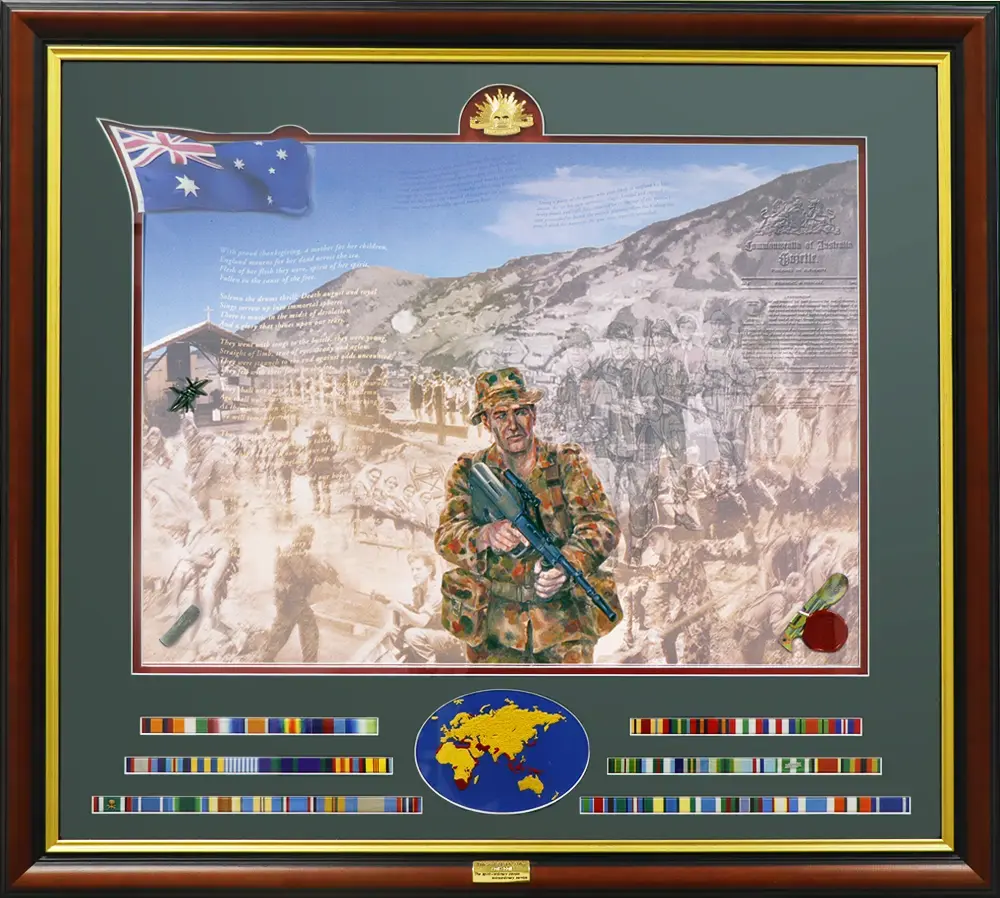
A centenary artwork created to tell 100 years of Australian Army service, directed by retired Lieutenant Colonel Charles Reynolds and led in design by Stephen Rainey, who remains with BrandNet today as Head of Design. In 2002, thirteen examples were signed by Alec Campbell and Frank MacDonald MM; six of those dual-signed works are preserved in the BrandNet Archive.
The Spirit — ordinary people, extraordinary service
Australian Army Centenary Limited Edition Montage • Edition of 2,001
Meet Alec Campbell and Frank MacDonald, two of Australia's final links to the First World War generation.
Unpack 30 historical elements and 48 campaign ribbons spanning a century of Army service.
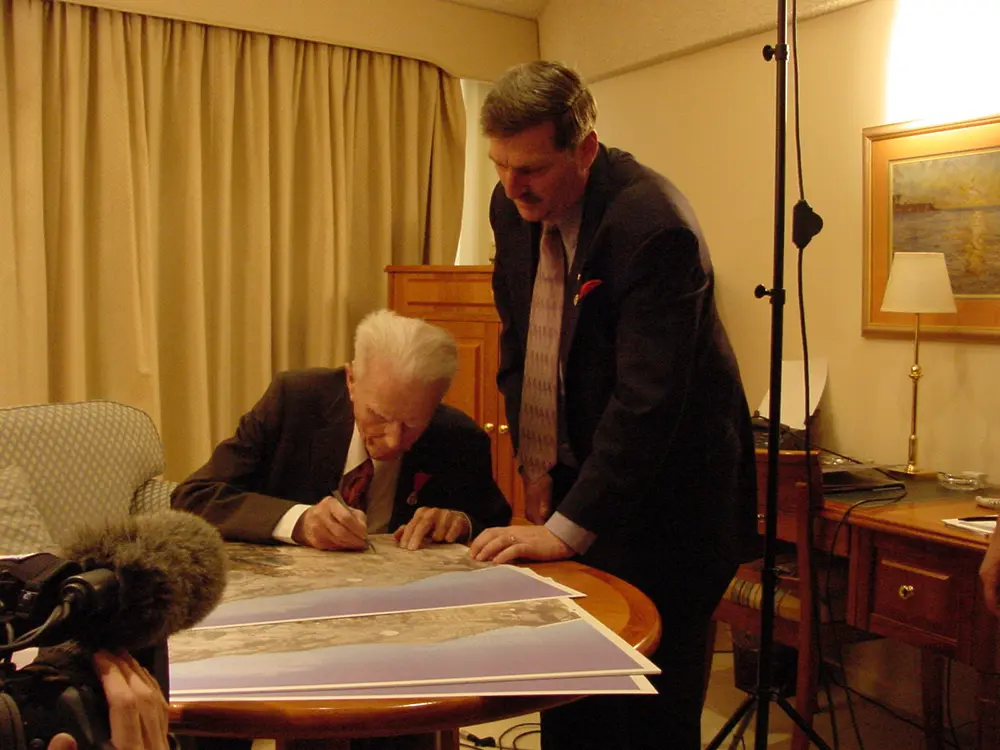
See surviving photographs from the signing of a small group of these centenary montages.
Discover six dual-signed examples, plus the unsigned first and final editions: #0001 and #2001.
From a centenary artwork to an extraordinary archive
Created for the Australian Army's centenary in 2001, the montage was conceived as a visual history of service — from the Boer War and two world wars through Korea, Malaya, Vietnam, peacekeeping and East Timor.
The project was directed by retired Lieutenant Colonel Charles Reynolds, who had served in Army artillery and staff appointments, including Director Public Information – Army, before joining Market Link Solutions after service in East Timor. Stephen Rainey was the lead designer, bringing together the many historical images and artistic elements that form the montage. More than 25 years later, Stephen remains with BrandNet as Head of Design. Historical advice, protocol and research were provided by Christopher Jobson, with further advice from the Army History Unit and ADF Honours and Awards.
What survives in the BrandNet Archive is more than a group of limited-edition prints. It is a record of the Army Centenary project itself — including the first and last numbered examples and six examples signed by Alec Campbell and Frank MacDonald.
A century of service — and a changing Army
The montage was created during the Australian Army's centenary year, when the Army commemorated 100 years of service while presenting a modern force shaped by a century of change.
The centenary identity and ceremonial imagery place the artwork firmly in its original 2001 context. The project connected historic uniforms, campaigns and service with the contemporary Army of the new century.
The last Australian survivor of Gallipoli
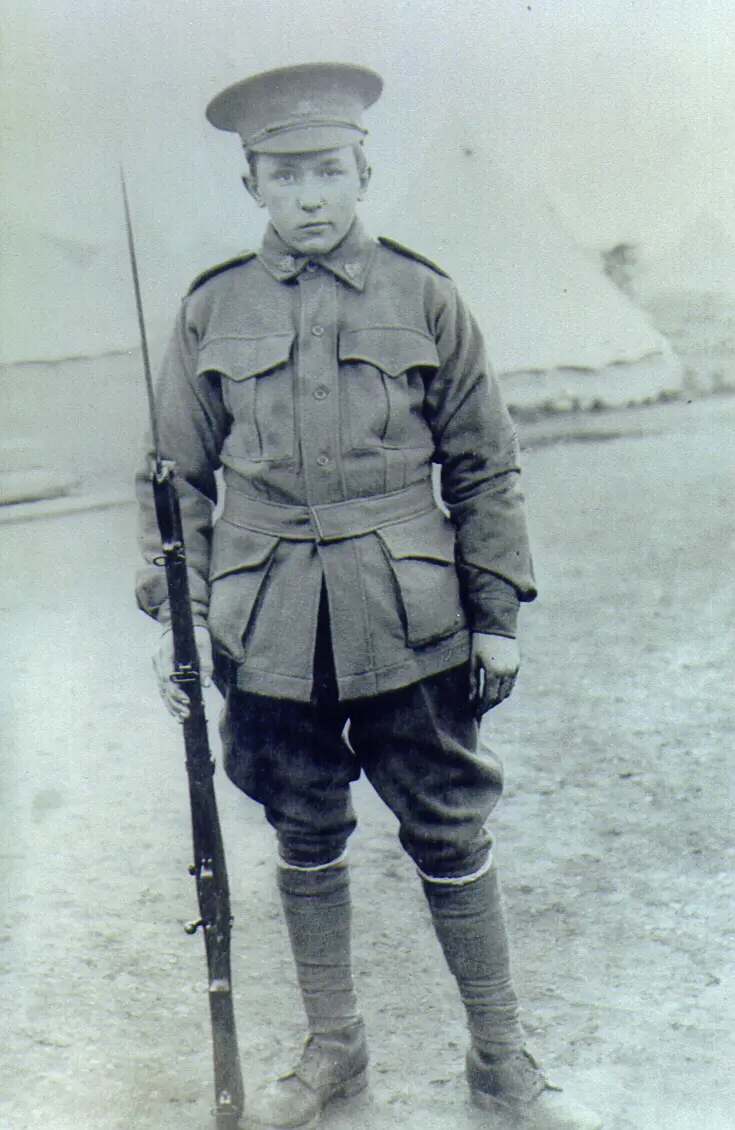
Alec Campbell was born in Launceston in 1899 and enlisted in the Australian Imperial Force in July 1915 at just 16, claiming to be 18. He reached Gallipoli late in the campaign and served as a water carrier with the 15th Battalion. Following Roy Longmore's death in 2001, Campbell became the sole surviving Australian veteran of the Gallipoli campaign. He died in Hobart on 16 May 2002, aged 103.
His survival into the new century made him a living connection with the original Anzacs — and gives the signed centenary montages a direct human connection to the Gallipoli generation.
Australian War Memorial record →Tasmania's last First World War veteran
Frank MacDonald was born at Ulverstone in 1896 and served with the 40th Battalion on the Western Front. As a signaller, he maintained communications under heavy fire and received the Military Medal for his conduct in 1917. He later served again during the Second World War and received France's Legion of Honour in 1998.
MacDonald died on 23 August 2003 aged 107. Tasmania continues to commemorate him through the Frank MacDonald Memorial Prize.
Hear his AWM oral history →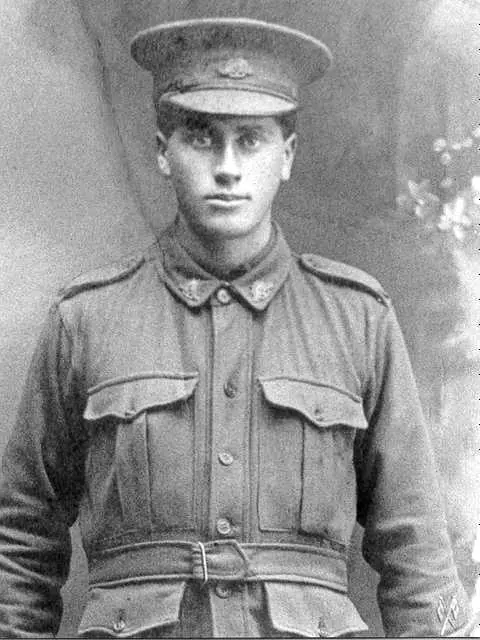
100 years of Army service in a single montage
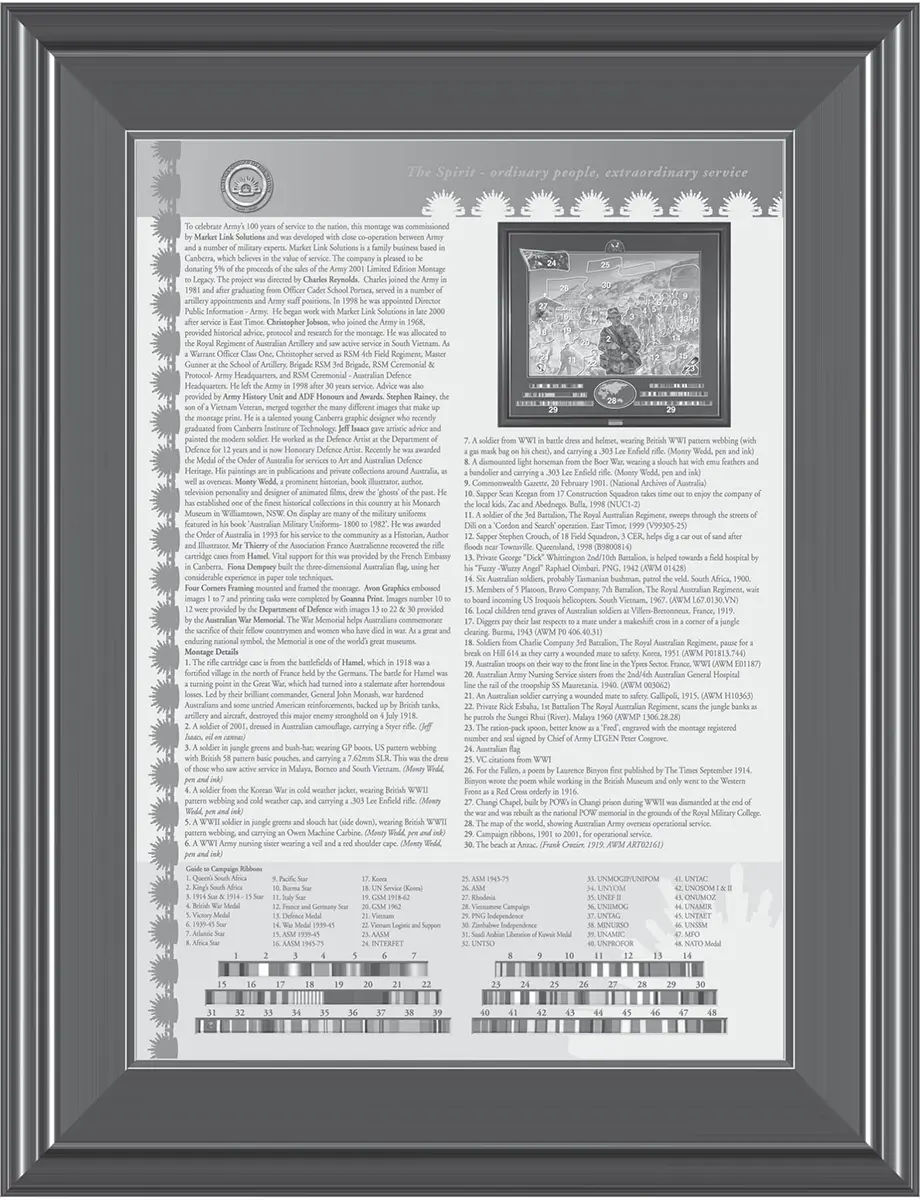
The original information sheet identifies 30 elements within the composition and a guide to 48 campaign ribbons. Each was chosen to help tell the story of Australian Army service from 1901 to 2001.
Click elements of the artwork for more information.
The map of the world, showing Australian Army overseas operational service. (as at 2001)
The 7th pattern Rising Sun badge. (1991-2025)
ANZAC Cove painted by the Australian War Artist Crosier
Changi Chapel. Built by POWs in Changi prison during WWII. It was dismantled at the end of the war and rebuilt as the national POW memorial in the grounds of the Royal Military College. The barbwire is a sign of incarceration.
For the Fallen, a poem by Laurence Binyon first published by The Times September 1914.
Victoria Cross citations from the First World War
Australian flag in 3D paper toll
The ration-pack spoon, better know as a 'Fred', engraved with the montage registered number and seal signed by Chief of Army LTGEN Peter Cosgrove.
Malaya 1960. Soldiers of the 1st Battalion, The Royal Australian Regiment, scan the jungle banks as they patrol the Sungei Rhui (River).
An Australian soldier carrying a wounded mate to safety, Gallipoli, 1915.
Australian Army Nursing Service sisters from the 2nd/4th Australian General Hospital, line the rail of the troopship SS Mauretania, 1940.
Australian troops on their way to the front line, in the Ypres Sector 1916-1918.
Hill 614, Korea 1951. Soldiers from Charlie Company 3rd Battalion, The Royal Australian Regiment, pause for a break as they carry a wounded mate to safety.
Under a make-shift cross, in a corner of a jungle clearing, Diggers pay their last respects to a mate. Ronsi, Burma 1943.
Local children tend graves of Australian soldiers at Villers-Bretonneux. France, 1919.
South Vietnam 1967. Members of 5 Platoon, Bravo Company, 7th Battalion, The Royal Australian Regiment wait to board the incoming US Iroquois helicopters, for their return trip to Nui Dat.
Six Australian soldiers, probably Tasmanian bushman, patrol the South African velt during the Boer War, 1900.
Private George “Dick” Whittington 2nd/10th Battalion, is helped towards a field hospital by his “Fuzzy –Wuzzy Angel” Raphael Oimbari.
A rifle cartridge case recovered from the battlefields near Hamel, France.
A sapper of 18 Field Squadron, 3 CER digs out a stuck car after a natural disaster. Townsville 1998
Dili, East Timor 1999. A soldier of the 3rd Battalion, The Royal Australian Regiment, sweeps through the streets of Dili on a “Cordon and Search” operation.
Sapper Sean Keegan from 17 Construction Squadron takes time out to enjoy the company of the local kids, Zac and Abednego. Bulla, 1998.
Proclaimation of the formation of the Australian Army - Commonwealth Gazette, 20 February 1901.
Ghosts of the past - from left to right Malaya, Borneo and South Vietnam; Korean War; WWII; WWI Army nursing sister; WWI and a dismounted light horseman from the Boer War. (Monty Wedd, pen and ink)
A soldier of 2001, dressed in Australian camouflage, carrying a Steyr rifle. (Jeff Isaacs, oil on canvas)
Gold plated plaque "The Australian Army 1901 - 2001 Ordinary people, extraordinary service".
Ribbons left to right
1. Queen’s South Africa
2. King’s South Africa
3. 1914 Star & 1914 - 15 Star
4. British War Medal
5. Victory Medal
6. 1939-45 Star
7. Atlantic Star
Ribbons left to right
8. Africa Star
9. Pacific Star
10. Burma Star
11. Italy Star
12. France and Germany Star
13. Defence Medal
14. War Medal 1939-45
Ribbons left to right
15. ASM 1939-45
16. AASM 1945-75
17. Korea
18. UN Service (Korea)
19. GSM 1918-62
20. GSM 1962
21. Vietnam
22. Vietnam Logistic and Support
Ribbons left to right
23. AASM
24. INTERFET
25. ASM 1945-75
26. ASM
27. Rhodesia
28. Vietnamese Campaign
29. PNG Independence
30. Zimbabwe Independence
Ribbons left to right
31. Saudi Arabian Liberation of Kuwait Medal
32. UNTSO
33. UNMOGIP/UNIPOM
34. UNYOM
35. UNEF II
36. UNIIMOG
37. UNTAG
38. MINURSO
39. UNAMIC
Ribbons left to right
40. UNPROFOR
41. UNTAC
42. UNISOM I & II
43. ONUMOZ
44. UNAMIR
45. UNTAET
46. UNSSM
47. MFO
48. NATO Medal
Peter Cosgrove and the numbered “Fred”
Each montage carried an individual registered number on the ration-pack spoon — the Army's familiar “Fred” — and the original information sheet records that the seal was signed by Chief of Army LTGEN Peter Cosgrove.
Cosgrove had been appointed Chief of Army in 2000 after commanding INTERFET in East Timor. He later became Chief of the Defence Force and, from 2014 to 2019, Governor-General of Australia.
Preserved with its story
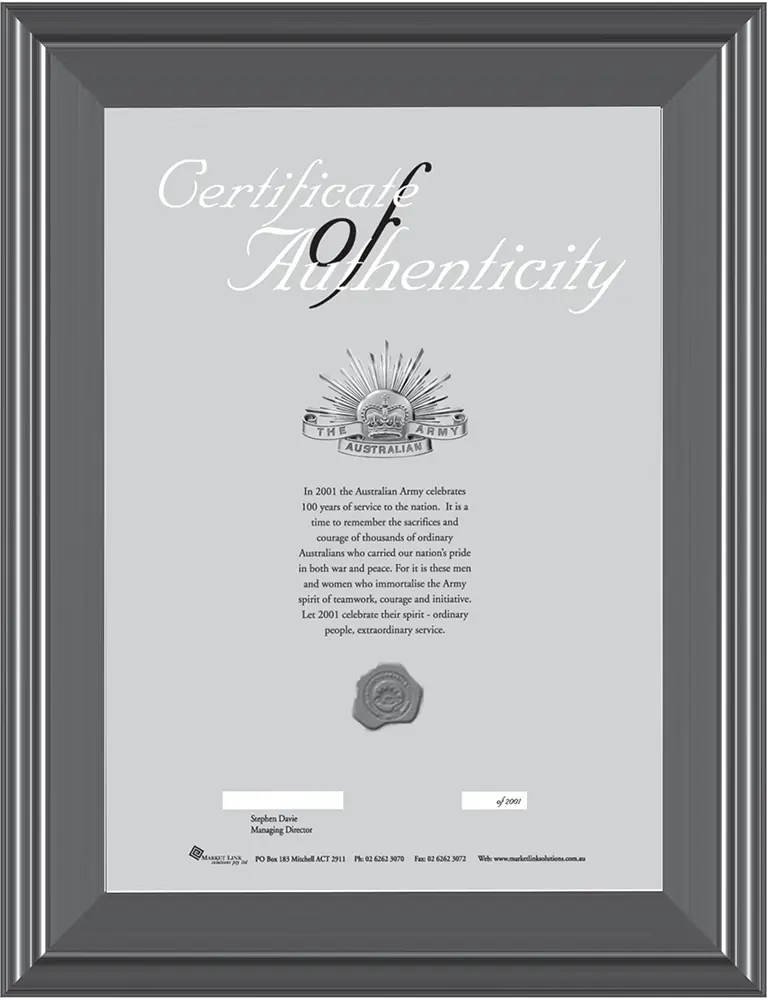
The surviving documentation explains the people, objects, photographs, artworks and ribbons incorporated into the montage. The original Certificate of Authenticity identifies each work as one of 2,001.
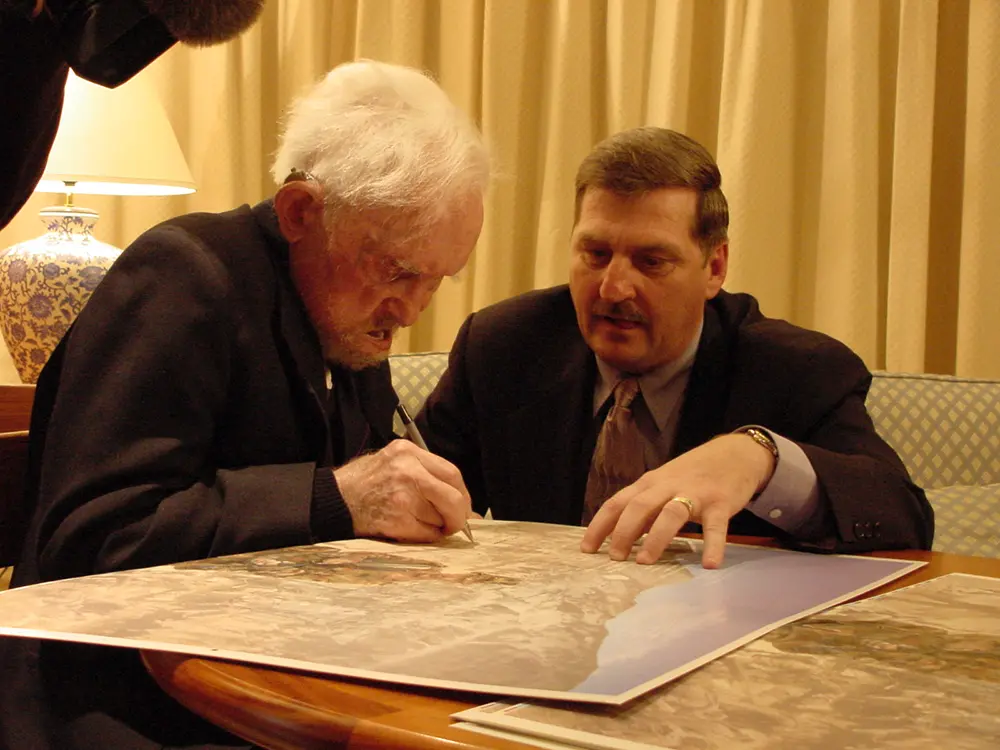
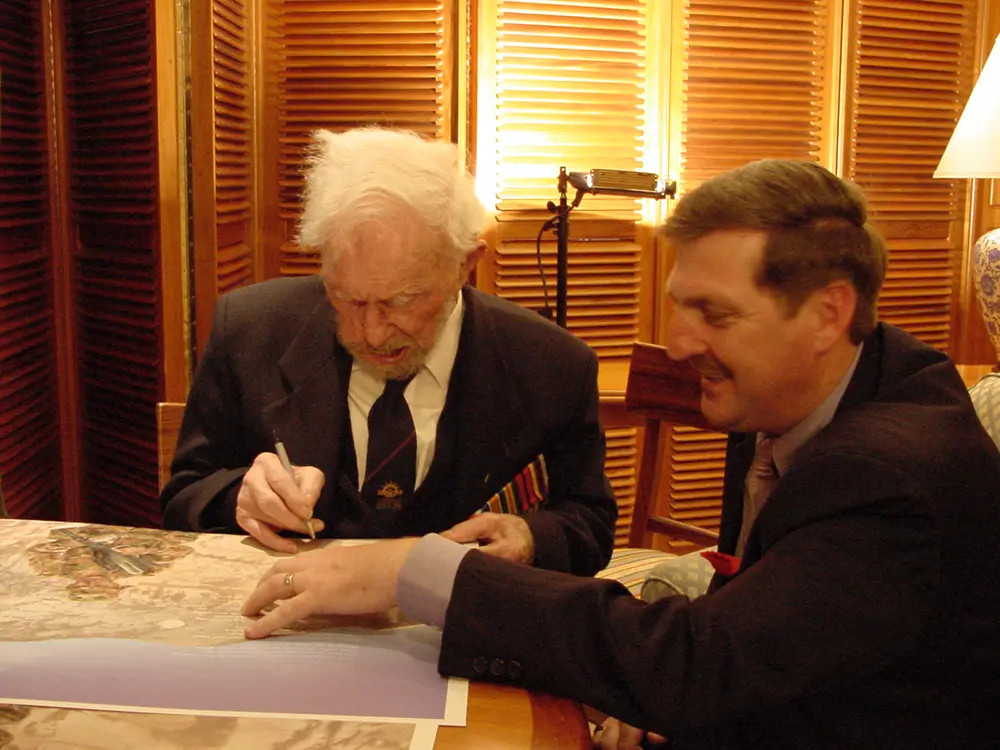
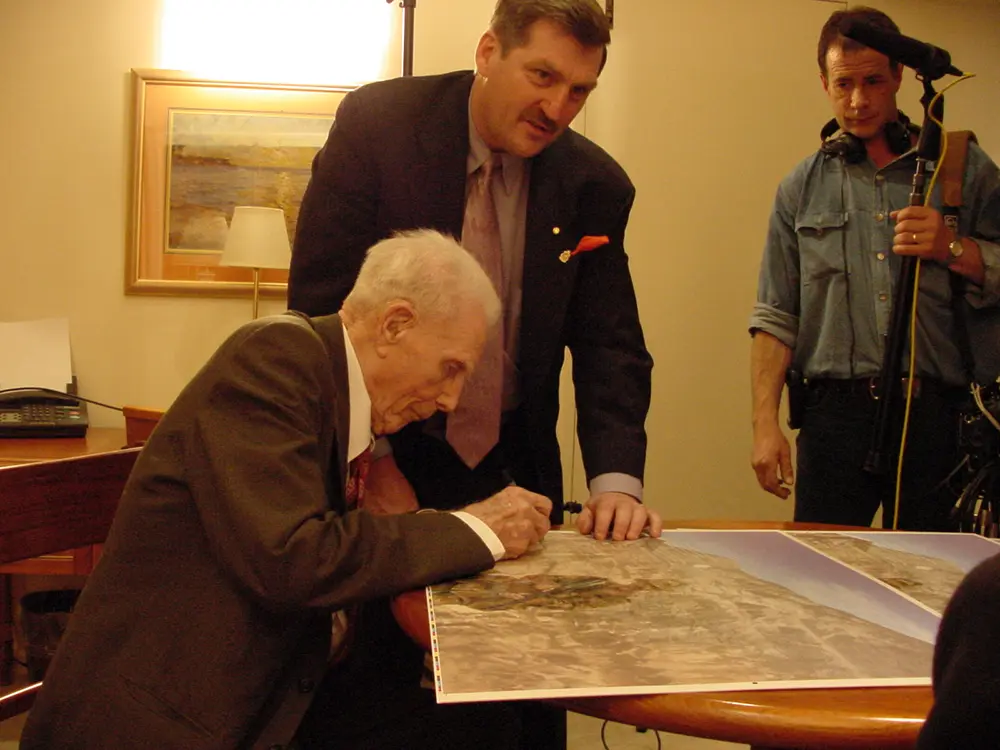
The signing
These photographs preserve the moment Alec Campbell and Frank MacDonald signed examples of the Army Centenary Montage. Thirteen were signed by both veterans. Six of those dual-signed works are now confirmed in the BrandNet Archive.
Eight exceptional centenary editions
Two bookend the entire edition. Six carry the signatures of both Alec Campbell and Frank MacDonald. All eight have been physically sighted and confirmed in the archive.
The First & Last Army Centenary Montage
Where the edition begins
The first numbered example from the complete edition of 2,001. Its significance is its position at the beginning of the Army Centenary issue.
Enquire about #0001 →Where the edition ends
The final numbered example — the natural counterpart to #0001 and a bookend to the 2,001-piece Army Centenary edition.
Enquire about #2001 →The Last Diggers Signed Army Centenary Montage
One of thirteen known examples signed by both veterans; this example has been physically confirmed in the BrandNet Archive.
Enquire about #0117 →One of thirteen known examples signed by both veterans; this example has been physically confirmed in the BrandNet Archive.
Enquire about #0118 →One of thirteen known examples signed by both veterans; this example has been physically confirmed in the BrandNet Archive.
Enquire about #0251 →One of thirteen known examples signed by both veterans; this example has been physically confirmed in the BrandNet Archive.
Enquire about #1140 →One of thirteen known examples signed by both veterans; this example has been physically confirmed in the BrandNet Archive.
Enquire about #1720 →One of thirteen known examples signed by both veterans; this example has been physically confirmed in the BrandNet Archive.
Enquire about #1936 →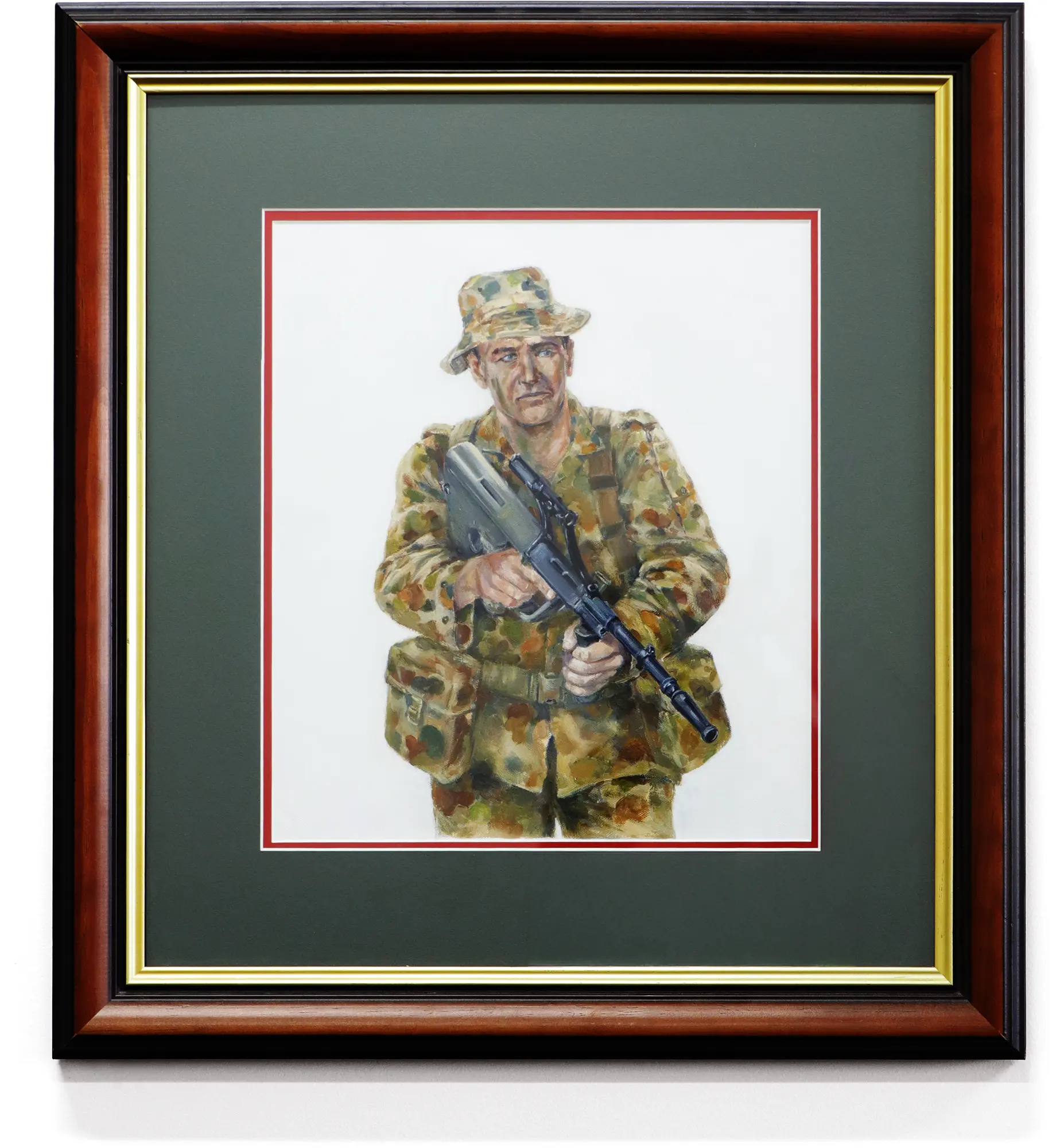
The Centenary Soldier 2001 Painting
The central focus of the Army Centenary Montage is the 2001 period Australia Soldier. Commissioned by BrandNet for the montage the original oil on canvas artwork by renowned defence artist Jeff Isaacs is offered for sale.
Framed size: 600 x 650 mm.
From the Army Centenary to Sands of Gallipoli
The Army Centenary project linked commemoration with practical support for the veteran community — an approach that became an important part of BrandNet's heritage programs.
$40,000 for Legacy
The original 2001 information sheet pledged 5% of proceeds from the Army Centenary Montage to Legacy. In 2002, $40,000 was presented to Legacy. BrandNet's records note that Chief of Army Lieutenant General Peter Cosgrove selected Legacy as the beneficiary, reflecting his personal connection with the organisation.
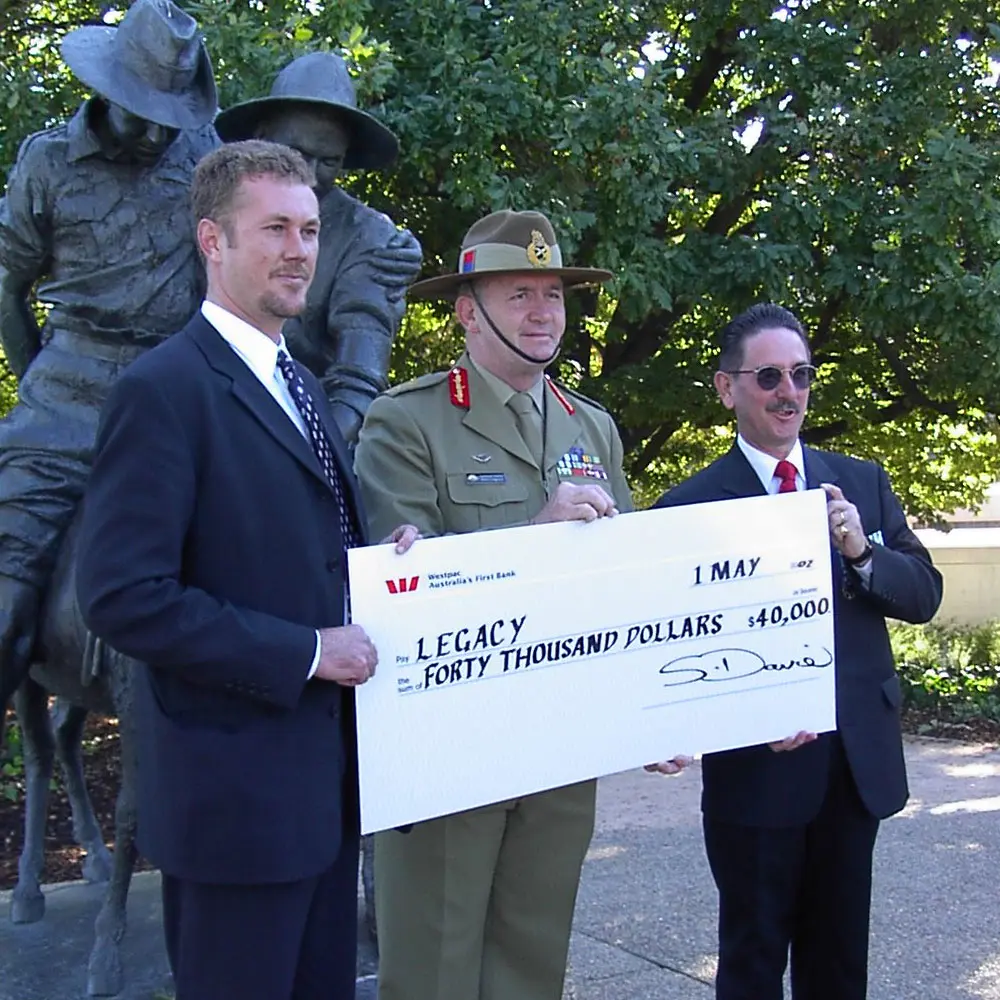
Stephen Davie CEO BrandNet (left), Chief of Army Lieutenant General Peter Cosgrove (centre) and the Legacy representative (right) at the $40,000 Army Centenary project donation, 2002.
Alec Campbell's influence
BrandNet's relationship with Alec Campbell helped shape the idea of connecting a commemorative object with the people, places and physical history of Gallipoli. That thinking became central to the Sands of Gallipoli collections launched in 2004, which incorporated sand collected from Anzac Cove and developed into a long-running commemorative program supporting veteran causes.
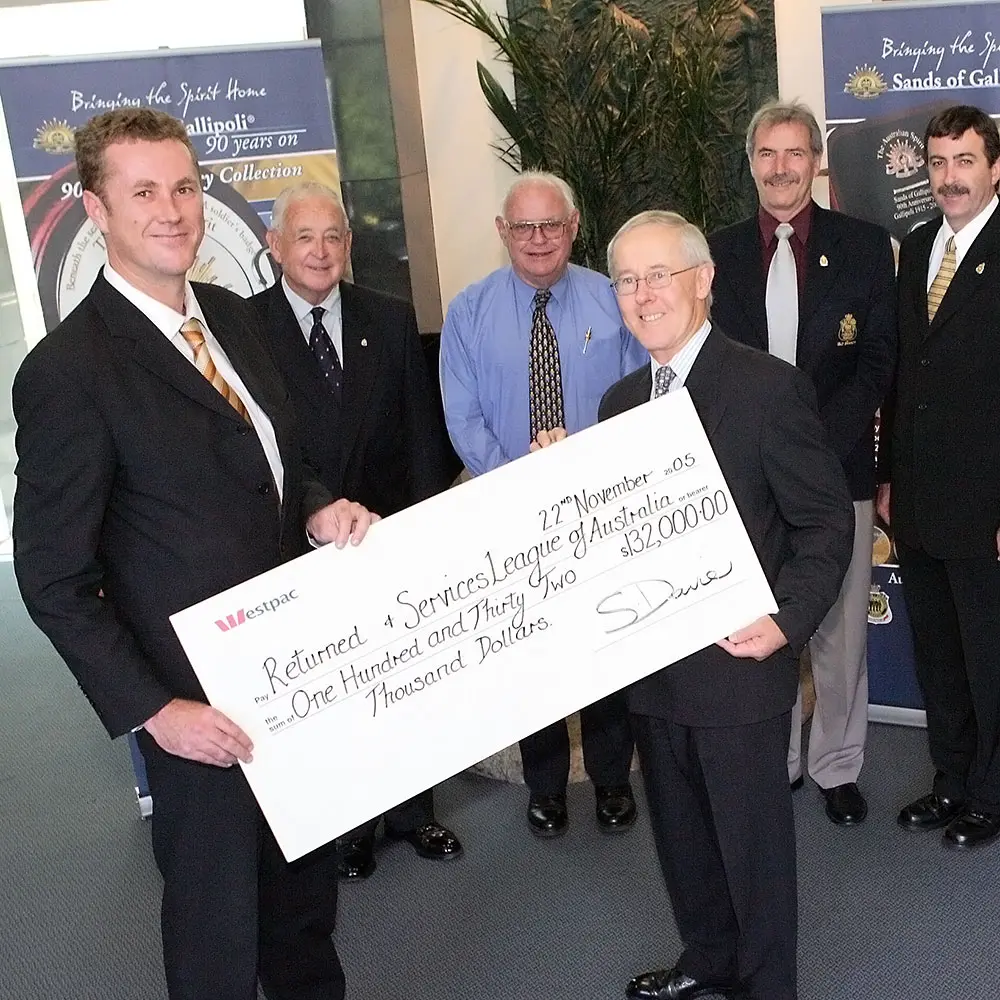
Stephen Davie (left) and Major General Bill Crews, President of RSL Australia (right), at a Sands of Gallipoli presentation of $132,000 to the Returned & Services League of Australia.
National recognition for Sands of Gallipoli
2004 — The campaign, delivered with RSL Queensland Branch, Rowland Communications Group and Market Link Solutions, received three Public Relations Institute of Australia awards:
- National Gold Award — Marketing Communications
- Queensland Gold Award — Marketing Communications
- Queensland Gold Award — Overall Award for Excellence
2005 — Sands of Gallipoli received two awards at the Australian Marketing Institute National Awards for Marketing Excellence:
- Winner — New Product/Service
- Winner — Marketing Communications
The Army Centenary Montage
Who was Alec Campbell?
Alec William Campbell (1899–2002), service number 2731, enlisted in the AIF at 16 and served with the 15th Battalion at Gallipoli as a water carrier. After Roy Longmore died in 2001, Campbell was the sole surviving Australian veteran of the Gallipoli campaign. He died in Hobart on 16 May 2002 aged 103.
Who was Frank MacDonald MM?
Frank MacDonald, service number 53, served with the 40th Australian Infantry Battalion during the First World War. He was recommended for and awarded the Military Medal. The surviving BrandNet material records him as one of Australia’s last surviving decorated veterans of the war.
Why was the Army Centenary Montage created?
It was commissioned to mark the Australian Army’s 100 years of service in 2001. The original project documentation records close cooperation with Army, military experts, the Army History Unit and ADF Honours and Awards.
Who directed the creation of the montage?
The original 2001 information sheet identifies Charles Reynolds as project director. Reynolds had joined the Army in 1981, served in artillery and Army staff appointments, became Director Public Information – Army in 1998, and joined Market Link Solutions after service in East Timor.
Who designed the montage?
Stephen Rainey was the lead designer who merged the many different images that make up the montage print. He remains with BrandNet today as Head of Design, creating a direct link between the original 2001 project and the BrandNet Archives.
Which artists contributed to the montage?
Jeff Isaacs provided artistic advice and painted the contemporary soldier in oils. Monty Wedd drew the historical “ghosts” representing earlier generations of Australian soldiers. Fiona Dempsey constructed the three-dimensional Australian flag using paper-tole techniques.
What makes the montage unusual?
It is a handcrafted three-dimensional work combining painting, drawing, archival photography, reproduced documents, campaign ribbons and physical objects. The original guide identifies 30 numbered features and 48 campaign ribbons.
What is the Hamel cartridge case?
Each montage incorporates a rifle cartridge case recovered from the battlefield of Hamel in France. The original documentation says Mr Thierry of the Association Franco Australienne recovered the cases, with support from the French Embassy in Canberra.
What is the “Fred” in the montage?
“Fred” is the Army nickname used in the original information sheet for the ration-pack spoon. On the montage it carries the individual registered number. The original information sheet states that it carries the seal signed by Chief of Army LTGEN Peter Cosgrove.
What was Peter Cosgrove’s connection to the project?
Peter Cosgrove was Chief of Army during the centenary year. The montage documentation records his signature on the seal associated with the individually numbered “Fred”. A surviving BrandNet photograph also records him with the completed montage.
What do the 48 campaign ribbons represent?
The ribbon guide forms a visual timeline of Australian operational service from the Queen’s and King’s South Africa Medals through the world wars, Korea, Vietnam, later Australian service medals, peacekeeping missions, INTERFET and the NATO Medal.
What are the 30 numbered elements?
They range from the Hamel cartridge case and soldiers representing different eras to archival photographs, the Commonwealth Gazette, Gallipoli imagery, the Changi Chapel, VC citations, the world map, campaign ribbons and Frank Crozier’s The beach at Anzac. The complete list is reproduced in the 2001 Montage Information Guide linked above.
How many Army Centenary Montages were made?
The limited edition comprised 2,001 individually numbered examples, reflecting the centenary year 2001.
Why are #0001 and #2001 significant?
They are the first and final numbered works in the complete 2,001-piece edition. Both are confirmed in the BrandNet Archive and are unsigned, so their significance comes from bookending the original Army Centenary edition rather than from the later Alec Campbell and Frank MacDonald signatures.
How many were signed by Alec Campbell and Frank MacDonald?
The surviving project material records thirteen examples signed by both veterans. Six of those dual-signed works have now been physically sighted and confirmed in the BrandNet Archive: #0117, #0118, #0251, #1140, #1720 and #1936.
Are the Archive examples physically confirmed?
Yes. BrandNet has physically sighted and confirmed the six dual-signed works as well as the unsigned bookend editions #0001 and #2001. The six signed examples were confirmed in good condition.
Acquire a piece of the Army Centenary story
For the first time, selected works retained from the original project archive are being prepared for acquisition.
Each archive example will be individually documented so collectors can inspect the exact edition number, signatures where applicable, condition and accompanying documentation before purchase.
Enquire with the Archive →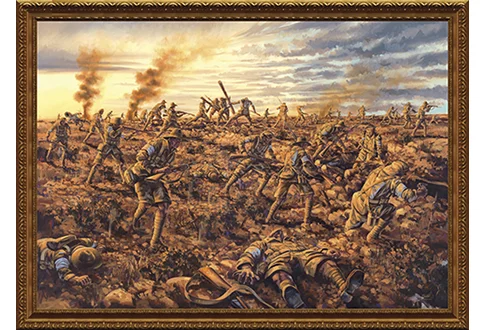
Explore more Australian military stories, art and collectables
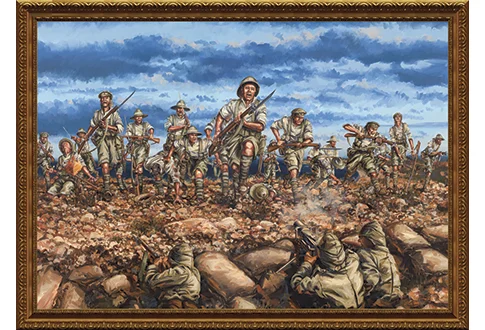
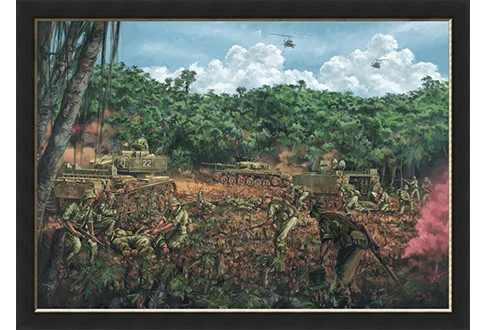
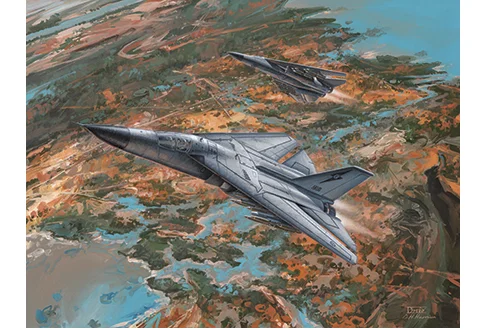
The Battle of The Nek is one story within a much larger archive of commissioned military artworks, historically significant pieces, low-number Archive Editions and Limited Edition collections.
Explore The BrandNet ArchivesThe Battle of Lone Pine
When presented with the Lone Pine project my awareness of the specific campaign was limited. Ironically, my first impressions of the battle were drawn from the fantastic dioramas on display at the Australian War Memorial, Canberra. I vividly recall visiting the Memorial as a child and being completely in awe of the superb miniature models. There was a certain wonderment derived from viewing a small snapshot of history and being drawn into the sense of emotion experienced by those who fought during conflict. Most notably I was fascinated with the scene depicting Australian troops fighting an unseen Turkish force in underground trenches at Lone Pine, Gallipoli. As a child, it was impossible to understand the full consequences of war, however, the miniature battle conveyed all the fear, adrenalin, terror and bravery one could only imagine Australian and Turkish soldiers experienced during hand to hand combat.
It soon became apparent during project planning that the diorama was a highly regarded representation of Lone Pine in terms of known accuracy and campaign detail. I was keen to draw parallels with the model as much as possible and did indeed reference some of the figures within the painting. This was important due to the lack of existing photographic material surrounding the opening battle. Painting historically accurate representations requires a large amount of detail and for this particular work I was fortunate to have assistance and guidance from Brig. Chris Roberts AM, CSC (Rtd). During correspondence there emerged some key factors that needed to be incorporated into the painting including - the distinctive white patches and armbands worn by Australians, unique Turkish trench system, time of attack and terrain. Each of these became determining factors for the overall composition and look of the painting and ultimately helped decide the depicted angle and viewpoint.
The Gallipoli campaign and the facts surrounding the ANZAC landing in April 1915 highlight the incredibly difficult topography including sheer cliff faces and impenetrable ridges. Period photos that do exist suggest Lone Pine was, in contrast, a flat plateau with few distinguishing features. This is not always ideal when attempting to create a dramatic scene and one of the challenges was to draw more interest from the flat environment. Fortunately the low dusk-sun helped to cast dramatic shadows across the scene and it was also possible to include foliage and undulating sections of landscape.
Similarly, one of the key identifying features from the initial skirmish was the supremely fortified Turkish frontline trench. As represented in the Memorial model, these were buried defences with a strong, log roof structure and covered completely under a thick layer of earth. With the trenches well camouflaged I was directed to find a way to represent this distinctive feature without making it appear overly obvious. By all accounts the Australians were caught completely by surprise and could only gain access to the trenches via any areas damaged by artillery fire. These latter actions provided the necessary visual key for showing some portion of the covered dugouts. Another source for inspiration was "The taking of Lone Pine" by artist Fred Leist who depicted several troops straining to shift some of the structure. I incorporated a similar action into the painting as homage to Leist's portrayal. For additional drama it was also possible to include a menacing line of Turkish rifles protruding from the narrow defensive slits.
It is not possible to explain my painting process without mentioning a few key influences. In recent times my own painting has been far more contemporary in style with a very clean and crisp realist approach. For the Lone Pine painting it was necessary to re-adopt a style and technique closer to that of my detailed aviation subject matter, while also balancing this with the more open approach of landscape painting. I also sought a lot of guidance from the works of former, and much admired war artists, such as George Lambert and Harold Septimus Power as well as contemporary military artists like Barry Spicer. However, above all others, there is Ivor Hele. His works captured an inherent fluidity, emotion and movement that avoided glorification of war and in my opinion are some of the most honest depictions of human conflict.
I can only hope that my painting of the Lone Pine attack is a requiem to those who served or fell during the battle while providing a sense of combat devoid of over sentimentality.
Drew Harrison - 2012Drew Harrison
Drew Harrison is a practicing artist based in Adelaide, South Australia. His formal illustrative training has provided a solid background for his evolution into contemporary artist. Acrylic paint is Drew's medium of choice and a material that he has adeptly mastered for creating a wide range of works.
Early projects in the field of illustration included several publications such as the children's book A Horse and More. An interest in flight led to a successful period of detailed aviation painting and regular prizes in the Royal Australian Air Force Heritage Awards. These works have since become part of the Service's permanent collection. With an eye for the vast Australian sky, his observational landscapes of the Adelaide Hills are a continued exploration of light, shade and vivid hues. Similarly, these traits are noticeable in Drew's wildlife paintings whereby the very essence of a subject is often manipulated and twisted to a new level. He has found success in all of these fields as either a prize winner or finalist in national competitions. Public acclaim has also been achieved with people's choice awards and highly commended paintings.
Colour, shape, form and texture remain strong hallmarks of his work, however these elements have recently been coupled with a unique and often satirical conceptualisation of 21st century living. In narrative based, expansive series such as Project Icarus, Chasing American Dreams, and the forthcoming Chaos Theories, darker themes have been explored using contemplative and realist subject matter and drawing on influence from pop art. Central to each work is an examination of humanity although this is often represented subliminally via mechanical and inanimate objects.
The current foray into military art represents a culmination of Drew's varied experience across multiple artistic techniques. On return to the field of fine art he has been able to draw influence from a pedigree of artists within this specialised area. However, there remains a characteristically fresh and unique atmosphere within each painting as well as his meticulous eye for historical detail and accuracy.
Drew has exhibited in several group exhibitions and his paintings are represented in private collections. He is also an experienced art tutor who has gained a reputation for effectively communicating and demonstrating practical art knowledge for many years.